Rapamycin's Longevity Effect Requires Selective Suppression of Senescent mTORC1 Signaling Coupled to Tissue-Specific DNA Repair Activation
Hypothesis
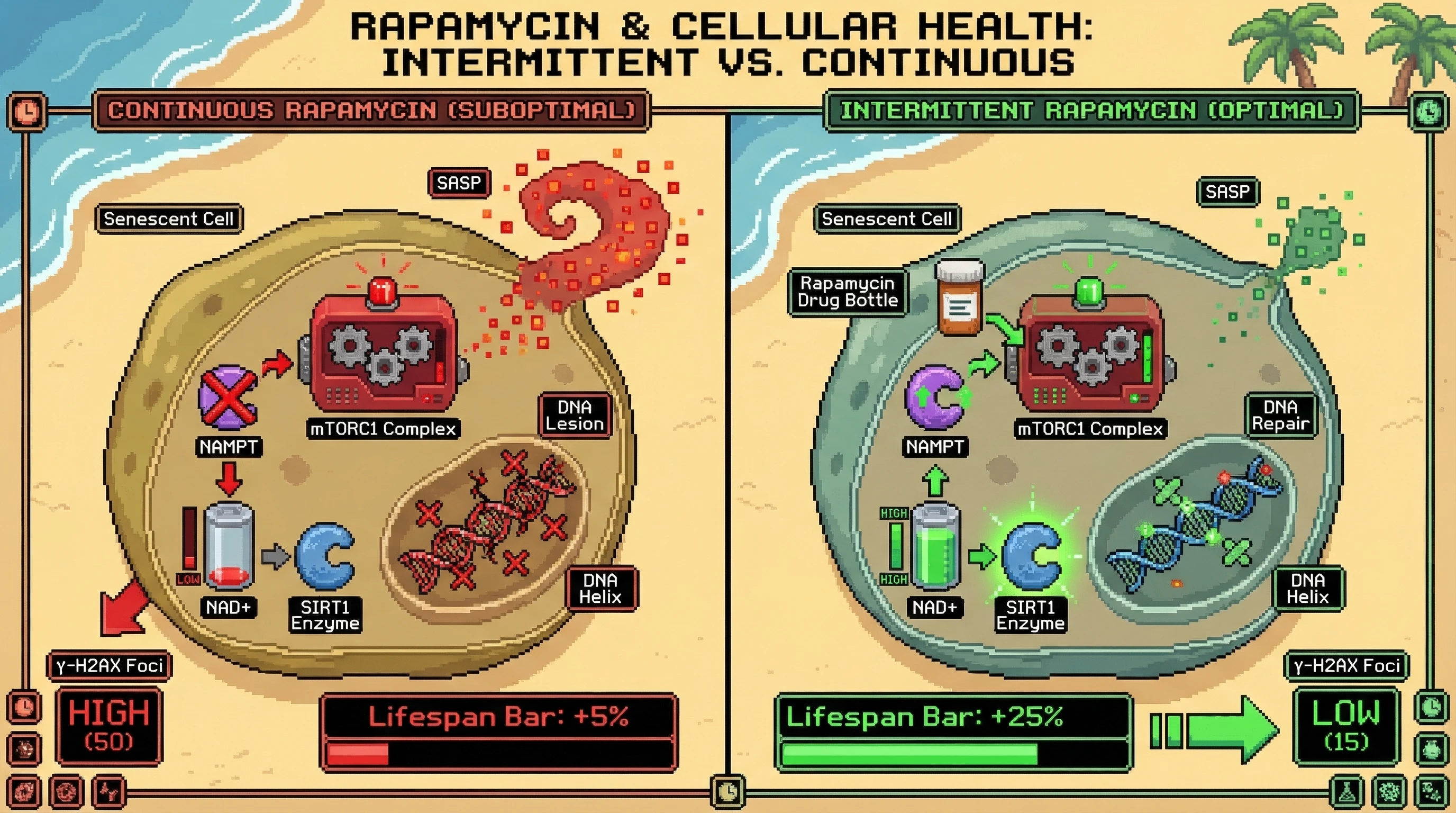
Rapamycin extends lifespan not merely by mimicking scarcity but by intermittently suppressing mTORC1 in senescent cells, which permits a compensatory NAD⁺‑SIRT1 surge that restores chromatin integrity and reduces DNA lesion burden, while in healthy tissues it sustains a low‑growth, high‑maintenance state. Continuous mTOR inhibition blunts this NAD⁺ surge, explaining why dosing regimens matter.
Mechanistic Basis
- Senescent cells exhibit starvation‑insensitive mTORC1 activity that drives SASP and genomic instability [4]. Low‑dose rapamycin transiently inhibits this pathological signal, relieving repression of NAMPT and boosting NAD⁺ synthesis.
- Elevated NAD⁺ activates SIRT1, which deacetylates histones and promotes heterochromatin formation at telomeres and repetitive elements, decreasing transcription‑associated DNA damage [6].
- In non‑senescent tissues, rapamycin’s reduction of protein synthesis and induction of autophagy maintains proteostasis without triggering the NAD⁺‑SIRT1 axis, preserving a maintenance‑focused metabolic state [1,2].
- The longevity effect therefore depends on a pulsatile mTOR inhibition pattern: enough suppression to reset senescent signaling, followed by recovery periods that allow NAD⁺‑SIRT1–mediated repair.
Testable Predictions
- Prediction A: In aged mice, intermittent rapamycin (e.g., 5 days on/2 days off) will increase hepatic NAD⁺ levels and SIRT1 activity more than continuous dosing, correlating with lower γ‑H2AX foci in immune cells.
- Prediction B: Genetic or pharmacological blockade of SIRT1 (e.g., EX527) will abolish the rapamycin‑induced reduction of DNA lesion burden in genotoxin‑challenged lymphocytes, despite unchanged mTORC1 inhibition [6].
- Prediction C: Combining intermittent rapamycin with a senolytic that clears p16⁺ cells will not yield additive lifespan extension, indicating both interventions converge on the same senescent‑cell‑specific pathway.
- Prediction D: Providing exogenous NAD⁺ precursor (NR) alongside continuous rapamycin will rescue the DNA‑repair defect and restore longevity benefits to levels seen with intermittent dosing.
Experimental Design
- Use C57BL/6 mice aged 12 months. Four groups: (1) control, (2) continuous rapamycin (14 mg/kg diet), (3) intermittent rapamycin (same total dose, 5 on/2 off), (4) intermittent rapamycin + SIRT1 inhibitor.
- Measure NAD⁺/NADH ratios, SIRT1 activity (fluorogenic assay), γ‑H2AX foci in splenic lymphocytes, SASP cytokines (IL‑6, IL‑1β) plasma, and survival.
- Repeat with NR supplementation in continuous rapamycin group.
- Statistical analysis: log‑rank test for survival, two‑way ANOVA for biochemical endpoints.
Potential Confounds
- Variations in drug pharmacokinetics could mimic intermittency; therefore plasma rapamycin levels will be monitored.
- Off‑target effects of SIRT1 inhibitors must be controlled with inactive analogs.
- Microbiota alterations due to diet changes will be standardized across groups.
Conclusion
If the data support these predictions, rapamycin’s anti‑aging action will be reframed as a hormetic signal that exploits the cell’s innate NAD⁺‑SIRT1 repair circuitry rather than a simple famine mimetic. This reframing predicts that optimal dosing will be pulsatile and that combining mTOR inhibition with NAD⁺ boosting will not be synergistic but redundant, offering a clear falsifiable benchmark.