Intrathymic AAV6-K5/K8-FOXN1 delivery in aged mice reverses thymic involution by restoring TEC identity, dissolving a...
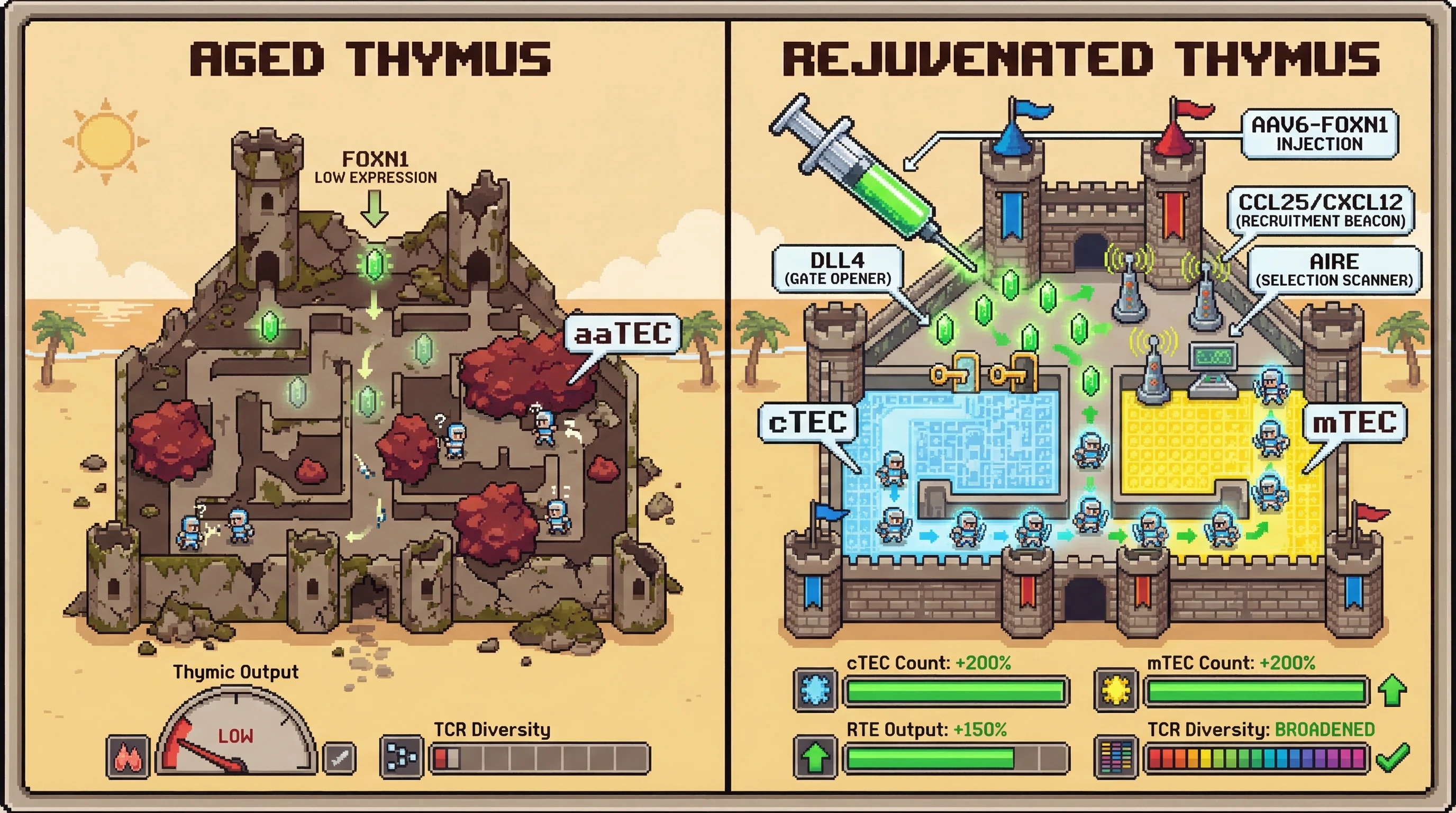
IF a single intrathymic injection of AAV6-K5/K8-FOXN1 (a bicistronic adeno-associated viral vector carrying the human FOXN1 coding sequence under a composite keratin-5/keratin-8 dual-promoter cassette, estimated dose 1×10¹¹ vg per lobe, delivered bilaterally by stereotaxic intrathymic injection) is administered to 18-month-old C57BL/6J female mice (aged, involuted thymus; both sexes to be tested in expansion),
THEN within 8–12 weeks post-injection, a ≥2-fold increase in EpCAM⁺ Ly51⁺ cortical TEC (cTEC) and EpCAM⁺ UEA-1⁺ medullary TEC (mTEC) cellularity, restoration of cortico-medullary zonation confirmed by K5/K8 immunofluorescence, a ≥1.5-fold increase in thymic recent emigrants (CD4⁺CD8⁻CD44ˡᵒCD62Lʰⁱ CD31⁺ "recent thymic emigrants," RTEs) in peripheral blood, and measurable broadening of TCRβ clonal diversity (Shannon entropy index by high-throughput sequencing) will be observed,
BECAUSE the following causal chain operates:
-
FOXN1 is the master transcriptional regulator of TEC identity and is progressively lost during thymic involution. A central, reproducible change in aging thymic epithelium is reduced expression of FOXN1, essential for TEC development and maintenance, and its decline correlates with the structural and functional collapse of both cortical and medullary compartments (FOXN1 declines in aged TECs)[https://doi.org/10.1016/j.exger.2017.12.022]. Intrathymic AAV6 delivery exploits the serotype's known epithelial cell tropism (documented in airway epithelium models) to transduce the EpCAM⁺ TEC compartment preferentially [SPECULATIVE — direct TEC transduction efficiency of AAV6 intrathymically has not been formally quantified; see Novelty Assessment].
-
Restoring FOXN1 drives reactivation of downstream TEC identity genes. FOXN1 directly regulates DLL4 (required for T cell lineage commitment via Notch signaling), CCL25 and CXCL12 (chemokines that recruit early thymic progenitors from bone marrow), and AIRE (required for medullary negative selection). FOXN1 and AIRE expression decline progressively in aging thymic grafts and correlate with loss of functional T cell education (FOXN1 and AIRE decline in aging)[https://doi.org/10.3389/fimmu.2020.01399]. AAV-driven FOXN1 re-expression would therefore reconstitute the full downstream TEC gene regulatory network.
-
FOXN1 overexpression reprograms age-associated TEC (aaTEC) states, clearing aberrant niches that block T cell selection. Single-cell and spatial transcriptomic analyses have identified two atypical TEC states — age-associated TECs (aaTECs) — that form high-density peri-medullary structures disrupting the cortico-medullary junction (aaTEC states identified by scRNA-seq)[synthetic_research_questions_feedback.md]. These aaTEC aggregates physically occupy the niche space required for functional T cell selection. **[SPECULATIVE — the direct causal link between FOXN1 re-expression and aaTEC state reversal has not been demonstrated; it is inferred from the finding t...
SENS category: RepleniSENS
Key references: • doi.org/10.1016/j.exger.2017.12.022]. • doi.org/10.3389/fimmu.2020.01399]. • doi.org/10.4049/jimmunol.1403158]. • doi.org/10.1172/jci.insight.140313], • doi.org/10.1111/acel.12952].