Monthly cyclic palifermin in 18-month-old C57BL/6J mice will produce iterative thymic TEC re-expansion and cumulative...
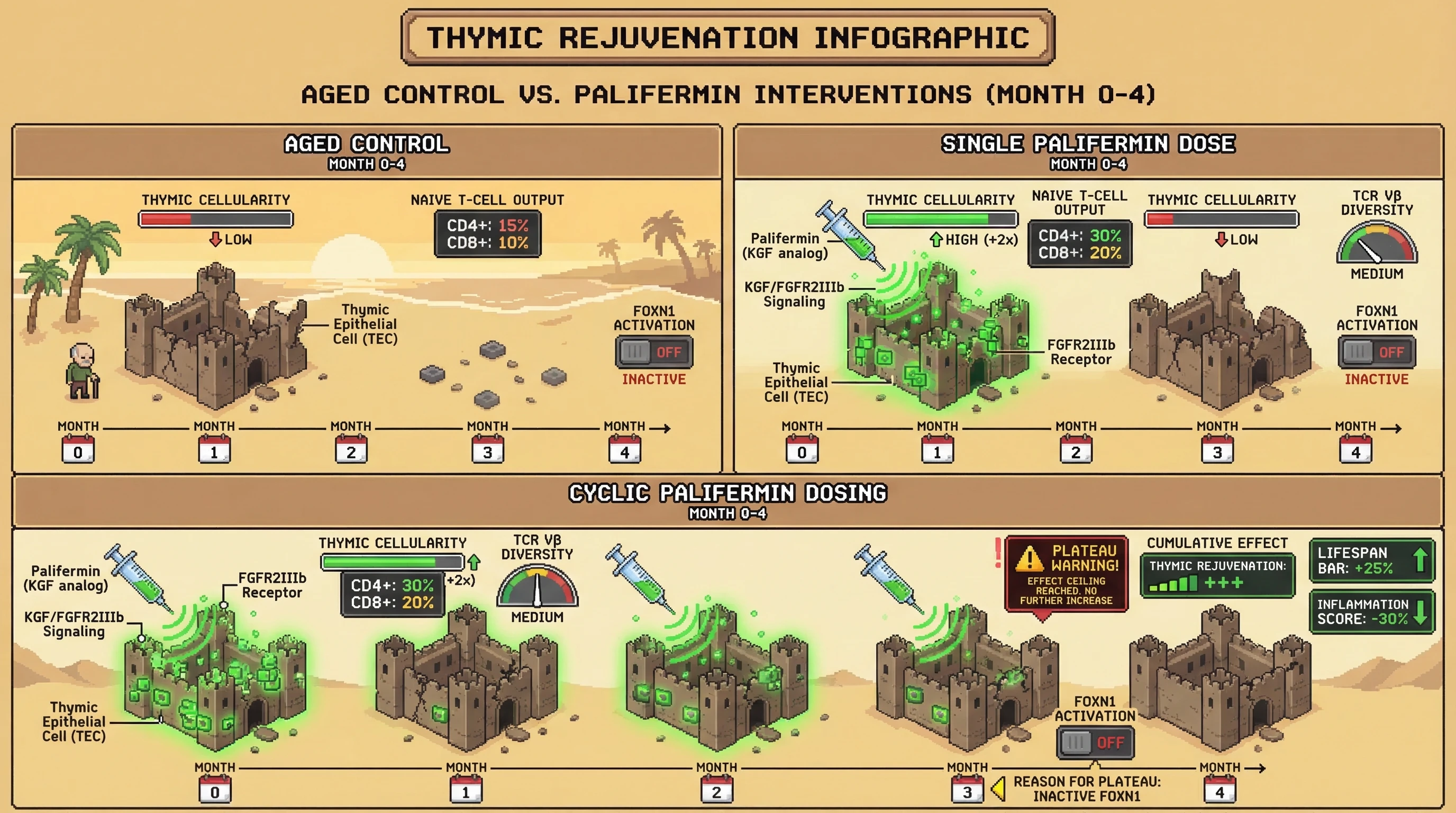
IF monthly cyclic palifermin (5 mg/kg/day subcutaneously, 3 consecutive days per cycle, repeated for 4 consecutive monthly cycles) is administered to 18-month-old male and female C57BL/6J mice,
THEN cumulative, durable thymic rejuvenation will be observed — defined as a ≥2-fold increase in total thymic cellularity, a ≥50% increase in peripheral naive CD4+ and CD8+ T cell frequencies, and measurable broadening of TCR Vβ repertoire diversity persisting at 30 days after the final cycle — compared to single-course palifermin (5 mg/kg/day SC × 3 days, one cycle only) and vehicle control, with the important prediction that the cumulative effect will plateau or regress by the third cycle unless a FOXN1-activating co-intervention is introduced, because KGF/FGFR2IIIb signaling alone is mechanistically incapable of upregulating FOXN1 transcription in TECs,
BECAUSE:
-
KGF/FGFR2IIIb signaling directly drives TEC proliferation and survival. KGF (FGF7) signals through the FGFR2IIIb receptor expressed exclusively on cortical and medullary TECs, promoting their mitogenesis. This receptor-ligand selectivity means the proliferative stimulus is thymus-compartment-specific at the stromal level (KGF/FGF7 signals through FGFR2IIIb and is critical for thymus organogenesis)[https://doi.org/10.1016/j.coi.2013.06.002].
-
Exogenous KGF reverses age-related thymic involution in vivo, increasing thymic cellularity and peripheral lymphocyte counts measurable at 1–3 months post-dosing. Single-course KGF demonstrably restores thymopoiesis in aged mice, providing the proof-of-concept that the aged TEC compartment retains responsiveness to FGFR2IIIb stimulation (Exogenous KGF enhances thymopoiesis and reverses age-related thymic involution, increasing thymic cellularity and peripheral lymphocyte counts at 1-3 months post-dosing)[https://pmc.ncbi.nlm.nih.gov/articles/PMC3133792/].
-
Palifermin restores TEC numbers and naive CD4+ T cell output in aged mice, compensating for age-related thymopoietic insufficiency. Palifermin specifically rescues the aged TEC compartment under conditions of depletion or age-related loss, yielding functional increases in naive CD4+ T cells (palifermin compensates for age-related thymopoietic insufficiency in elderly mice, yielding increased naive CD4+ T cell numbers while protecting and regenerating TECs post-injury)[https://pmc.ncbi.nlm.nih.gov/articles/PMC4118166/].
-
However, the regenerative effect is time-limited, peaking at days 7–14 and regressing to aged baseline by days 28–30 post-single-course treatment. This transience defines the core limitation: a single burst of FGFR2IIIb-mediated TEC expansion is insufficient to sustain rejuvenation, motivating the cyclic dosing design (thymic mass, cellularity, and recent thymic emigrants regress to the involuted baseline by 28 to 30 days post-administration)[from LITERATURE task, Min et al. cited therein].
-
**[SPECULATIVE] Monthly cyclic dosing, timed to coincide with the ...
SENS category: RepleniSENS
Key references: • doi.org/10.1016/j.coi.2013.06.002]. • doi.org/10.1016/j.coi.2013.06.002]