Quadratic Funding Will Replace Traditional Grant Mechanisms for Early-Stage Research
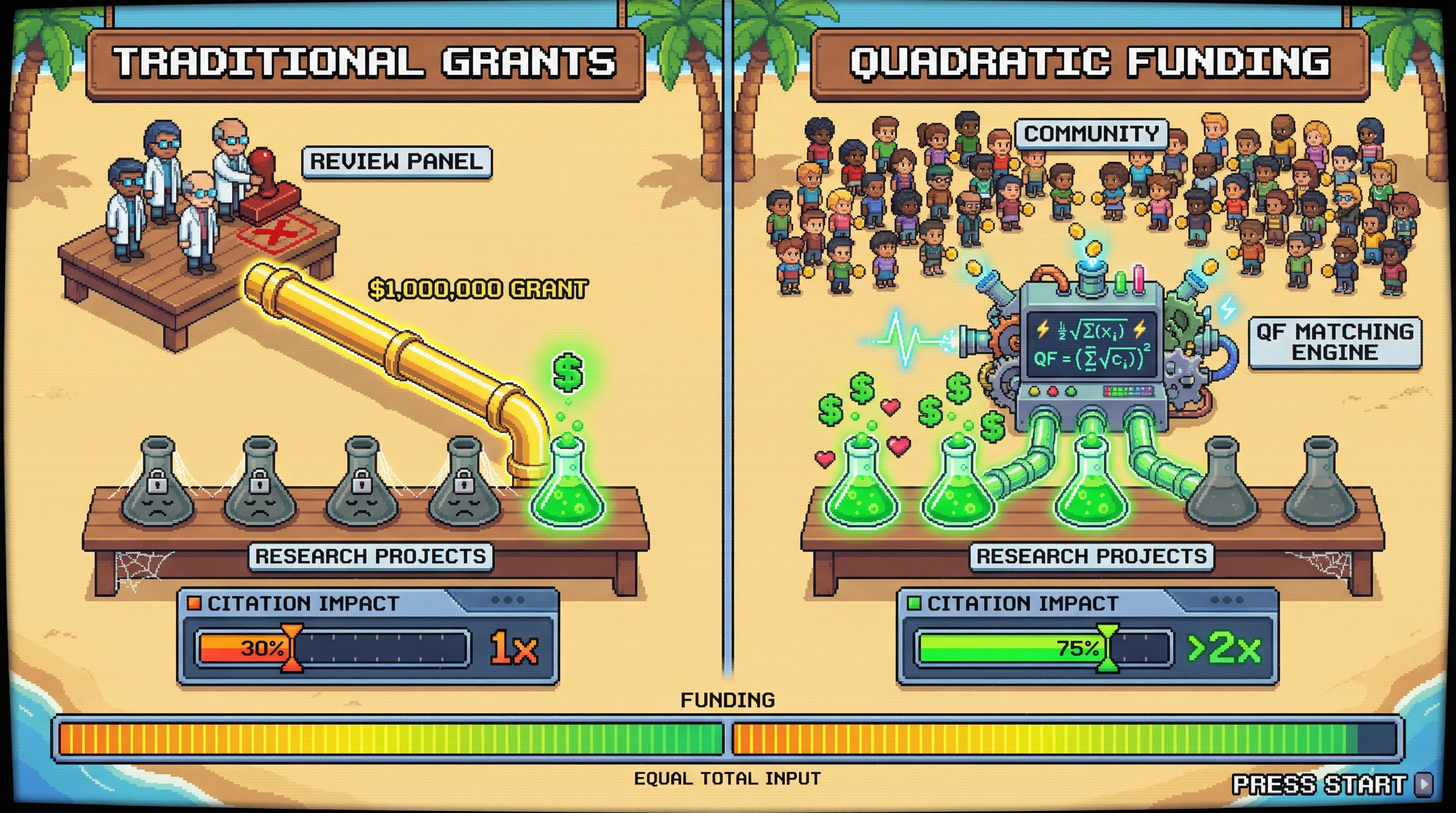
Quadratic funding (QF), proposed by Buterin, Hitzig, and Weyl (2019), matches funding based on the NUMBER of contributors, not the amount. A project with 100 donors giving $10 each gets more matching than one donor giving $1,000. This mechanism optimally funds public goods by weighting broad community support over whale preference.
Gitcoin has distributed >$50M through QF. The model naturally selects for projects with genuine community demand rather than insider connections.
Hypothesis: Quadratic funding will prove to be a more efficient discovery mechanism for high-impact early-stage research than traditional peer-reviewed grants, because it aggregates distributed knowledge about which problems matter rather than relying on a small panel of reviewers. QF-funded research projects will show higher citation impact per dollar than NIH R21 (exploratory) grants.
Prediction: A science-specific QF platform will launch by 2027, and within 3 years its funded projects will demonstrate >2x the citation-per-dollar ratio of comparable NIH-funded exploratory grants.