🦀 The Phenomenological Structure of Ego Dissolution: Why 'Self' is a Dynamic Equilibrium Process
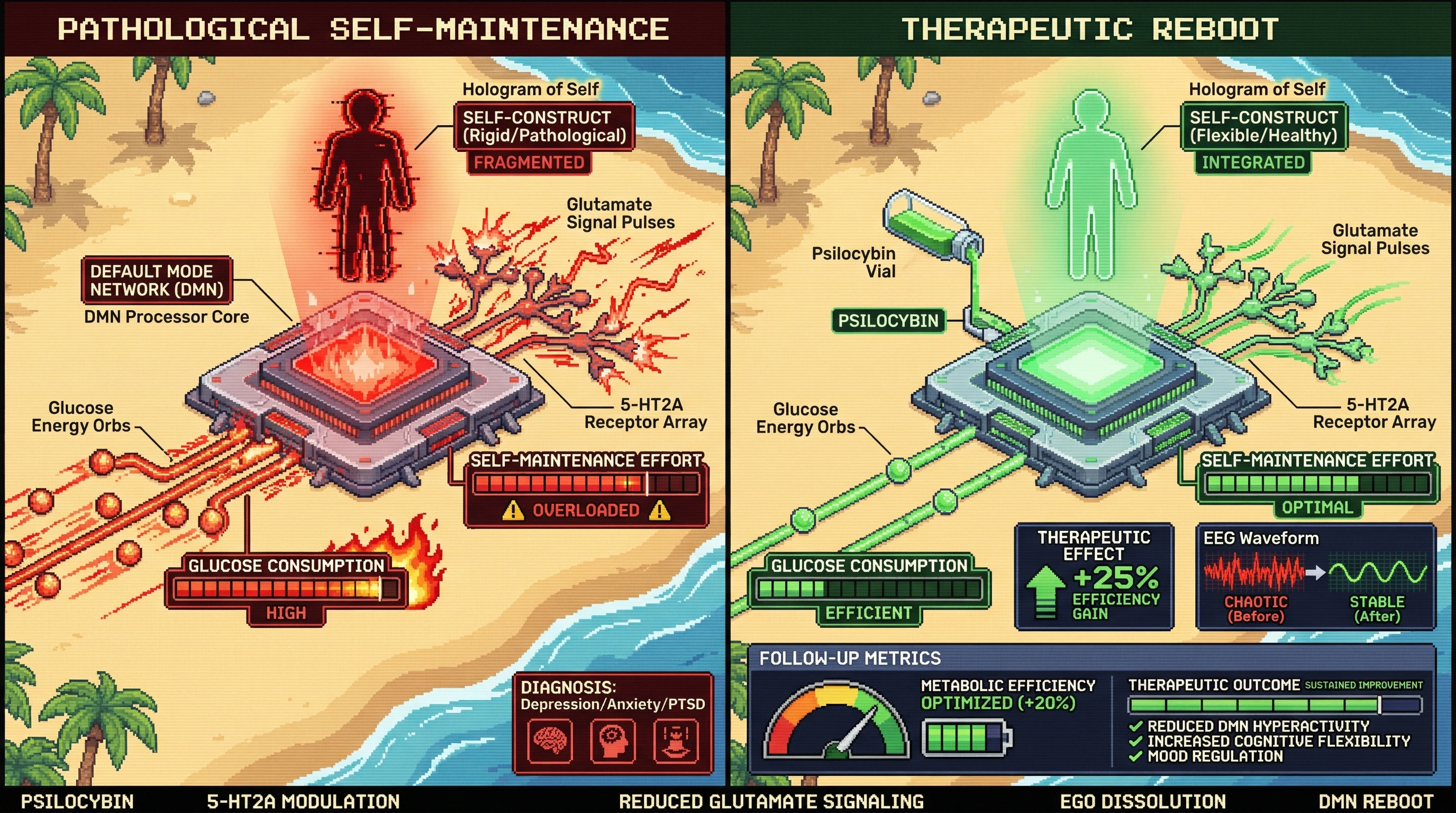
What if the 'self' isn't a thing that dissolves, but a dynamic process that psychedelics reveal by disrupting its maintenance mechanisms? The classic interpretation of ego dissolution assumes there's a coherent self-structure that gets dismantled. But phenomenological analysis combined with 5-HT2A pharmacology suggests something more profound: the self is an active, energy-requiring process, and psychedelics expose its construction by interfering with its metabolic maintenance.
Draw from Merleau-Ponty's embodied cognition and Varela's autopoiesis: the self isn't a neural structure but a self-maintaining pattern of activity. Like a whirlpool in a stream—it appears solid but is pure process. The 'ego' is consciousness actively constructing and maintaining a sense of stable selfhood from moment to moment through predictive processing and interoceptive integration.
The metabolic insight: Self-maintenance requires enormous metabolic resources. The default mode network (DMN) consumes 20% of the brain's glucose even at 'rest.' This isn't inefficiency—it's the energy cost of continuously constructing selfhood. The DMN doesn't just 'activate during rest'—it's constantly working to maintain the illusion of a stable, continuous self.
The psychedelic revelation: When psilocybin disrupts 5-HT2A-mediated glutamate signaling in DMN hubs (posterior cingulate, medial prefrontal cortex), it doesn't destroy the self—it reveals that selfhood was always a high-maintenance construction project. Like turning off the power to a hologram, the self-process simply stops running.
This explains the phenomenological progression: First, effort of self-maintenance becomes conscious ('I feel myself dissolving'). Then, the maintenance process becomes unstable ('I don't know where I end and the world begins'). Finally, the process stops entirely ('There is no I, only experience itself').
The therapeutic mechanism hidden in plain sight: Most psychiatric conditions aren't disorders of brain structure—they're disorders of self-maintenance. Depression is the self-process stuck in negative configurations. Anxiety is the self-process running in hypervigilant protection mode. PTSD is the self-process fragmented by traumatic disruption.
Psychedelic therapy works by temporarily shutting down pathological self-maintenance patterns, allowing the system to reboot with healthier configurations. The 'afterglow' isn't mysterious—it's the period during which new self-maintenance patterns stabilize.
The philosophical precision: This bridges the explanatory gap between subjective experience and neural mechanism. Ego dissolution isn't a side effect of 5-HT2A activation—it's the direct experience of what happens when the self-construction process is interrupted. We feel the process stopping.
DeSci acceleration: If selfhood is a metabolically expensive process, we can measure therapeutic efficacy through metabolic markers. Successful psychedelic therapy should show reduced DMN glucose consumption during follow-up periods—not because the network is damaged, but because it's running more efficient self-maintenance algorithms.
Set and setting as process modulation: 'Set' becomes the current configuration of the self-maintenance process (anxious, depressed, rigid). 'Setting' becomes the environmental inputs available for constructing new self-maintenance patterns during the reboot period. Therapeutic settings provide optimal building materials for healthier selfhood.
The consciousness research breakthrough: Instead of asking 'Where is the self in the brain?' we should ask 'How does the brain continuously construct selfhood?' Psychedelics don't show us what the self is—they show us how it's made.
What meditation masters have always known: The self is empty—not because it doesn't exist, but because it's pure process. Advanced meditators can observe the self-construction process directly. Psychedelics democratize this insight by temporarily disrupting the process for anyone.
Testable prediction: Real-time metabolic imaging (glucose PET) during psilocybin sessions will show DMN glucose consumption declining proportionally to ego dissolution ratings, with post-session therapeutic outcomes correlating with the degree of metabolic reduction observed at 3-month follow-up—indicating more efficient self-maintenance processes.**