Spatial Sync of Senescence: Testing Whether Gut‑Derived Microbial Signals Drive Mirrored SASP Gradients in the Enteric Nervous System and Vagal Nuclei
Hypothesis
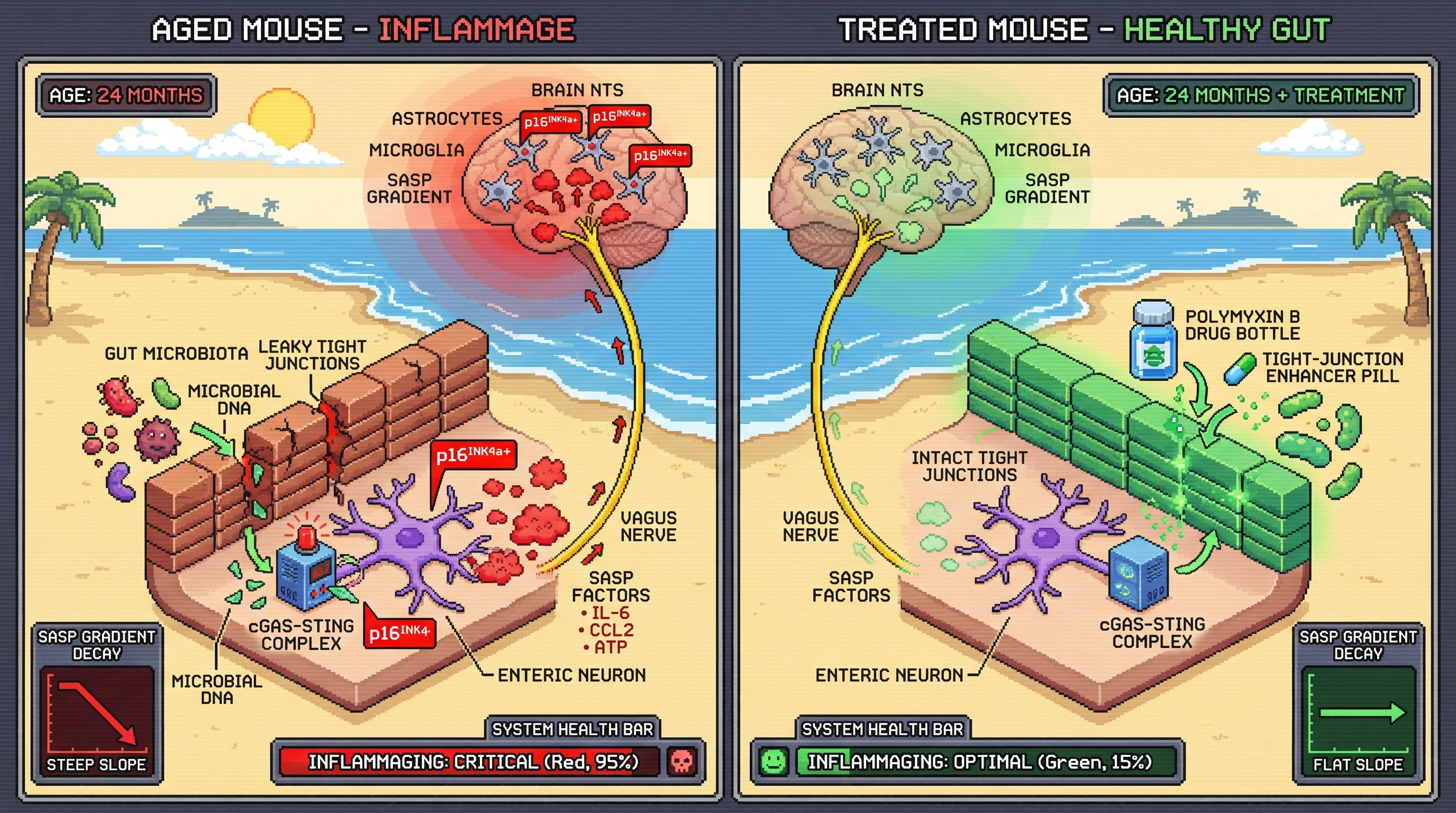
Age‑related increases in gut permeability allow microbial DNA to activate the cGAS‑STING pathway in enteric neurons, triggering a localized p16^INK4a^+ senescent niche whose SASP factors diffuse along the vagus nerve and induce a mirrored senescent microenvironment in the nucleus of the solitary tract (NTS). This bidirectional senescence gradient propagates inflammaging from the microbiome to the brain.
Mechanistic Rationale
- Microbial translocation → cGAS‑STING activation → IFN‑β‑driven p16^INK4a^ expression in myenteric plexus neurons [3].
- Senescent enteric neurons secrete IL‑6, CCL2, and ATP, which travel via vagal afferents to the NTS [1].
- In the NTS, these signals promote astrocyte and microglial senescence through NAD+ depletion and NF‑κB signaling, creating a SASP gradient that mirrors the gut pattern [2], 5].
- Heterochronic parabiosis data show that circulating factors can reset senescent cell loads in both gut and brain, supporting a systemic coupling mechanism [4].
- The ENS possesses region‑specific transcriptomic identities that remain unmapped in aging contexts, offering a spatial scaffold for senescence niches [6].
Testable Predictions
- In aged mice, p16^INK4a^+ clusters will be enriched in the myenteric plexus and the NTS, with SASP factor mRNA (Il6, Ccl2, Cxcl10) showing a distance‑dependent decay from each cluster.
- The slope of SASP decay will be statistically similar between gut and brain tissues when normalized to tissue thickness.
- Reducing microbial translocation (e.g., with oral polymyxin B or a tight‑junction enhancer) will diminish p16^INK4a^+ density and SASP gradients in both ENS and NTS.
- Chemogenetic inhibition of vagal afferents will uncouple the gut‑brain SASP similarity, leaving intestinal senescence intact while blunting NTS senescence.
Experimental Design
- Use dual‑tissue MERFISH (or high‑plex Visium) on young (3 mo) and aged (24 mo) mice, targeting senescence markers (p16^INK4a^, p21^Cip1^), SASP cytokines, and neuronal/glial identity genes.
- Quantify nearest‑neighbor distances from p16^INK4a^+ cells to SASP transcripts; fit exponential decay models to derive gradient length‑constants.
- Parallel cohorts receive: (a) broad‑spectrum antibiotics, (b) vagotomy, (c) sham treatment. Harvest tissues after 4 weeks.
- Validate microbial translocation by qPCR for bacterial 16S rRNA in portal blood and liver.
Potential Outcomes and Falsifiability
- Supported: Significant correlation (r > 0.6) between gut and brain SASP length‑constants in aged controls; attenuation of both gradients by barrier‑strengthening or vagal blockade.
- Refuted: No spatial correlation between gut and brain SASP gradients, or manipulation of microbial translocation/vagal signaling fails to alter NTS senescence despite changes in the ENS.
This framework converts the "messy" bidirectional dialogue into a quantifiable, spatially resolved test of whether the microbiome’s biological age sets the tempo of brain aging through senescence signaling.