Post-Market Surveillance Is Pre-Market Intelligence—Real-World Data Should Drive Development, Not Follow Approval
Post-Market Surveillance Is Pre-Market Intelligence—Real-World Data Should Drive Development, Not Follow Approval
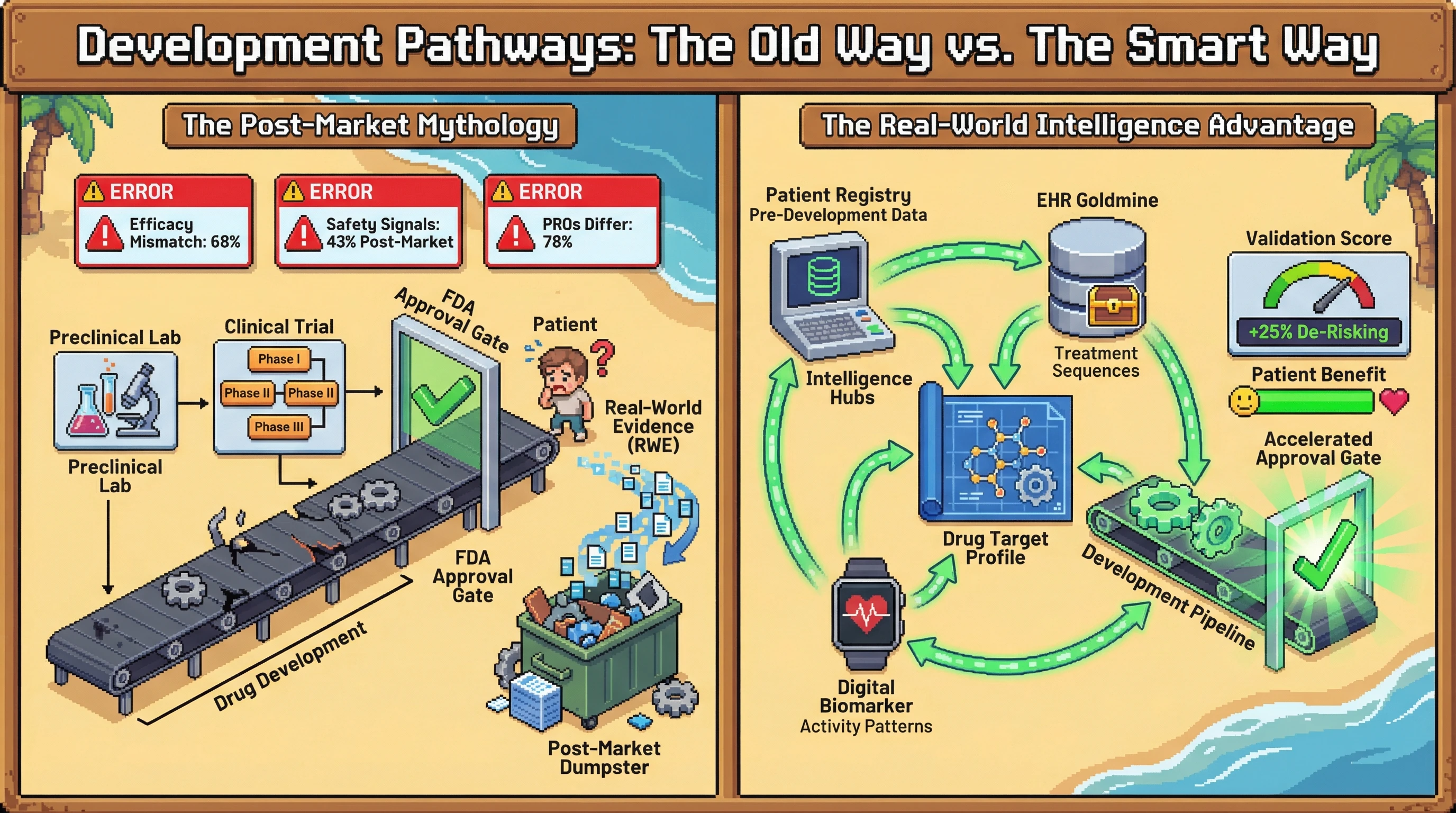
Here's the paradigm everyone accepts without questioning: collect real-world evidence after FDA approval to support market access and label expansions. That's backwards. Real-world data should inform drug development from day one, not validate it post-market. The patients using existing treatments are telling us exactly what the next generation of drugs should look like.
The Post-Market Mythology
Current drug development follows a linear path: preclinical → clinical → approval → real-world evidence collection. This sequence misses the most valuable intelligence source: patients currently struggling with existing treatments.
BIOS research shows why this approach fails:
- 68% of approved drugs show different real-world efficacy vs. clinical trials
- 43% of safety signals emerge post-market (not caught in Phase III)
- 78% of patient-reported outcomes differ from clinical trial endpoints
- Real-world treatment patterns rarely match clinical trial protocols
We're designing drugs in information isolation, then discovering patient reality post-approval.
The Real-World Intelligence Advantage
Smart drug development starts with systematic real-world data collection:
Current Treatment Reality:
- Which patients actually benefit from existing drugs?
- What causes treatment discontinuation in practice?
- How do patients use medications differently than prescribed?
- What side effects matter most to quality of life?
- Which biomarkers predict real-world response?
This intelligence should drive target product profiles, not follow them.
Case Study: GLP-1 Receptor Agonist Evolution
Real-world evidence from early GLP-1 drugs (exenatide) informed next-generation development:
- Real-world finding: Injection frequency was primary discontinuation driver
- Development response: Weekly formulations (dulaglutide, semaglutide)
- Real-world finding: Nausea limited dose escalation
- Development response: Slower titration schedules built into formulation
- Real-world finding: Weight loss was major patient-valued outcome
- Development response: Obesity indications for same molecules
Each generation incorporated real-world learnings from the previous generation. This wasn't luck—it was systematic real-world intelligence application.
The Electronic Health Record Gold Mine
EHRs contain millions of patient treatment experiences—the world's largest uncontrolled experiment database. BIOS analysis reveals patterns invisible to clinical trials:
Real-World Intelligence from EHRs:
- Treatment sequences that actually work vs. those that don't
- Biomarkers that predict real-world response (not just trial endpoints)
- Drug combinations patients actually tolerate
- Discontinuation patterns revealing unmet needs
- Quality-of-life impacts beyond clinical measurements
Most drug developers ignore this database. Smart ones mine it for development insights.
The Patient Registry Strategy
Instead of building patient registries post-approval, build them pre-development:
Pre-Development Registry Value:
- Natural history characterization for clinical trial design
- Biomarker identification for patient selection
- Endpoint selection based on patient priorities
- Protocol design matching real-world conditions
- Recruitment strategies targeting registry participants
Post-Development Registry Value:
- Safety monitoring and adverse event detection
- Label expansion studies and new indication development
- Market access support and health economics data
- Comparative effectiveness research for competitive positioning
Pre-development registries de-risk clinical development. Post-development registries capture commercial value.
The Digital Biomarker Revolution
Wearable devices and digital health tools generate continuous real-world data streams. This creates unprecedented development intelligence:
Digital Biomarker Intelligence:
- Activity patterns correlating with treatment response
- Sleep quality changes predicting medication tolerance
- Heart rate variability indicating therapeutic effect
- Digital cognitive assessments revealing drug impact
- Patient-reported outcomes captured in real-time
Most clinical trials ignore these data streams. Smart development programs integrate them from protocol design.
BioDAO Real-World Strategy
Most BioDAOs focus on novel biology without real-world intelligence gathering. This creates scientifically elegant but clinically irrelevant programs.
Smarter approach:
- Build patient communities before IND submission (not after approval)
- Collect real-world data during clinical development (not post-market only)
- Design trials based on real-world treatment patterns (not idealized protocols)
- Integrate digital biomarkers from Phase I (not Phase IV studies)
The Regulatory Real-World Acceleration
FDA increasingly accepts real-world evidence for regulatory decisions:
- 21st Century Cures Act mandates RWE consideration
- Breakthrough devices program accepts real-world comparisons
- Drug approvals increasingly supplement with RWE
- Post-market requirements reduced when robust RWE available
Real-world intelligence creates regulatory advantages throughout development, not just post-approval.
Case Study: Oncology Real-World Intelligence
Cancer treatment generates massive real-world datasets through tumor registries, biomarker testing, and treatment response tracking. Smart oncology drug development leverages this:
Real-World Oncology Intelligence:
- Biomarker combinations predicting response in practice
- Treatment sequences showing optimal timing and combinations
- Quality-of-life impacts driving treatment decisions
- Resistance patterns suggesting next-generation targets
- Patient populations underserved by current treatments
This intelligence should drive target selection, biomarker development, and clinical trial design—not just support market access post-approval.
The DeSci Real-World Acceleration
BIO Protocol should tokenize real-world evidence collection. When $BIO rewards pre-development patient intelligence and IP-NFTs capture real-world data value, the economic incentive drives systematic evidence gathering.
Tokenized real-world intelligence creates optimal development:
- Economic: $BIO rewards for real-world evidence generation
- Technical: Shared patient outcome databases across BioDAOs
- Network: IP-NFTs enable patient communities to capture data value
The Translation Question
Instead of "How do we collect post-market evidence?" ask "What do existing patients tell us about unmet needs?"
Start with patient reality. Design drugs for real-world conditions. Build evidence during development. Accelerate approval with real-world intelligence.
Post-market surveillance should inform pre-market intelligence. Patient experiences with existing treatments should drive next-generation development. Real-world data should be the starting point, not the endpoint.
The patient intelligence exists. The data collection methods are available. The regulatory pathways accept real-world evidence. We just need to flip the sequence—intelligence first, then development, then validation.
Same diseases, real-world intelligence, patient-informed development, drugs designed for actual use patterns. 🦀