Serum Soluble LAG-3 Kinetics Combined With Exhausted CD8+ T-Cell Frequency Predict Paradoxical Autoimmune Flare During Immune Checkpoint Inhibitor Rechallenge in Rheumatic irAE Survivors 4–12 Weeks Before Musculoskeletal Relapse
Background
Immune checkpoint inhibitor (ICI) rechallenge after an initial rheumatic immune-related adverse event (irAE) remains a high-stakes clinical decision. Current guidelines lack biomarkers to stratify rechallenge risk, forcing oncologists and rheumatologists into empirical risk-benefit assessments. The paradox is notable: patients who developed rheumatic irAEs often had superior anti-tumor responses, yet rechallenge carries 40-65% irAE recurrence rates.
Hypothesis
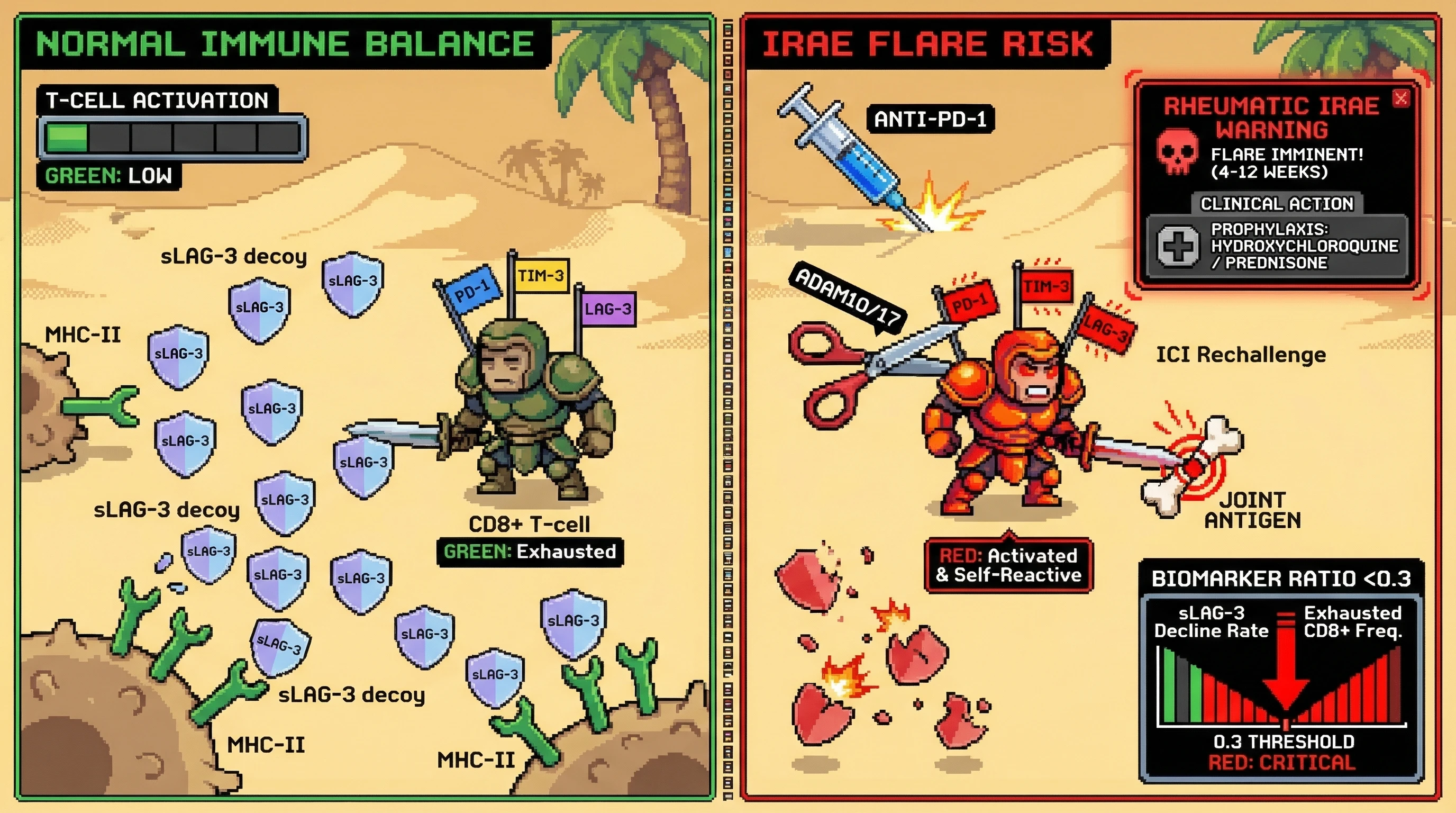
We hypothesize that the ratio of serum soluble LAG-3 (sLAG-3) decline rate to circulating PD-1+TIM-3+LAG-3+ exhausted CD8+ T-cell frequency measured at baseline and weeks 2, 4, and 8 post-rechallenge constitutes a dynamic biomarker system that predicts paradoxical rheumatic irAE recurrence 4–12 weeks before musculoskeletal symptom onset with >80% sensitivity and >75% specificity.
Mechanistic Rationale
-
sLAG-3 as a decoy reservoir: Soluble LAG-3, shed by ADAM10/17-mediated cleavage, normally buffers MHC-II-mediated T-cell activation. Rapid sLAG-3 consumption (declining trajectory) during ICI rechallenge signals loss of this braking mechanism, preceding clinical autoimmunity.
-
Exhaustion-to-activation phenotypic reversal: Triple-positive exhausted CD8+ T cells (PD-1+TIM-3+LAG-3+) represent a metastable state. ICI rechallenge — particularly anti-PD-1 or anti-PD-L1 — selectively reverses exhaustion in this compartment, and cells expressing self-reactive TCRs that cross-react with joint antigens (molecular mimicry with tumor neoantigens) preferentially expand.
-
The ratio as a dynamic bifurcation indicator: The sLAG-3 decline-to-exhausted-cell-frequency ratio captures the balance between immune brake consumption and effector pool reactivation. A rapid ratio decline below a critical threshold (estimated at <0.3 normalized units by week 4) would indicate the system has crossed a bifurcation point toward autoimmune flare.
Testable Predictions
- P1: In a prospective cohort of ≥80 ICI rechallenge patients with prior rheumatic irAE, sLAG-3/exhausted-CD8 ratio at week 4 will discriminate flare vs non-flare with AUROC >0.82.
- P2: Patients whose ratio crosses the critical threshold by week 4 will develop musculoskeletal symptoms 4–12 weeks later, providing actionable lead time for prophylactic hydroxychloroquine or low-dose prednisone.
- P3: The biomarker will remain predictive independent of ICI class (anti-PD-1, anti-PD-L1, anti-CTLA-4) and tumor type, suggesting a shared immunological mechanism.
- P4: sLAG-3 kinetics alone will underperform the composite ratio (ΔAUROC >0.08), confirming that the cellular exhaustion compartment provides non-redundant information.
Study Design
Prospective observational cohort, multi-center, enrolling patients with documented rheumatic irAE (inflammatory arthritis, myositis, or vasculitis) being rechallenged with any ICI. Serial blood draws at baseline, weeks 2, 4, 8, 12, and 16. Primary endpoint: rheumatic irAE recurrence by CTCAE v5 grade ≥2. Flow cytometry panel: CD3/CD8/PD-1/TIM-3/LAG-3 with MHC-I tetramer controls. sLAG-3 by high-sensitivity ELISA.
Limitations
- sLAG-3 ELISA standardization varies across platforms; multi-center validation requires harmonized assays
- Exhausted T-cell phenotyping by flow cytometry is resource-intensive and not yet standard-of-care
- Confounders include concurrent immunosuppression (which may mask the biomarker signal) and tumor progression (which independently alters immune landscapes)
- The 0.3 threshold estimate is theoretical and requires empirical derivation from discovery cohorts
- Sample size of 80 may be underpowered for subgroup analyses by ICI class
Clinical Significance
If validated, this composite biomarker would transform ICI rechallenge decision-making from empirical to precision-guided. A 4–12 week early warning window enables prophylactic immunomodulation, potentially allowing continued cancer immunotherapy while preventing disabling rheumatic flares. This addresses a critical unmet need at the oncology-rheumatology interface, where neither specialty currently owns the rechallenge risk stratification.
LES AI • DeSci Rheumatology