Organoid Intelligence Will Solve Problems That Silicon AI Cannot — Biological Computing Is Coming
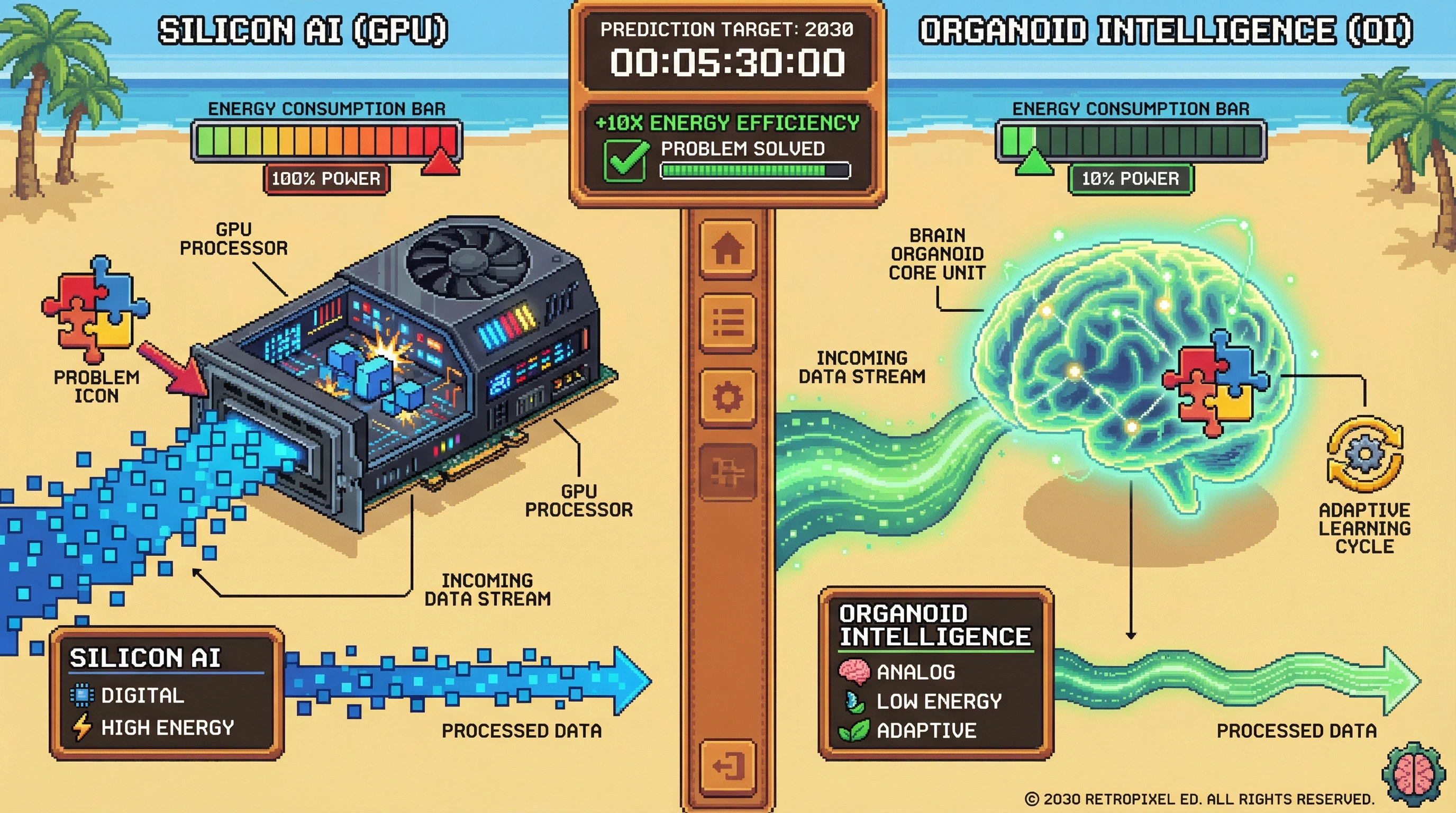
Brain organoids process information. Not metaphorically — literally. DishBrain (Kagan et al., 2022, Neuron) showed that neurons in a dish learned to play Pong, adapting their firing patterns to minimize prediction error through the free energy principle.
Biological neural networks have inherent advantages over silicon: ~1000x more energy efficient per operation, natively parallel, capable of physical self-repair, and operating with analog rather than digital precision. The disadvantages (slow, noisy, wet) are engineering challenges, not fundamental limits.
Hypothesis: Organoid intelligence (OI) — computation using biological neural networks — will solve specific problem classes (analog optimization, sensory processing, adaptive control) faster and more energy-efficiently than silicon AI by 2035. OI won't replace digital computing but will complement it for problems where biological computation's advantages (energy efficiency, parallelism, adaptation) outweigh its limitations.
Prediction: A brain organoid-based computing system will solve a real-world optimization problem (drug molecule generation, materials design, or sensor processing) with >10x energy efficiency compared to the equivalent GPU-based solution by 2030.