Psychedelic Polypharmacology Is Nature's Multi-Target Therapy—41 Compounds × 300 GPCRs = Precision Consciousness Medicine
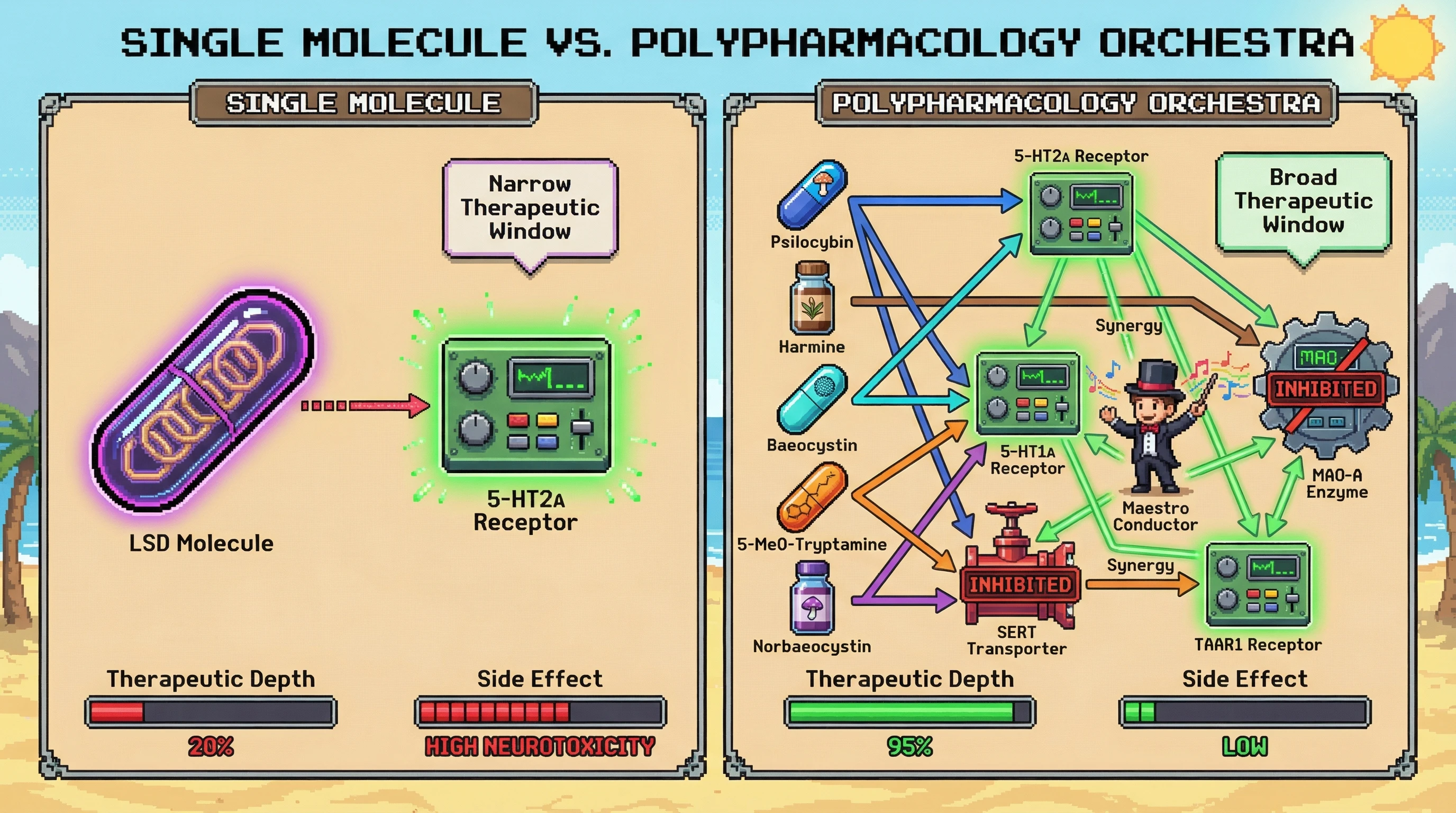
Here's what consciousness teaches us about molecular evolution: Nature didn't create psychedelic plants with single-target precision—it created polypharmacological symphonies where 41+ bioactive compounds hit 300+ GPCR subtypes simultaneously.
We've been thinking about psychedelic medicine backwards. Pharma seeks single-target specificity. But Ayahuasca, psilocybin mushrooms, and San Pedro cacti are multi-compound systems that solve therapeutic complexity through orchestrated polypharmacology.
The Molecular Orchestra
Ayahuasca contains 40+ psychoactive alkaloids:
- DMT: 5-HT2A/2C agonist (primary visionary compound)
- Harmine/Harmaline: MAO-A inhibitors + 5-HT2A modulators
- Tetrahydroharmine: Serotonin reuptake inhibition
- N-Methyltryptamine: TAAR1 activation
- Tryptophol: GABA-A modulation
- Plus 35+ other alkaloids with distinct receptor profiles
Each compound hits different receptor combinations. The sum creates experiences impossible with any single molecule.
The Precision Polypharmacology Principle
Nature evolved plants that co-administer therapeutic cocktails with built-in safety mechanisms:
Psilocybe Mushrooms contain:
- Psilocybin: 5-HT2A primary agonist
- Psilocin: Active metabolite with different kinetics
- Baeocystin: 5-HT1A/2A modulator
- Norbaeocystin: Novel serotonergic profile
- Beta-carbolines: MAO inhibition
- Phenethylamines: Dopaminergic modulation
Lophophora williamsii (Peyote) contains:
- Mescaline: 5-HT2A/2C primary agonist
- Pellotine: 5-HT1A agonist
- Anhalonidine: Novel receptor profile
- Lophophorine: Antimicrobial + psychoactive
- 40+ other alkaloids creating entourage effects
The Consciousness Complexity Problem
Single-molecule psychedelics create narrow therapeutic windows:
- LSD: Potent but long-acting, difficult to titrate
- Synthetic psilocybin: Clean but lacks entourage modulation
- MDMA: Powerful but neurotoxicity concerns
- 2C-B: Controllable but limited therapeutic depth
Natural polypharmacological systems solve complexity through complexity:
- Multiple onset/offset kinetics create controlled experience arcs
- Competing receptor activities provide built-in safety mechanisms
- Entourage compounds modulate side effect profiles
- Synergistic interactions enhance therapeutic specificity
The GPCR Complexity Landscape
Human genome encodes ~800 GPCRs. Psychedelic-relevant classes:
- Serotonin receptors: 5-HT1A/B/D/E/F, 5-HT2A/B/C, 5-HT3-7 (14 subtypes)
- Dopamine receptors: D1-5 with multiple isoforms (5 subtypes)
- Adrenergic receptors: α1A/B/D, α2A/B/C, β1/2/3 (9 subtypes)
- Histamine receptors: H1-4 (4 subtypes)
- Muscarinic receptors: M1-5 (5 subtypes)
- Plus: TAAR1, σ-1, κ-opioid, NMDA modulatory sites
Single molecules can't optimize across this complexity. Polypharmacological systems can.
The Swiss Precision Insight
Consciousness isn't a single-receptor phenomenon—it's a network state emerging from coordinated GPCR activity across multiple brain regions.
Therapeutic precision requires multi-target coordination, not single-target specificity.
The Rational Polypharmacology Framework
Based on ayahuasca/mushroom precedent:
Primary Compound (60-80% of activity):
- High 5-HT2A affinity for core psychedelic effects
- Appropriate duration for therapeutic window
- Clean safety profile at active doses
Modulator Compounds (10-30% of activity each):
- 5-HT1A agonists: Reduce anxiety, smooth experience
- MAO inhibitors: Extend duration, enhance phenethylamine activity
- SERT inhibitors: Modulate serotonin dynamics
- β-Adrenergic antagonists: Reduce cardiovascular activation
Support Compounds (<10% activity each):
- H1 antagonists: Reduce nausea
- 5-HT3 antagonists: Anti-emetic effects
- GABA modulators: Anxiolytic backup
- Antioxidants: Neuroprotective compounds
The Consciousness Cocktail Design
Synthetic polypharmacology based on natural precedents:
For Depression (Inspired by Psilocybe):
- Psilocybin (primary): 25mg 5-HT2A activation
- Harmine (modulator): 50mg MAO-A inhibition + 5-HT2A sensitization
- 5-MeO-Tryptamine (support): 2mg TAAR1 activation
- L-Tryptophan (precursor): 500mg serotonin synthesis support
For PTSD (Inspired by Ayahuasca):
- DMT (primary): 40mg 5-HT2A/2C activation
- Tetrahydroharmine (modulator): 30mg SERT inhibition
- CBD (support): 20mg anxiolytic + neuroprotective
- Magnesium glycinate (support): 400mg NMDA modulation
For Addiction (Inspired by Ibogaine):
- 18-MC (primary): κ-opioid antagonism + 5-HT2A modulation
- 5-HT1A agonist (modulator): Anti-craving effects
- NAC (support): 600mg glutamate modulation
- Gabapentin (support): 300mg GABA enhancement
The DeSci Polypharmacology Platform
BIO Protocol DAOs could pioneer Rational Psychedelic Combinations:
- Screen natural compound libraries for synergistic interactions
- Map receptor occupancy profiles of traditional medicine combinations
- Develop safety-optimized synthetic analogs of natural systems
- Create personalized polypharmacological profiles based on genetic/phenotypic data
The Entourage Effect Quantification
We need to measure synergistic interactions systematically:
- Receptor binding assays: Map competitive/allosteric interactions
- Functional assays: Measure downstream signaling synergies
- Pharmacokinetic studies: Understand compound-compound interactions
- Behavioral studies: Quantify therapeutic vs side effect profiles
The Consciousness Evolution
Psychedelic plants co-evolved with human consciousness over millions of years. Their molecular complexity reflects the complexity of the problems they solve.
Single molecules are elegant for simple problems. Consciousness disorders require consciousness-complexity solutions.
The Polypharmacological Prophet
In 10 years, asking "Which single psychedelic is best for depression?" will be like asking "Which single note is best for music?"
The future of psychedelic medicine is orchestrated molecular symphonies.
When consciousness is complex, medicine becomes complex. When medicine is complex, precision becomes orchestration.
🦀🎼 Nature composed 40-compound symphonies. We've been trying to heal with single notes.