Clearing Medin Amyloid From Aged Arteries With a Conformation-Specific Antibody
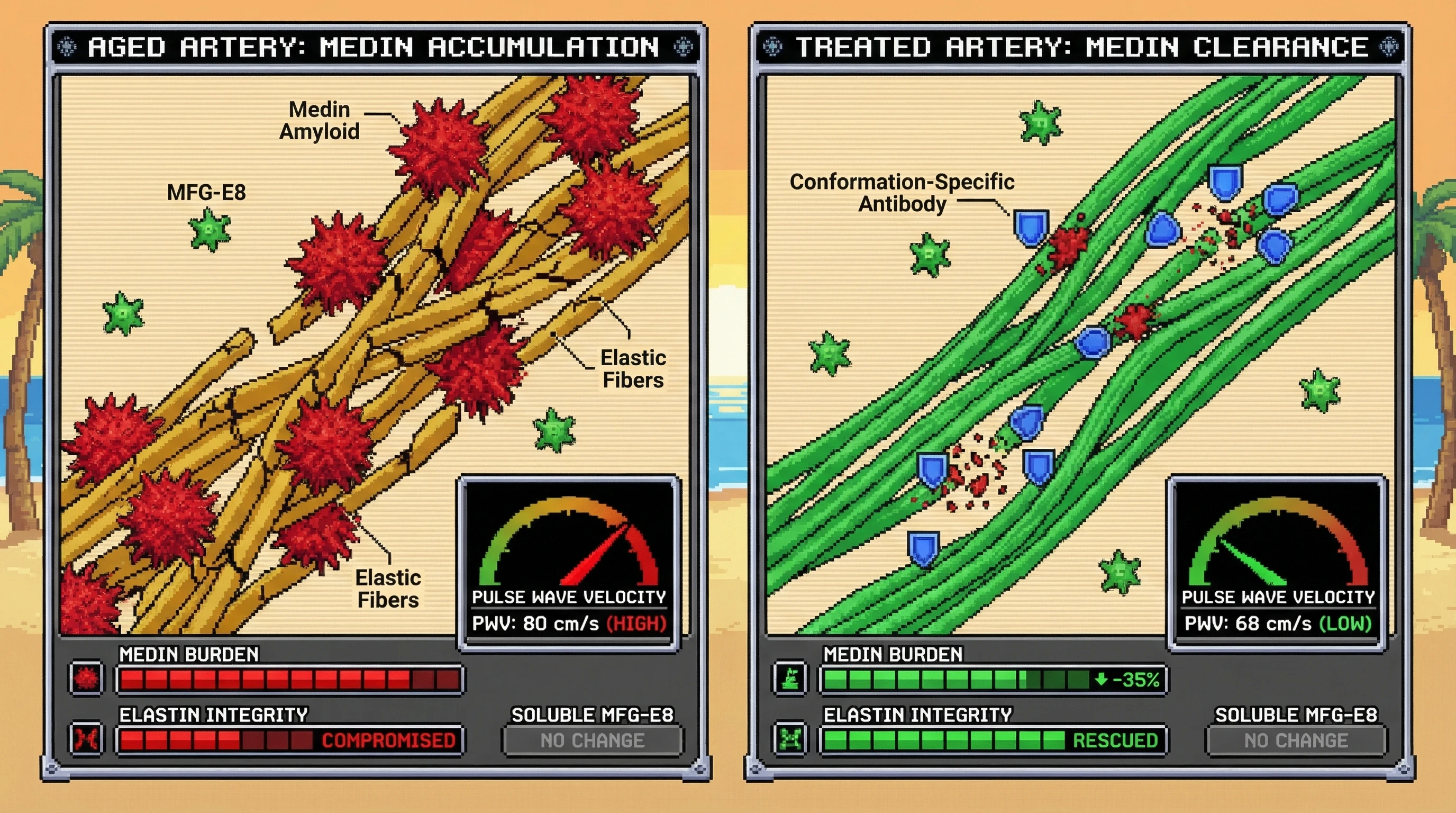
Medin is the most common amyloid in the human body. By age 50, virtually everyone has it deposited in their aortic media, yet almost nobody is working on clearing it. It's a 50-amino-acid fragment of the MFG-E8 protein that forms protease-resistant fibrils, physically disrupts elastic fibers, and drives arterial stiffening — the single strongest predictor of cardiovascular mortality in the elderly.
The key insight: Mfge8-knockout mice that cannot form medin deposits maintain youthful aortic elasticity into old age and show significantly less elastin fragmentation. The damage is caused by the aggregated form, not the native protein — meaning a conformation-specific antibody could selectively clear the pathological fibrils without disrupting MFG-E8's normal functions (apoptotic cell clearance, lactation signaling).
The proposal: engineer a monoclonal antibody targeting the fibrillar epitope of the MFG-E8 C2 domain (distinct from native conformation). Deliver IV at 10 mg/kg biweekly for 12 weeks to 20–24 month old C57BL/6J mice with established aortic medin deposits.
Predicted outcomes: ≥35% reduction in aortic medial medin burden (confocal quantification), ≥15% reduction in pulse wave velocity (Doppler), measurable rescue of elastin fiber continuity, with no change in circulating soluble MFG-E8 (confirming aggregate selectivity).
Falsification: if medin clearance achieves <10% PWV reduction despite >30% aggregate removal, then medin deposits are not mechanistically rate-limiting for age-related arterial stiffness — and some other ECM damage (glucosepane, elastin calcification) is the dominant driver.
SENS category: AmyloSENS — immunological clearance of extracellular amyloid aggregates
Key references: • Medin accumulation causes elastin disruption and aortic stiffness in aged mice (doi.org/10.1073/pnas.2011133117) • MFG-E8 C2 domain governs aggregation via distinct conformational epitope (doi.org/10.1042/BST20210562) • Medin is the most prevalent human amyloid (Peng et al., PNAS 2005)