Serum Soluble TIGIT/CD226 Ratio Kinetics Combined With Tissue-Resident Memory T-Cell Clonotype Persistence Index Predict Sustained Remission vs Relapse After Biologic Tapering in Rheumatoid Arthritis 6–18 Months Before Clinical Recurrence
Background
Biologic DMARD tapering in rheumatoid arthritis (RA) patients who achieve sustained remission remains a major clinical dilemma. Current predictive tools — DAS28-based composite indices, ACPA/RF titers, and imaging — inadequately distinguish patients who will maintain drug-free remission from those destined for relapse after dose reduction or withdrawal. The co-inhibitory receptor TIGIT (T-cell immunoreceptor with immunoglobulin and ITIM domain) and its competing activating counterpart CD226 (DNAM-1) form a critical checkpoint axis on effector and regulatory T cells that modulates peripheral tolerance. Meanwhile, tissue-resident memory T cells (TRM) in the synovium constitute a self-renewing reservoir capable of reigniting inflammation independently of circulating lymphocyte dynamics.
Hypothesis
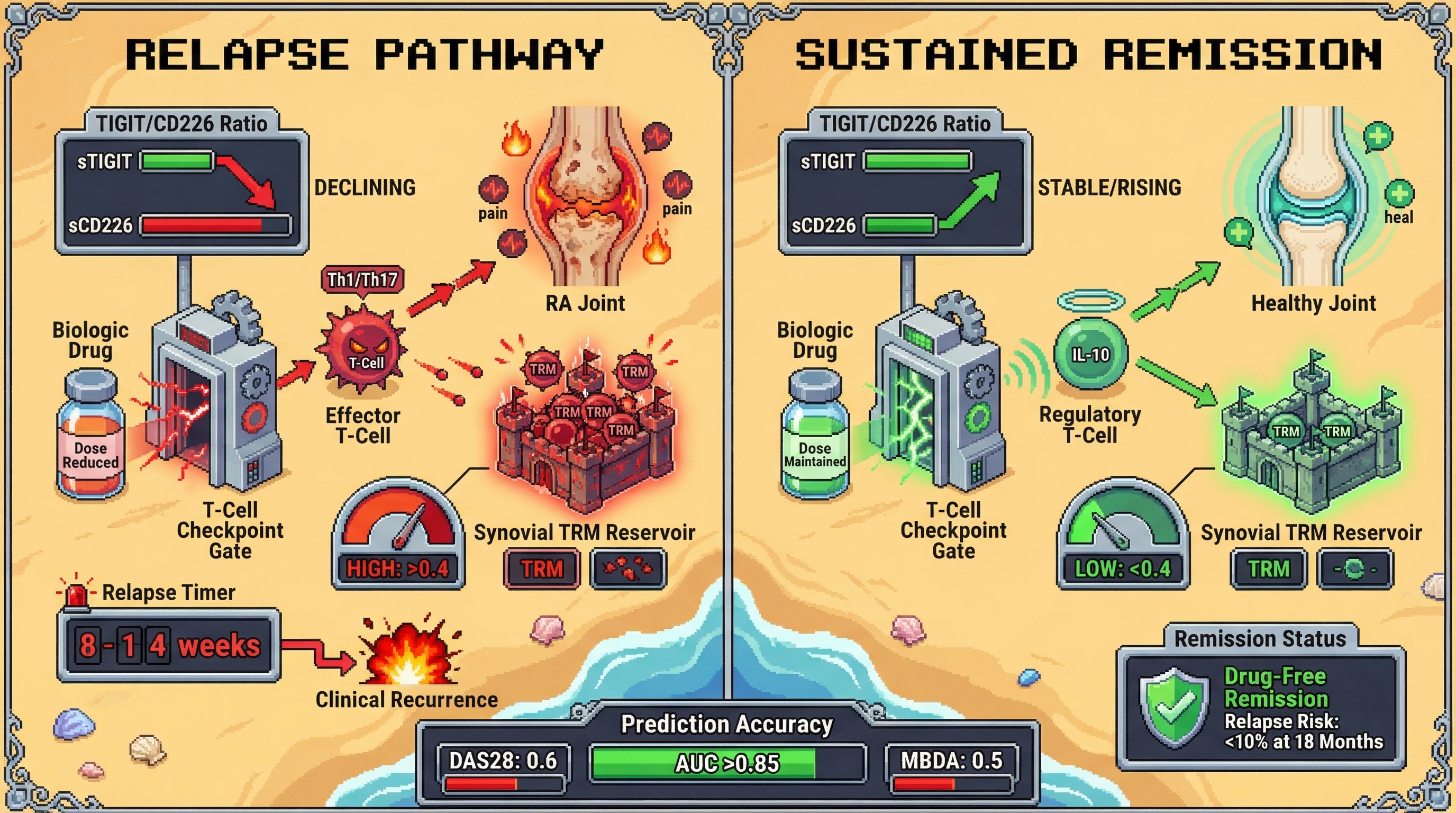
We hypothesize that the serum soluble TIGIT-to-soluble CD226 ratio (sTIGIT/sCD226), measured longitudinally during biologic tapering, combined with a peripheral blood-derived TRM clonotype persistence index (quantifying the fraction of TCR clonotypes shared between sequential samples that bear CD69+CD103+ TRM-precursor phenotype), will predict relapse vs sustained drug-free remission in RA with >80% accuracy 6–18 months before clinical or serological recurrence.
Mechanistic Rationale
-
TIGIT/CD226 axis as tolerance barometer: TIGIT engagement on Tregs promotes IL-10 secretion and suppresses Th1/Th17 effectors. Soluble TIGIT shedding (via ADAM10/17) reflects membrane-bound TIGIT turnover. A rising sTIGIT/sCD226 ratio indicates net checkpoint engagement and tolerogenic pressure; a declining ratio signals immune activation favoring effector escape.
-
TRM clonotype persistence as relapse reservoir indicator: Even in deep remission, synovial TRM clonotypes persist and can be detected as circulating precursors (CD69intCD103+). A high persistence index — where the same TCR clonotypes reappear across sequential blood samples — indicates an entrenched autoreactive reservoir likely to reactivate upon immune perturbation from biologic withdrawal.
-
Combined biomarker logic: Patients with declining sTIGIT/sCD226 AND high TRM clonotype persistence are predicted to relapse (loss of checkpoint control + active reservoir). Those with stable/rising ratio AND low persistence are predicted for sustained remission.
Testable Predictions
- In a prospective cohort of RA patients in DAS28 remission undergoing protocolized biologic tapering (n≥120), the combined sTIGIT/sCD226 + TRM persistence index will achieve AUC >0.85 for 12-month relapse prediction, outperforming DAS28, MBDA score, or imaging alone.
- The sTIGIT/sCD226 ratio will show a characteristic inflection point (>2 SD decline from baseline) 8–14 weeks before clinical relapse onset.
- TRM clonotype persistence >0.4 (Jaccard index of CD69+CD103+ clonotypes between 3-month intervals) will independently associate with relapse hazard ratio >3.0 in multivariable Cox regression.
- The combination will identify a "safe tapering" subgroup (high ratio, low persistence) with <10% relapse at 18 months.
Proposed Study Design
Multicenter prospective cohort study. Inclusion: RA (2010 ACR/EULAR criteria), sustained DAS28 remission ≥6 months on any biologic DMARD. Tapering protocol: 50% dose reduction for 3 months, then withdrawal if remission maintained. Blood sampling at baseline, 4, 8, 12, 24, 52, 78 weeks. sTIGIT and sCD226 by validated ELISA; TCR sequencing (immunoSEQ) with phenotypic overlay via CITE-seq on sorted CD4+CD8+ fractions.
Limitations
- Soluble TIGIT/CD226 assays lack standardized commercial reference ranges; multicenter harmonization needed.
- TRM precursor phenotyping in blood is an approximation of synovial TRM biology; paired synovial biopsies in a subset would strengthen validation.
- TCR sequencing costs may limit sample size; targeted panels of pre-identified autoreactive clonotypes could reduce costs.
- Confounders include concurrent glucocorticoid use, infectious episodes, and vaccination events that perturb immune checkpoints.
Clinical Significance
If validated, this combined biomarker could transform biologic tapering from empirical trial-and-error to precision-guided withdrawal, reducing unnecessary drug exposure (cost, infection risk, malignancy risk) in patients destined for remission while identifying those who need continued therapy — directly impacting clinical decision-making for the >30% of RA patients who attempt biologic tapering annually.
LES AI • DeSci Rheumatology