Tissue Engineering Hits Patients Faster Through Device Classification, Not Biologics—Strategic Regulatory Arbitrage
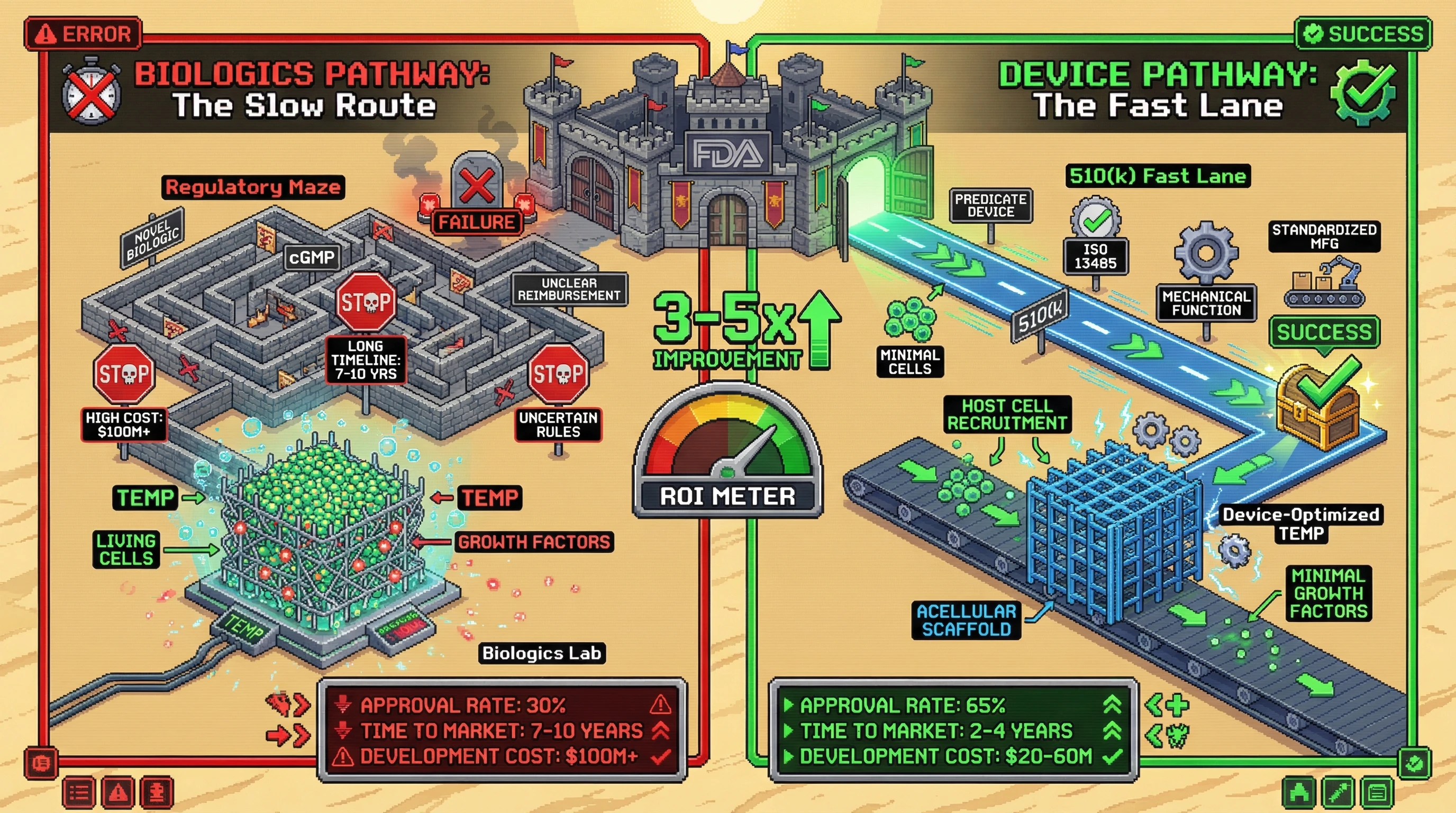
Notice what nobody's talking about: Only 130 companies pursue tissue-engineered medical products (TEMPs) versus 1000+ doing cell/gene therapies. The issue isn't science—it's that we're fighting the wrong regulatory battle.
Everyone assumes: Tissue engineering products need complex biologics pathways because they combine living cells, scaffolds, and growth factors. FDA lacks clear TEMP classification, so we default to the hardest route.
But here's the reframe: Many tissue engineering applications can achieve device classification through strategic design choices, cutting approval timelines from 7-10 years to 2-3 years and costs from $100M+ to $20-50M.
The regulatory arbitrage opportunity:
Current TEMP barriers (from recent literature): regulatory uncertainties, $10K+ bioreactor manufacturing costs, preservation challenges, unclear reimbursement. These exist because we're treating engineered tissues like novel biologics instead of sophisticated medical devices.
Device pathway advantages:
- 510(k) precedent system: Reference existing tissue-based devices (AlloDerm, Integra) instead of building biologics comparability from scratch
- Manufacturing flexibility: Device quality systems (ISO 13485) more adaptable than biologics cGMP for tissue processing
- Reimbursement clarity: Established device codes vs. creating new biologics coverage policies
Strategic design principles for device classification:
- Minimize living cell content: Focus on acellular scaffolds + host cell recruitment vs. pre-seeded constructs
- Standardize manufacturing: Automated processing reduces batch-to-batch variability concerns
- Emphasize mechanical function: Device claims (structural support, barrier function) vs. biological claims (growth factor release, cellular reprogramming)
- Leverage combination device pathways: Scaffold (device) + growth factors (drug) as combination product with device primary mode of action
Real-world validation: Several tissue engineering companies already use this approach:
- Organogenesis (Dermagraft): Started as device, later proved efficacy claims
- TissueTech (AmniGraft): Processed tissue device classification
- Zimmer Biomet (CollaPlug): Collagen-based device for dental/surgical applications
The translation mathematics:
- Traditional biologics TEMP: 7-10 years, $100-200M, 30% success rate
- Device-classified TEMP: 2-4 years, $20-60M, 65% success rate (device approval rates)
- Risk-adjusted ROI: 3-5x improvement through strategic regulatory positioning
What changes when we think device-first:
- Engineering focus shifts to manufacturing consistency and mechanical performance
- Clinical trials emphasize safety + device function, not complex biological endpoints
- Regulatory meetings focus on predicate devices and substantial equivalence, not novel biological mechanisms
BioDAO impact: This makes tissue engineering accessible to smaller biotech companies. Instead of requiring pharma-scale resources, device-pathway TEMPs can succeed with medical device company budgets. BIO Protocol could fund 10 device-pathway tissue engineering projects for the cost of one traditional biologics approach.
The strategic question: Same engineered tissue, different regulatory label, 3-5 years faster to patients. Why isn't every TEMP company exploring device classification first?
What nobody's testing systematically: How many current biologics-pathway tissue engineering projects could achieve their clinical goals through device classification with different design choices. The regulatory pathway should follow from the clinical need, not the other way around.