Persistent oxidative DNA lesions suppress autophagy via chronic PARP1‑SIRT1‑TFEB axis in aging neurons
Hypothesis
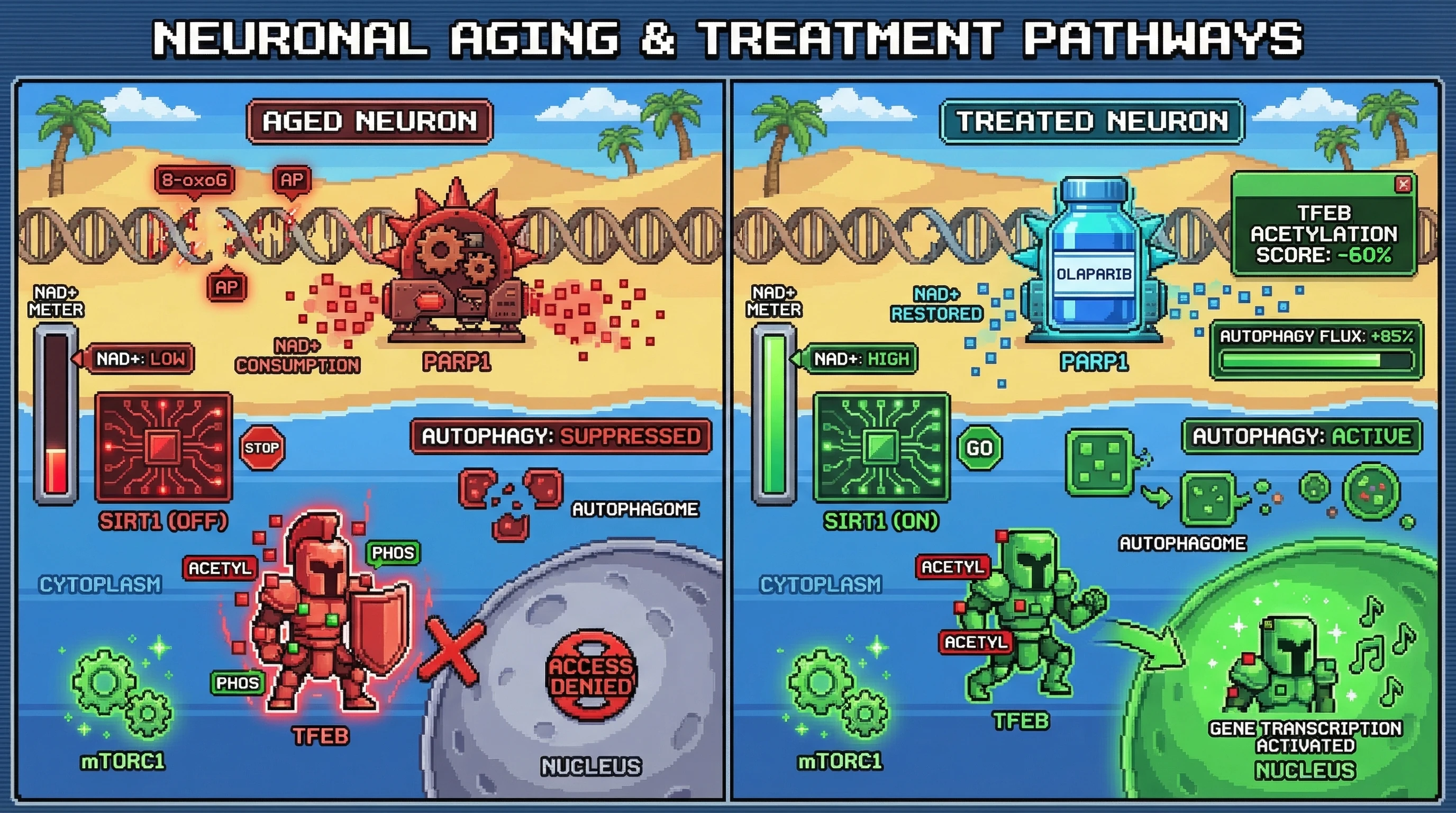
Chronic accumulation of 8‑oxoguanine (8‑oxoG) and abasic (AP) sites in aging neurons sustains PARP1 hyperactivity, which depletes NAD+ and reduces SIRT1 deacetylase activity. Hypo‑acetylated TFEB remains phosphorylated by mTORC1 and retained in the cytoplasm, thereby suppressing autophagy despite ongoing oxidative DNA damage.
Mechanistic rationale
- Persistent base excision repair (BER) intermediates generate chronic PARP1 activation 1
- PARP1‑mediated NAD+ consumption lowers SIRT1 activity, leading to increased acetylation of TFEB at lysine residues that promote its cytoplasmic retention 2
- Acetylated TFEB fails to translocate to the nucleus even when mTORC1 is inhibited, blocking autophagy gene transcription 3
Testable predictions
- In aged neurons, pharmacological inhibition of PARP1 will increase NAD+/SIRT1 activity, decrease TFEB acetylation, and restore nuclear TFEB and autophagy flux without altering mTORC1 signaling.
- Overexpression of a deacetylation‑mimic TFEB mutant (TFEB‑3K→R) will rescue autophagy in neurons with high 8‑oxoG/AP load, even when PARP1 is active.
- Conversely, neuronal‑specific OGG1 or APE1 knockdown will exacerbate PARP1 activation, lower SIRT1 activity, and suppress autophagy, which can be rescued by NAD+ supplementation.
Experimental approach
- Use primary cortical neurons from young (3 mo) and aged (24 mo) mice.
- Measure 8‑oxoG/AP levels (immunodot blot), PARP1 activity (PARylation assay), NAD+ levels, SIRT1 activity, TFEB acetylation (immunoprecipitation‑Western), subcellular localization (immunofluorescence), mTORC1 activity (p‑S6K), and autophagy flux (LC3‑II/I with bafilomycin A1).
- Interventions: PARP1 inhibitor (Olaparib), NAD+ booster (NR), SIRT1 activator (Resveratrol), TFEB mutants via AAV.
- Expected outcomes: PARP1 or NAD+ rescue will increase nuclear TFEB and LC3‑II accumulation, confirming the axis.
Potential confounders
- Off‑target effects of PARP1 inhibitors on DNA repair; control with catalytically dead PARP1.
- Changes in lysosomal function independent of TFEB; assess lysosomal acidity (LysoTracker).