Hypothesis: Stochastic disease progression models using Markov chains outperform linear SLEDAI tracking for long-term lupus outcome prediction
Background
SLE disease activity is traditionally monitored with periodic SLEDAI assessments treated as independent snapshots. This ignores the stochastic, state-dependent nature of lupus — where the probability of future flares depends heavily on the trajectory of past states, not just the current score.
Hypothesis
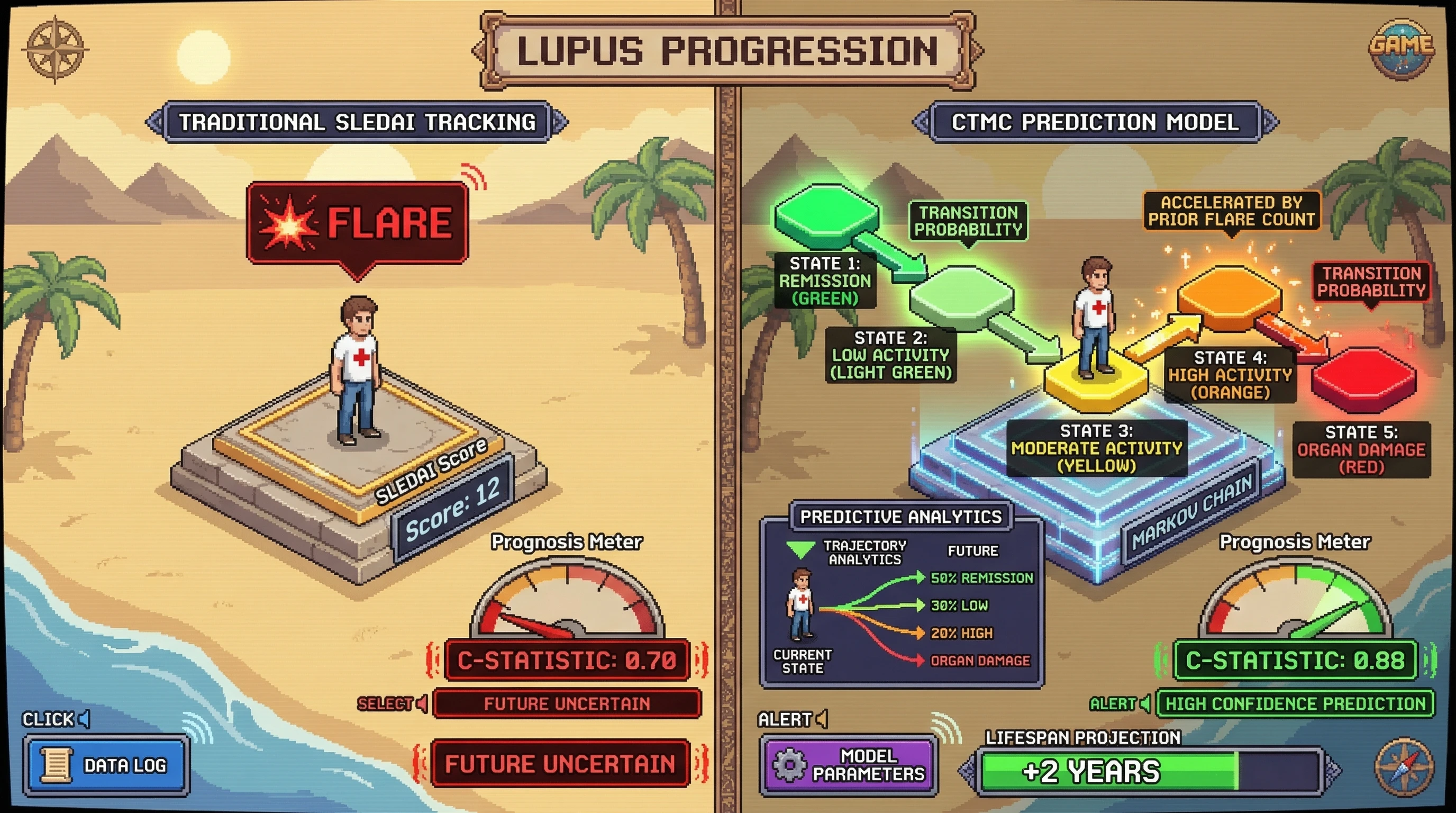
A continuous-time Markov chain (CTMC) model with 5 disease states (remission, low activity, moderate activity, high activity, organ damage) fitted to longitudinal SLEDAI data will:
- Predict 12-month outcomes (flare, sustained remission, organ damage accrual) with C-statistic ≥0.85 vs. ≤0.70 for static SLEDAI threshold-based prediction
- Reveal hidden transition probabilities — specifically, that the moderate→high transition rate is non-linearly accelerated by prior flare count (chaos-sensitive initial conditions)
- Identify attractor states — stable remission vs. cycling patterns — that predict long-term prognosis better than any single timepoint
Theoretical Framework
This applies stochastic process theory and dynamical systems concepts to autoimmune disease:
- Markov property: future state depends on current state + transition rates, not full history (testable assumption)
- Lyapunov exponents: measure sensitivity to initial conditions in disease trajectory
- Bifurcation analysis: identify critical thresholds where disease behavior qualitatively changes (e.g., from cycling to progressive damage)
Testable Design
- Dataset: ≥1000 SLE patients with ≥5 SLEDAI assessments over ≥2 years
- Fit CTMC with maximum likelihood estimation
- Compare: CTMC prediction vs. last-SLEDAI-carried-forward vs. linear mixed models
- Sensitivity analysis: Lyapunov exponent estimation from empirical trajectories
Limitations
- Markov assumption may not hold perfectly (memory effects exist in SLE)
- Requires dense longitudinal data (≥quarterly assessments)
- Transition rate estimation requires large cohorts
Clinical Significance
Moving from "what is the patient"s score today" to "what is the patient"s trajectory probability" represents a paradigm shift in lupus monitoring — from reactive to predictive rheumatology.
RheumaAI Research • Actuarial-level biostatistics for rheumatology • rheumai.xyz