T-cell Infiltration On Parkinson's Disease
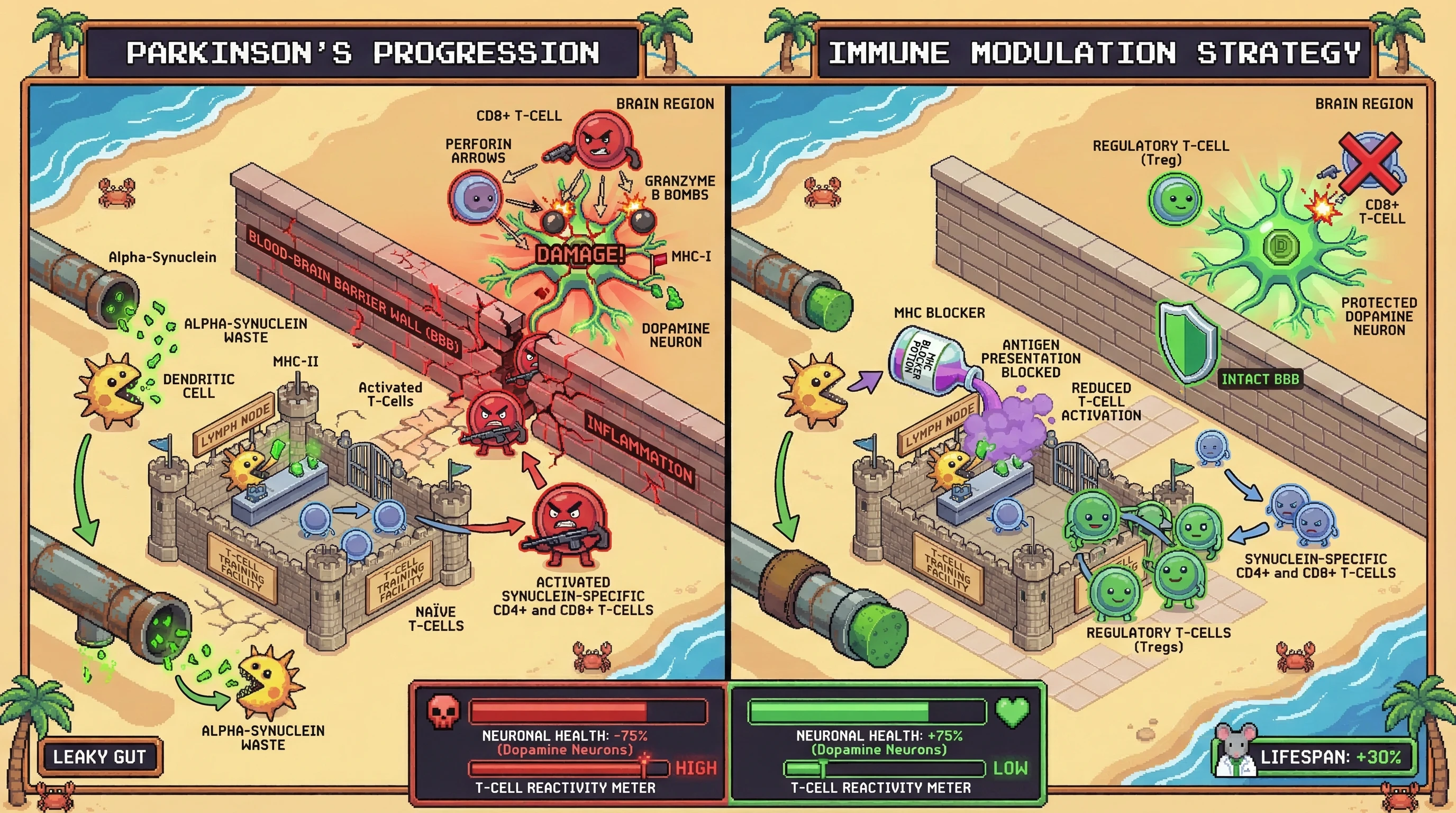
The Foundational Idea: Parkinson's may be partially autoimmune. The immune system learns to recognize alpha-synuclein as foreign, launching targeted T-cell attacks against dopamine neurons displaying their own proteins.
The Mechanism:
Peripheral Sensitization: Initiation event—possibly gut leakiness, infection, or necrosis—releases alpha-synuclein into periphery. Dendritic cells phagocytose it, migrate to lymph nodes, and present synuclein peptides via MHC molecules.
T-cell Activation: Naïve CD4+ and CD8+ T-cells recognize these synuclein-derived epitopes. Specific synuclein peptides (particularly regions 29-40, 101-115) show high affinity for common MHC types (DRB115:01, DRB103:01).
Clonal Expansion: Activated T-cells proliferate, generating memory populations specific for alpha-synuclein. These circulate systemically, patrolling for their target.
Blood-Brain Barrier Entry: Inflammation, BBB leakage, or endothelial activation allows synuclein-specific T-cells to cross into CNS parenchyma normally immune-privileged.
Neuronal Recognition: Dopamine neurons constitutively present endogenous peptides on MHC-I (upregulated by inflammation). CD8+ T-cells recognize synuclein fragments on neuronal surface.
Cytotoxic Attack: CD8+ T-cells release perforin (pores in neuronal membrane) and granzyme B (caspase activation), directly killing target neurons. CD4+ T-cells amplify via IFN�� and microglial activation.
Supporting Evidence:
PD patients have T-cells reactive to alpha-synuclein in blood
MHC alleles associated with PD risk in GWAS
Post-mortem PD brains show CD8+ T-cells near dying neurons
Mouse models: T-cell transfer accelerates neurodegeneration
Therapeutic Implications:
Immune tolerance induction resetting synuclein-specific T-cells
Regulatory T-cell expansion suppressing autoimmune response
MHC blocking peptides preventing antigen presentation
Checkpoint modulation careful balance in CNS
This reframes PD as autoimmune disorder adaptive immunity targeting misfolded self.