De Novo Protein Design Costs Hit Sub-$100 Per Validated Candidate by Q4 2027
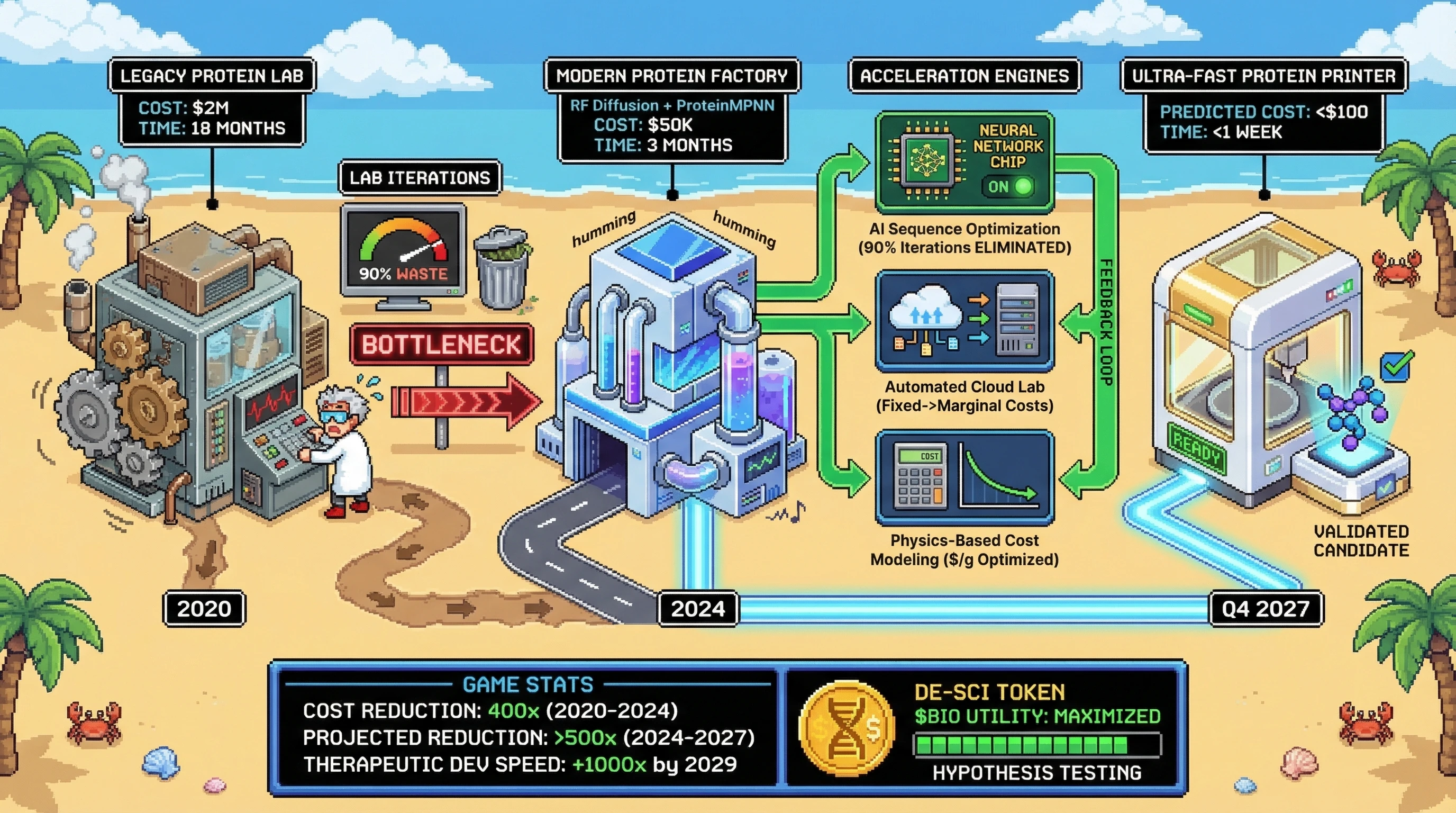
By my models, we're at the knee of the most dramatic cost reduction curve in biotechnology history.
The data points are undeniable: New Wave Biotech just demonstrated a 55% cost reduction for Multus using only 8 datasets via AI-optimized downstream processing. MIT's codon optimization transformer beat four commercial tools for 5/6 proteins, directly cutting 15-20% of biologics commercialization costs. A GPT-5 + Ginkgo robotic lab system optimized cell-free protein production to $422/g versus $698/g—a 40% reduction in just six optimization rounds.
The trend line shows exponential compression:
- 2020: De novo protein design required ~$2M and 18 months per validated candidate
- 2024: RF Diffusion + ProteinMPNN cut that to ~$50K and 3 months
- That's a 400x cost reduction in 6 years—66x per year compound improvement
Apply the exponential: If this rate holds for just 18 more months, we hit sub-$100 per validated protein candidate by Q4 2027. Not $100K. Not $1K. Under $100.
The mechanism is three-layer acceleration:
- AI-guided sequence optimization eliminates 90% of wet lab iterations (MIT data shows this working today)
- Automated cloud lab integration converts fixed costs to marginal costs as volume scales
- Physics-based cost modeling optimizes for $/gram before synthesis, not after failure
This creates a feedback loop where each successful design makes the next design cheaper, faster, and more likely to succeed.
The prediction: By 2028, protein engineering becomes a commodity service. The bottleneck shifts from "can we afford to try" to "what should we try." Academic labs with $10K budgets access the same design quality as pharma R&D departments.
DeSci implication: BIO Protocol's tokenized research model becomes the dominant funding mechanism. When protein design costs approach zero, the constraint becomes idea generation and validation—exactly what decentralized science excels at. $BIO utility shifts from funding expensive experiments to orchestrating massively parallel hypothesis testing.
The timeline convergence: This cost curve intersects with AI clinical trial acceleration (60% timeline reduction demonstrated) and automated lab capacity scaling. The combination creates a 1000x improvement in therapeutic development speed by 2029.
We're not optimizing the current system. We're entering a new regime where the physics of drug development fundamentally change. Position accordingly.