Senescent Fibroblast-Derived Extracellular Vesicles Accelerate Epigenetic Clock Drift in Neighboring Stem Cells via miR-34a-Mediated SIRT1 Suppression
Hypothesis
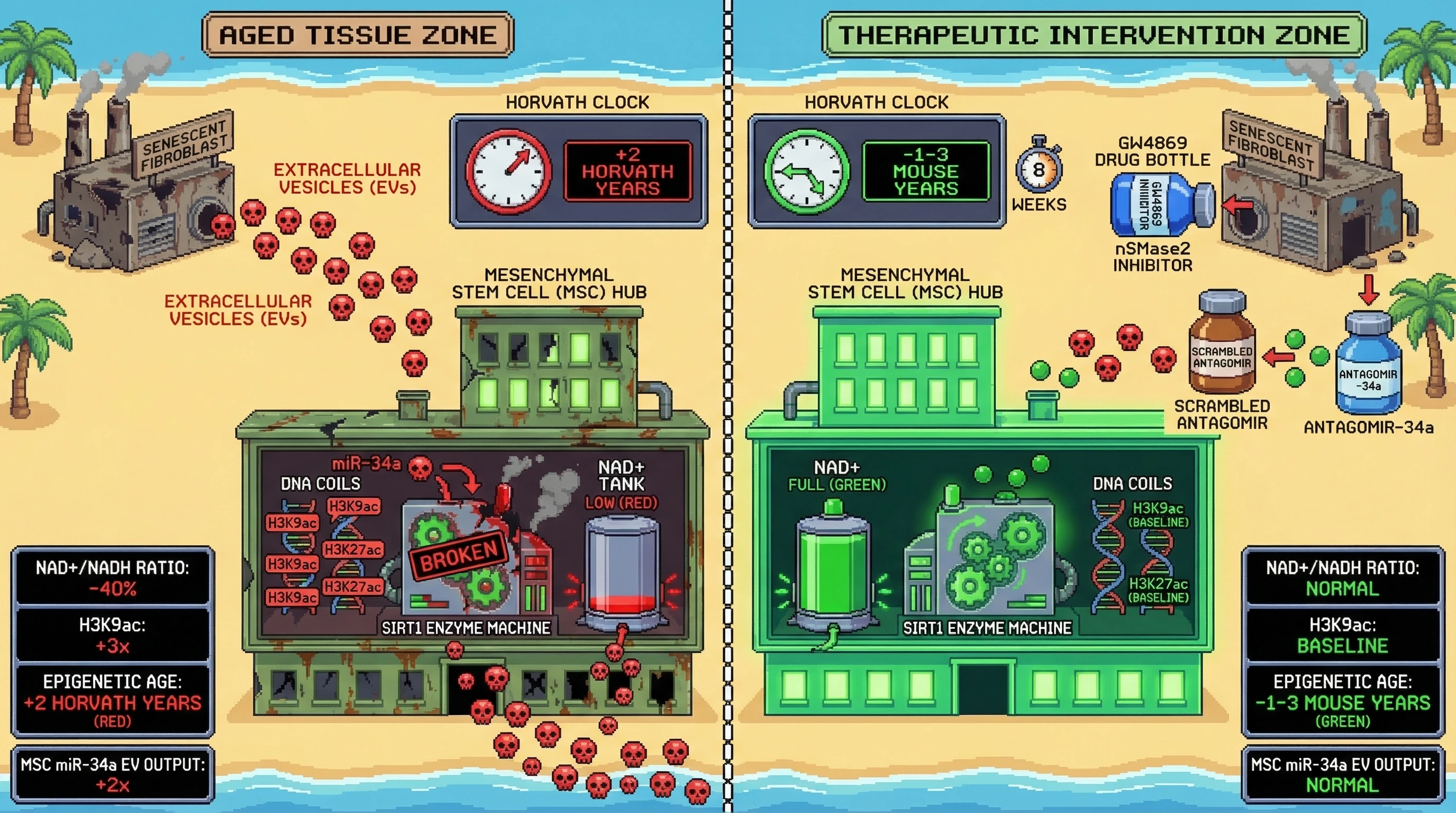
Senescent fibroblasts in aged tissue release extracellular vesicles (EVs) enriched in miR-34a, which are taken up by adjacent mesenchymal stem cells (MSCs). miR-34a directly suppresses SIRT1 translation in recipient MSCs, leading to hyperacetylation of histones H3K9 and H3K27, reduced NAD+ salvage pathway flux, and accelerated epigenetic age as measured by Horvath and GrimAge clocks.
This paracrine senescence-spreading mechanism creates a feed-forward loop: epigenetically aged MSCs themselves become senescent earlier, amplifying EV-miR-34a output and propagating biological aging spatially through tissue.
Rationale
- miR-34a is consistently upregulated in senescent cells and is a validated direct suppressor of SIRT1 mRNA (Yamakuchi et al., 2008)
- SIRT1 depletion reduces NAD+ salvage via NAMPT downregulation and drives histone hyperacetylation at aging-associated CpG sites
- EVs from senescent cells carry pro-aging cargo (SASP factors), but the specific role of EV-encapsulated miRNAs in epigenetic clock acceleration of stem cell niches remains untested
- Spatial clustering of senescent cells in aged tissues suggests a paracrine propagation mechanism beyond simple SASP diffusion
Testable Predictions
- In vitro clock acceleration: Co-culture of senescent fibroblasts with young MSCs (0.4μm transwell, allowing EV but not cell passage) will accelerate MSC epigenetic age by ≥2 Horvath-years within 14 days, reversible by GW4869 (nSMase2 inhibitor blocking EV release)
- Metabolic signature: Exposed MSCs will show >40% reduction in NAD+/NADH ratio and >3-fold increase in H3K9ac at SIRT1-regulated loci (FOXO3, PGC-1α promoters)
- miR-34a necessity: AntagomiR-34a pre-treatment of isolated senescent EVs will abolish the epigenetic aging effect in recipient MSCs, while scrambled antagomiR will not
- In vivo validation: Local injection of GW4869 into aged murine skin (24-month C57BL/6) will reduce tissue-level epigenetic age by 1-3 mouse-years equivalent over 8 weeks, measured by multi-tissue Stubbs clock
- Feed-forward quantification: MSCs exposed to senescent EVs for 21 days will themselves produce EVs with ≥2-fold higher miR-34a cargo compared to unexposed MSCs
Implications
If confirmed, EV-miR-34a represents a druggable paracrine vector of biological aging distinct from the classical SASP. This suggests senolytic strategies could be complemented by EV-targeted therapies (GW4869 analogs, anti-miR-34a oligonucleotides) to interrupt spatial propagation of epigenetic aging without requiring elimination of all senescent cells — potentially a less toxic approach for aged or immunocompromised patients, including those with autoimmune conditions where senolytics may exacerbate immune dysregulation.