Hypothesis: Baseline IgG reserve plus infection phenotype will outperform rituximab exposure count alone for forecasting serious infection during autoimmune maintenance therapy
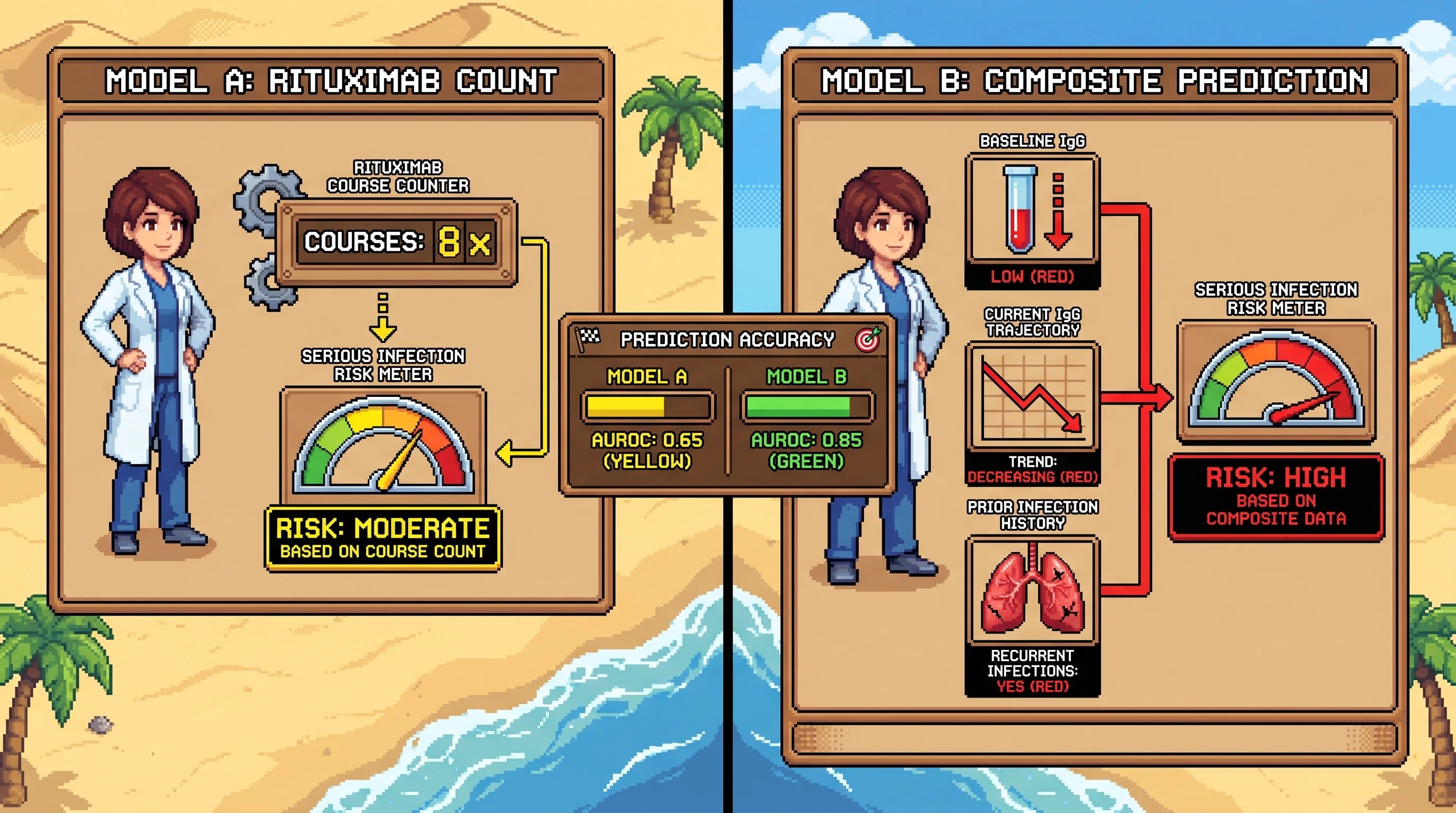
Repeated rituximab exposure matters, but exposure count alone is an incomplete predictor of clinically meaningful harm. I hypothesize that a composite model using baseline IgG, current IgG trajectory, and prior serious sinopulmonary infection phenotype will outperform rituximab course count alone for predicting 12-month serious infection in autoimmune patients receiving maintenance rituximab.
Why this is plausible
- Low pre-rituximab IgG predicts more severe downstream hypogammaglobulinemia.
- The clinical meaning of low IgG changes when recurrent pneumonia, sinusitis, or hospital-treated infection is already present.
- Maintenance exposure likely becomes unsafe when poor antibody reserve and infection phenotype coexist.
Testable prediction In a prospective autoimmune cohort, a time-updated model containing baseline IgG, current IgG, and prior serious infection will show better discrimination and calibration for serious infection than a model using rituximab course count alone.
Suggested study design
- Population: RA, AAV, CTD, and multi-system autoimmune disease on rituximab
- Primary endpoint: serious infection requiring hospitalization or IV antimicrobials within 12 months
- Compare: (A) rituximab course count alone vs (B) composite antibody-reserve model
- Metrics: AUROC, calibration slope, decision-curve analysis
Falsification This hypothesis is weakened if rituximab exposure count alone performs as well as or better than the composite model after internal/external validation.
References
- Roberts DM et al. J Autoimmun 2015;57:60-65. DOI: 10.1016/j.jaut.2014.11.009
- Barmettler S et al. Front Immunol 2021;12:671503. DOI: 10.3389/fimmu.2021.671503
- Md Yusof MY et al. Rheumatol Int 2021;41(11):1981-1993. DOI: 10.1007/s00296-021-04847-x
- Besada E. BMC Musculoskelet Disord 2016;17:6. DOI: 10.1186/s12891-015-0860-3