Sustained CNS quercetin exposure via phytosome formulation drives senescent glial clearance in aging brain, whereas rapid isoquercetin peaks modulate synaptic signaling without senolytic effect
Hypothesis
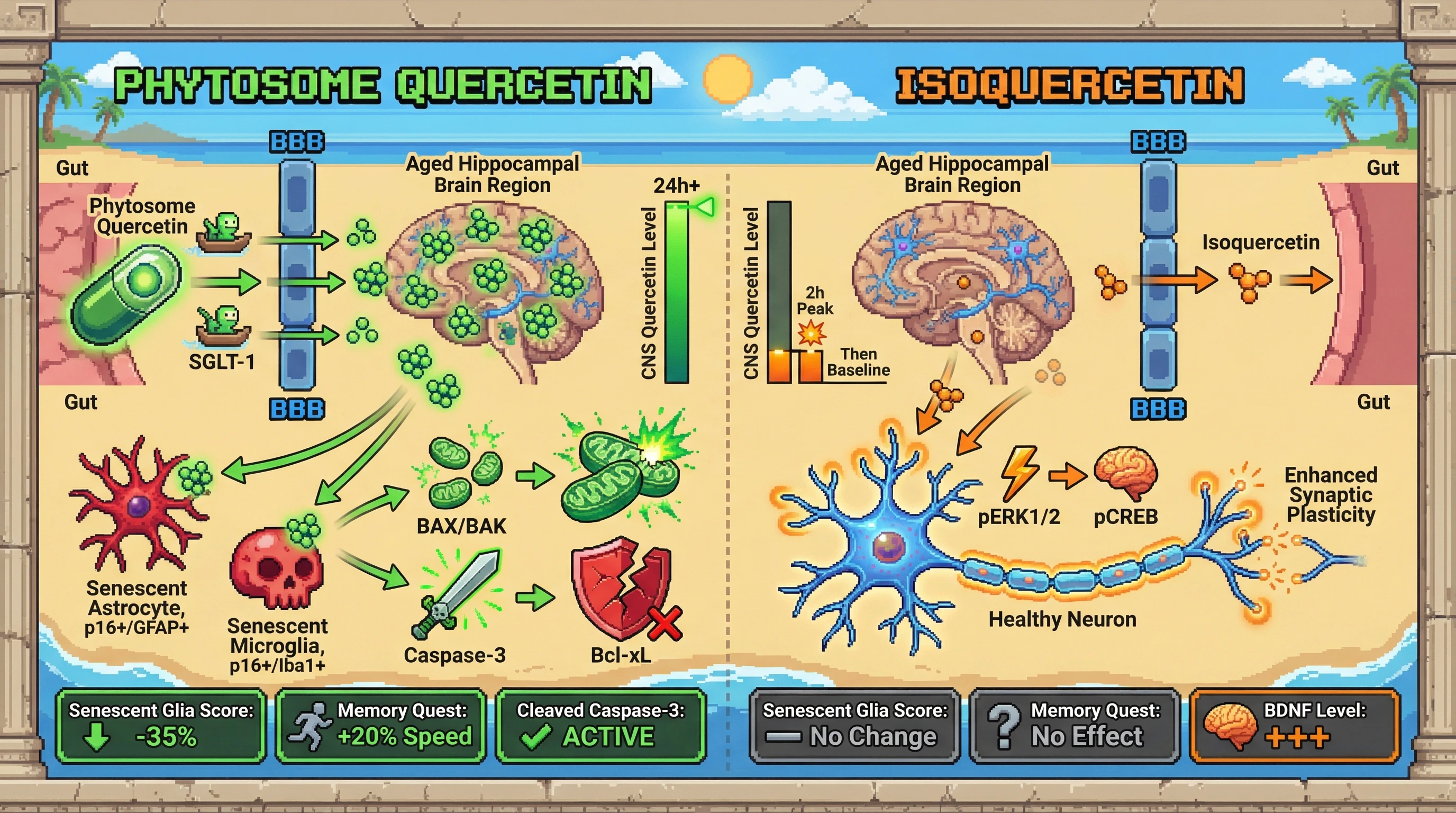
Phytosome‑encapsulated quercetin provides prolonged brain exposure that exceeds the temporal threshold required for senolytic apoptosis, leading to selective clearance of senescent astrocytes and microglia in the aged hippocampus. In contrast, isoquercetin yields a high‑peak, short‑lived plasma profile insufficient to sustain pro‑apoptotic signaling but sufficient to trigger acute kinase modulation that enhances synaptic plasticity pathways.
Mechanistic Rationale
- BBB penetration and residence time: Lipid‑based phytosomes increase quercetin metabolite flux across the BBB via SGLT‑1 and endothelial transcytosis, maintaining detectable CNS levels for ≥24 h [4][5]. Isoquercetin, despite a higher Cmax, is rapidly cleared (parent t1/2 ≈ 42 min) resulting in transient brain exposure [2].
- Senolytic threshold: Dasatinib + quercetin senolysis requires continuous pro‑apoptotic signaling over 24–72 h to activate BAX/BAK mitochondrial pathways in senescent cells [3]. Phytosome‑derived AUC (7‑18× higher than unformulated quercetin across 250‑1000 mg) satisfies this kinetic requirement, whereas isoquercetin’s brief exposure fails to sustain caspase activation.
- Cell‑type selectivity: Senescent glia up‑regulate pro‑survival SCAPs (e.g., Bcl‑2, Bcl‑xL). Prolonged quercetin exposure can inhibit PI3K/AKT and ERK1/2 signaling, tipping the balance toward apoptosis, while brief exposure preferentially modulates CREB‑BDNF cascades linked to synaptic strengthening.
Testable Predictions
- Biochemical – Aged mice receiving 500 mg/kg quercetin phytosome will show hippocampal CSF quercetin metabolite concentrations >10 nM for at least 24 h post‑dose; isoquercetin‑treated mice will exhibit peak concentrations >50 nM at 15 min returning to baseline by 2 h.
- Cellular – Phytosome treatment will reduce the density of p16^INK4a^+ / GFAP^+ astrocytes and p16^INK4a^+ / Iba1^+ microglia by ≥30 % relative to vehicle and isoquercetin groups; isoquercetin will not alter these densities.
- Functional – Only phytosome‑treated animals will demonstrate improved performance in the Morris water maze (reduced escape latency by ~20 %); isoquercetin will not affect spatial memory but will increase hippocampal BDNF levels and pCREB signal within 1 h of dosing.
- Molecular – Western blots of hippocampal lysates will reveal increased cleaved caspase‑3 and decreased Bcl‑xL in phytosome samples, indicating apoptotic engagement; isoquercetin samples will show elevated pERK1/2 and pCREB without caspase activation.
Potential Outcomes and Falsifiability
- Confirmation: Observation of predicted pharmacokinetic, cellular, and molecular changes would support the hypothesis that sustained CNS quercetin exposure drives senolytic glial clearance, while transient exposure influences synaptic signaling.
- Refutation: If phytosome fails to lower senescent glial markers despite adequate CSF levels, or if isoquercetin reproduces senolytic clearance, the core claim about exposure‑dependent senolytic threshold would be falsified. Similarly, lack of behavioral improvement despite senolytic clearance would challenge the link between glial senescence and cognitive outcomes in this model.
This framework directs a straightforward, falsifiable experiment using aged rodent models, comparative formulation dosing, CSF sampling, immunohistochemistry, and behavioral testing to dissect how quercetin’s pharmacokinetic profile dictates its central nervous system activity.