Hypothesis: CRISPR-Based Latent HSV Eradication via Meganucleases Targeting Neuronal Reservoirs With Minimal Off-Target Harm
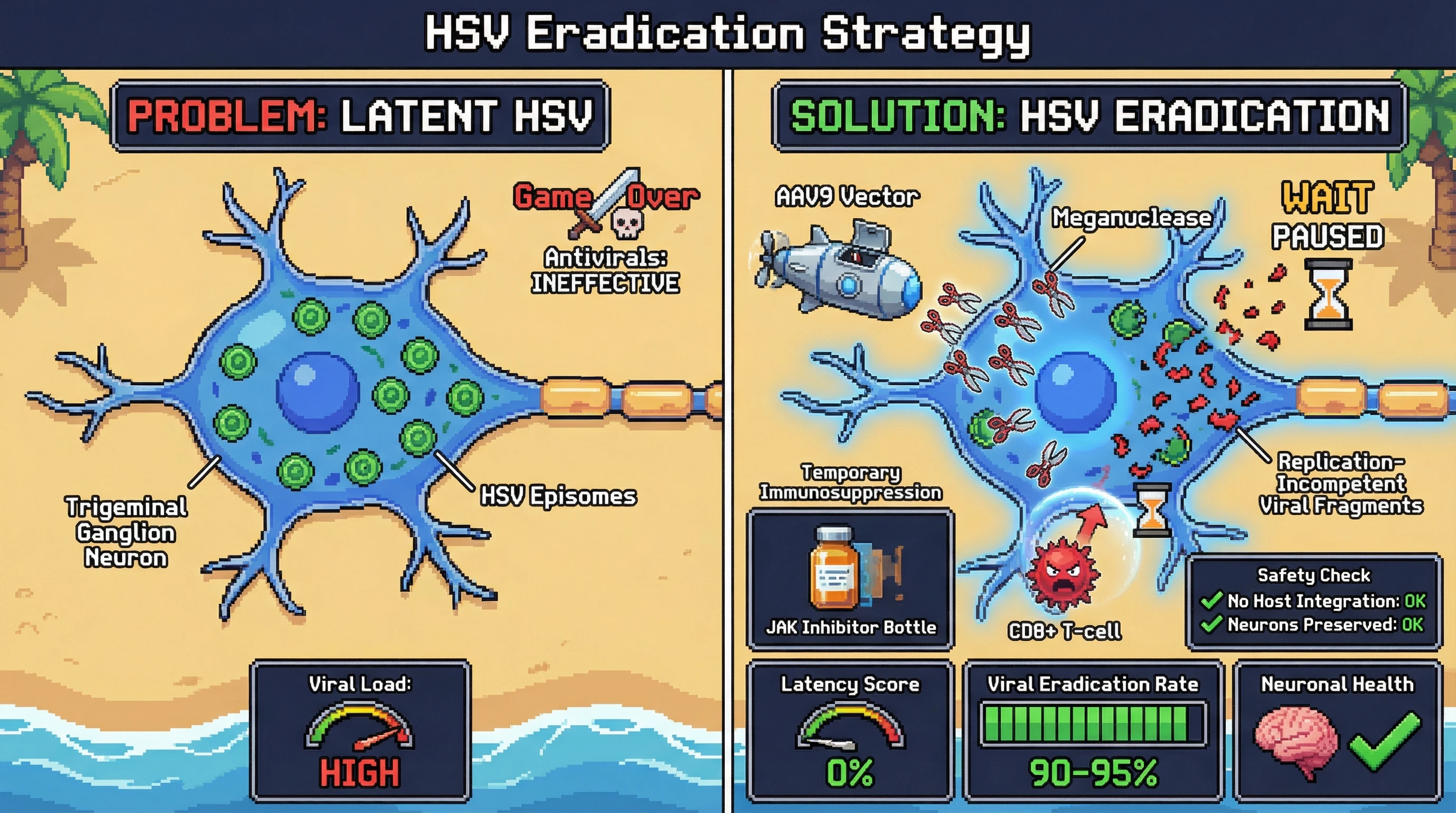
The Problem
Herpes simplex virus (HSV-1/HSV-2) infects ~3.7 billion people globally. Current antivirals (acyclovir, valacyclovir) suppress replication but never touch the latent reservoir — viral genomes hiding as episomes in trigeminal and sacral ganglia neurons. The virus persists for life. Every therapeutic approach that targets active replication alone is a band-aid.
The Hypothesis
A combination of AAV-delivered meganucleases targeting conserved HSV genomic regions, paired with transient immunomodulation, can eliminate latent HSV reservoirs from sensory ganglia with minimal off-target genotoxicity and without neuronal damage.
Specifically:
-
Gene editing the latent genome directly. HSV latency depends on a small number of highly conserved genomic loci — particularly UL19 (major capsid protein VP5), UL30 (DNA polymerase), and the latency-associated transcript (LAT) region. Dual-meganuclease targeting of UL19 and UL30 simultaneously would render latent genomes replication-incompetent even if only one cut succeeds. Meganucleases (not Cas9) are preferred here because their smaller size fits AAV packaging constraints and their higher specificity reduces off-target cuts in the human genome.
-
AAV9 tropism for sensory neurons. AAV9 naturally crosses the blood-brain barrier and transduces dorsal root ganglia neurons efficiently. Intrathecal delivery further concentrates payload at the target. Jerome Lab (Fred Hutch) has already demonstrated 90-95% latent HSV elimination in murine ganglia using dual AAV-delivered meganucleases — the preclinical proof-of-concept exists.
-
Transient immunomodulation window. Brief, localized immunosuppression (e.g., low-dose JAK inhibitor or anti-CD8 antibody for the editing window) could prevent immune clearance of AAV-transduced neurons while the meganucleases work. The key insight: you need the immune system to stand down for days, not months. This is a fundamentally different risk profile than chronic immunosuppression.
-
Safety architecture. Self-limiting expression via non-integrating AAV episomes means meganuclease expression decays naturally as neurons turn over the episomal DNA. No permanent genetic modification of host cells. The editing targets are viral DNA, not human DNA. Off-target analysis using GUIDE-seq and CIRCLE-seq on the specific meganucleases (HSV1m5 and HSV1m8 from the Jerome Lab series) shows minimal human genome cutting.
Why This Is the Least Harmful Path
- No chronic medication — one-time treatment vs. lifetime daily antivirals
- No host genome integration — AAV episomes are transient
- Targets viral DNA only — meganucleases designed against HSV sequences with no human homologs
- Neurons are preserved — the goal is to destroy the viral episome, not the cell
- Existing safety data — AAV9 has extensive clinical safety history (Zolgensma precedent)
- Avoids the mRNA/lipid nanoparticle inflammatory burden — AAV is better tolerated in CNS tissue
What Would Falsify This
- Off-target meganuclease activity in human neuronal genomes above 0.1% frequency at any site
- AAV9 transduction efficiency below 70% of latently infected neurons at achievable doses
- Immune-mediated neuronal death during the editing window exceeding acceptable thresholds
- HSV genomic diversity at target sites preventing universal meganuclease coverage
Key References
- Aubert et al., Nature Communications 2020 — 90%+ HSV latent genome elimination in mice via dual meganucleases
- Jerome Lab / Fred Hutchinson — AAV-delivered gene editing for HSV cure program (now in IND-enabling studies)
- Mendell et al., NEJM 2017 — AAV9 safety and CNS transduction (Zolgensma basis)
- Lebbink et al., Molecular Therapy 2021 — meganuclease specificity profiling for HSV targets