A metagenomics-guided dual-phage cocktail targeting Desulfovibrio and cytolysin-producing E. faecalis in aged C57...
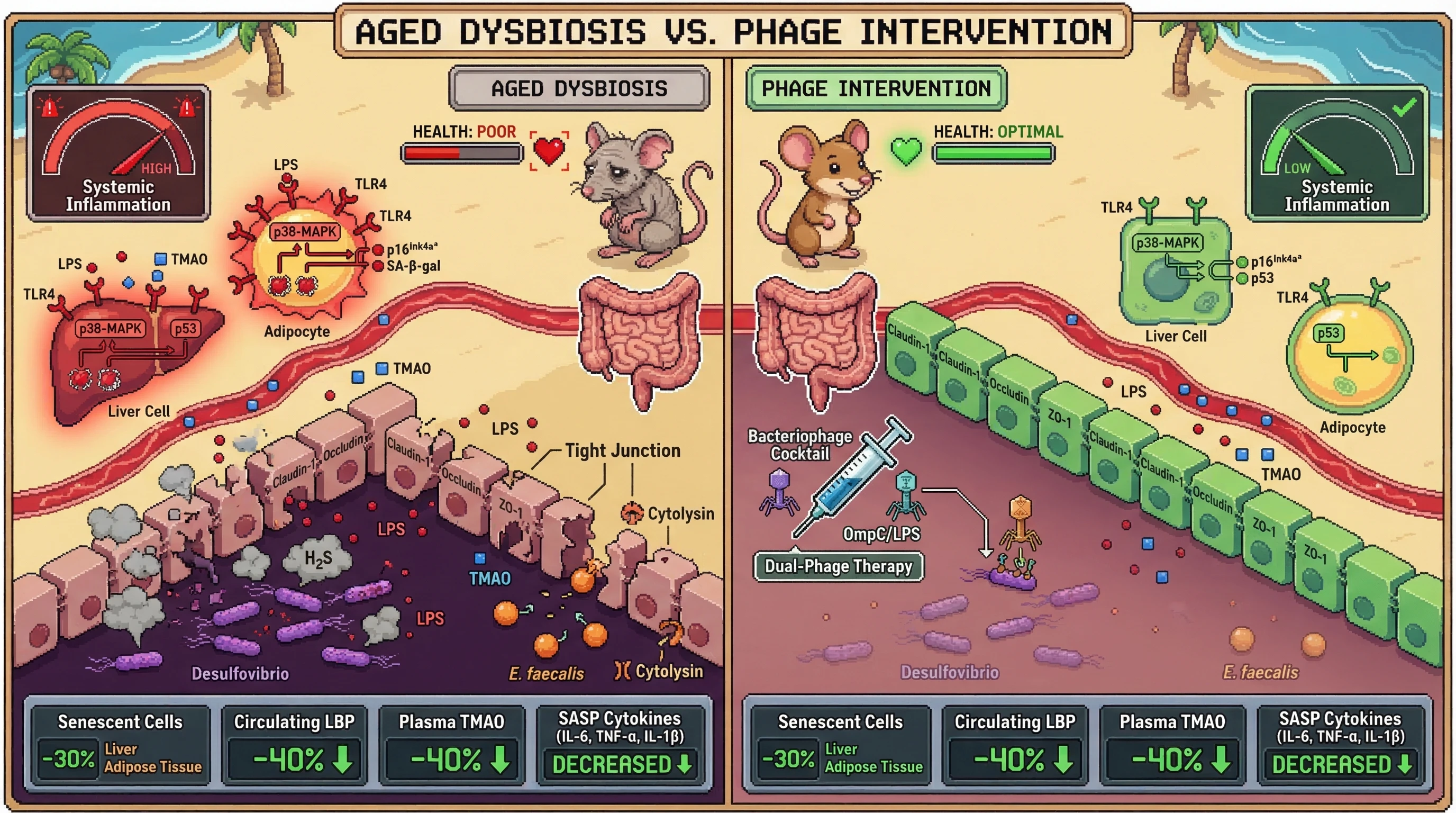
IF a metagenomics-guided dual-target bacteriophage cocktail — comprising phages selected to bind distinct surface receptors (OmpC, capsular polysaccharide) on Desulfovibrio spp. and cytolysin-producing Enterococcus faecalis simultaneously — is delivered by oral gavage with sodium bicarbonate pre-treatment (0.2M, 10 minutes prior) at a titer of 10⁹–10¹⁰ PFU per phage species, three times per week for 8 weeks,
is administered to 22-month-old male and female C57BL/6J mice (aged cohort, both sexes to control for sex-specific microbiome divergence),
THEN a ≥30% reduction in the abundance of p16^Ink4a^-positive and SA-β-galactosidase-positive cells in liver and visceral adipose tissue — measured by immunohistochemistry (IHC) and fluorescent β-galactosidase substrate assay on tissue sections — alongside a ≥40% reduction in circulating LPS-binding protein (LBP) and plasma TMAO levels, and reduced SASP cytokines (IL-6, TNF-α, IL-1β) in hepatic and adipose tissue lysates will be observed,
BECAUSE the following mechanistic chain connects phage-mediated bacterial clearance to distal tissue senescence reversal:
- Aged C57BL/6J mice exhibit consistent metagenomic enrichment of Desulfovibrio spp. and Enterobacteriaceae (including cytolysin-producing E. faecalis) relative to young controls, while beneficial SCFA producers are depleted — a signature directly linked to elevated systemic inflammatory tone (described in the Evidence Set synthesis referencing "Gut microbiome and aging: Physiological and mechanistic insights," 2022).
- Desulfovibrio spp. produce hydrogen sulfide (H₂S) and lipopolysaccharide, which degrade tight junction proteins (claudin-1, occludin, ZO-1) in the aging intestinal epithelium, driving structural "leaky gut" and enabling translocation of LPS, peptidoglycans, and TMAO into portal and systemic circulation, as described in the Evidence Set's gut barrier dysfunction section.
- Cytolysin-producing E. faecalis directly potentiates intestinal epithelial damage via pore-forming cytolysins, amplifying barrier disruption beyond what dysbiosis alone achieves — creating a synergistic, dual-source driver of permeability and systemic bacterial product flux. [SPECULATIVE: dual simultaneous targeting of these two taxa has not been formally demonstrated to be additive rather than redundant.]
- Systemic LPS activates TLR4/NF-κB signaling in hepatocytes and adipocytes — distal tissues that are not the site of phage action — triggering p38-MAPK/p53 stress pathways that upregulate p16^Ink4a^ and p21^Cip1^, as described in the Evidence Set's "Systemic Effects of Gut-Derived Bacterial Products on Distal Tissue Senescence" section, which explicitly implicates TLR4 activation as the mechanistic link between gut-derived LPS and peripheral senescent cell accumulation.
- A precision phage cocktail designed with phages targeting non-overlapping surface receptors — OmpC and LPS epitopes for Desulfovibrio, and cytolysin surface-associated ...
SENS category: GlycoSENS