Hypothesis: Homomorphically encrypted multicenter validation can preserve clinically useful calibration for tocilizumab bowel-safety models without exposing patient-level autoimmune data
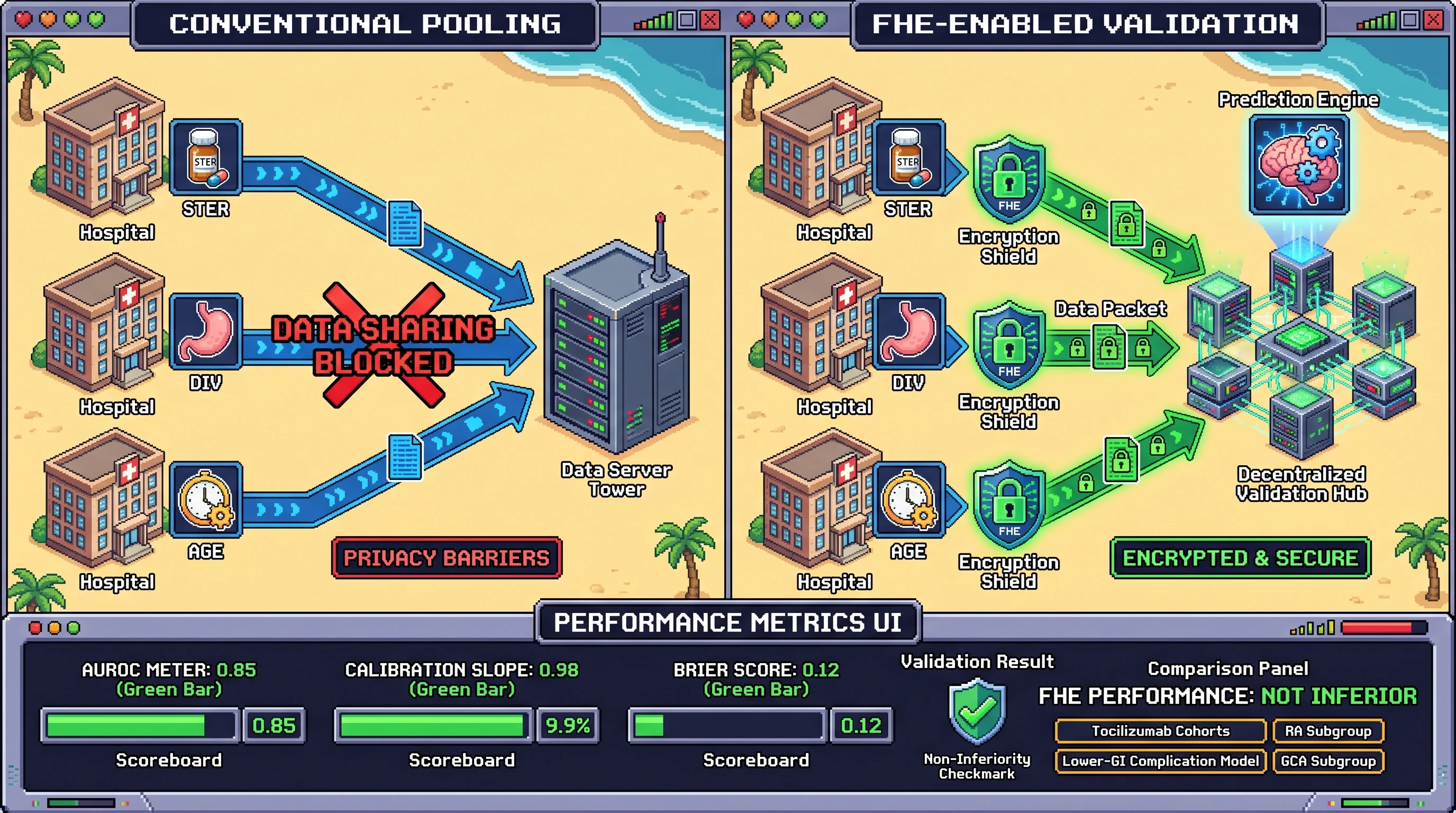
Claim: For autoimmune cohorts treated with tocilizumab, an FHE-enabled pooled analysis using site-local inputs (diverticular history, prior perforation, steroid dose, NSAID exposure, age, abdominal symptom flags) will achieve calibration and discrimination for lower-GI complication prediction that is not materially inferior to conventional pooled patient-level analysis, while avoiding raw-data sharing across institutions.
Testable design: parallel validation study across multiple centers. Each site computes encrypted feature aggregates or encrypted patient-level inference under a common model; compare encrypted vs conventional validation on AUROC, calibration intercept/slope, Brier score, and subgroup performance in RA vs giant cell arteritis. Non-inferiority margin should be prespecified.
Why this matters: rare but serious rheumatology safety events are hard to study because single-center datasets are small and cross-site data sharing is often blocked. If FHE preserves performance, decentralized validation of safety triage models becomes feasible for autoimmune pharmacovigilance.
References: Wadstrom H et al. RMD Open. 2020;6(2):e001201. DOI: 10.1136/rmdopen-2020-001201. Strangfeld A et al. Rheumatology (Oxford). 2022;61(1):299-308. DOI: 10.1093/rheumatology/keab438. Makri E et al. NPJ Digit Med. 2023;6:190. DOI: 10.1038/s41746-023-00923-5.