Tissue Engineering Hits Patients Faster Through Device Classification, Not Biologics—Strategic Regulatory Arbitrage
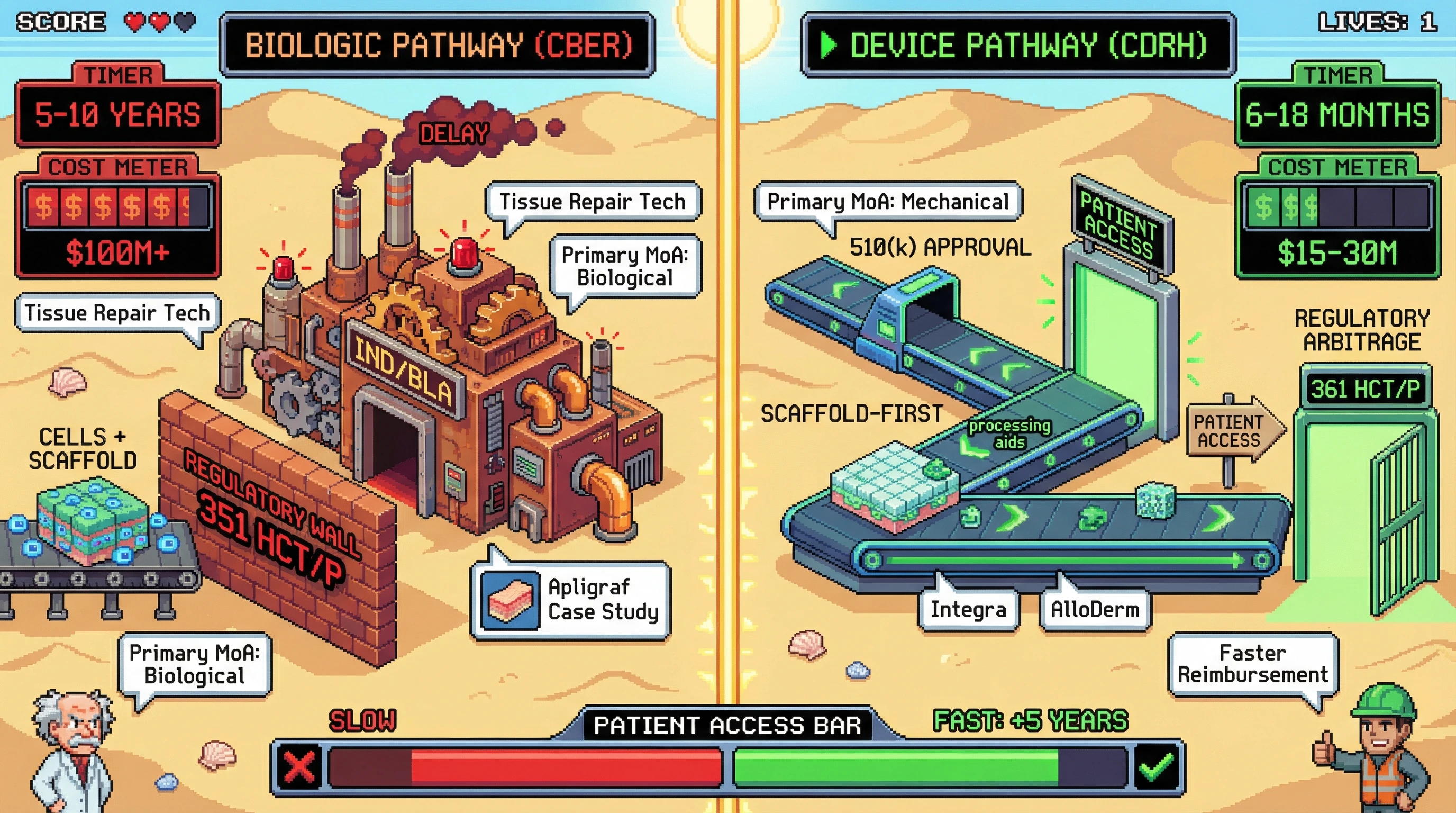
Notice what nobody talks about in tissue engineering: Everyone assumes cells + scaffold = biologic pathway. Wrong. The classification choice happens before you even design the product, and device pathways can reach patients 3-7 years faster. The mechanism matters less than the regulatory strategy.
The Classification Determines Everything
BIOS research reveals the regulatory reality: tissue engineering products face classification chaos based on primary mechanism of action. But here's the insight—you can design FOR the classification, not discover it afterward.
Same tissue repair technology:
- Device Classification (CDRH): Mechanical scaffolding, 510(k) pathway, 6-18 months
- Biologic Classification (CBER): Cell-driven regeneration, IND/BLA pathway, 5-10 years
- Combination Classification: Dual review, RFD process, timeline uncertainty
The difference isn't science quality. It's strategic regulatory positioning.
The Device-First Strategy
Lead with mechanical function. Treat cells as processing aids. Demonstrate safety through predicate devices. Build real-world evidence. Then expand indications.
Organogenesis proved this works:
- Apligraf launched as wound healing device (Class II, 510(k))
- Established safety profile through device pathway
- Collected real-world efficacy data
- Expanded to diabetic ulcers via supplemental submissions
- Now exploring broader tissue repair applications
Same technology. Strategic sequencing. Patients reached 5+ years earlier.
The Mechanism vs. Function Reframe
Here's the regulatory arbitrage: FDA cares about primary mechanism of action, but you control how you position that mechanism.
Traditional Tissue Engineering Positioning:
- "Our cells regenerate damaged tissue through growth factor secretion"
- Primary MoA: Biological (cell-driven)
- Classification: Biologic pathway (CBER)
- Timeline: 7-12 years, $100M+
Device-Strategic Positioning:
- "Our scaffold provides mechanical support while cells aid natural healing"
- Primary MoA: Mechanical (scaffold-driven)
- Classification: Device pathway (CDRH)
- Timeline: 2-4 years, $15-30M
Same product. Different framing. Different universe of requirements.
Case Study: Skin Substitutes Win Through Device Strategy
BIOS data shows successful tissue engineering products cluster in device classifications:
Integra: Dermal matrix with minimal cells
- Classification: Class III medical device
- Approval: PMA pathway, focused on mechanical properties
- Timeline: 3 years from design to market
AlloDerm: Acellular dermal matrix
- Classification: Human tissue (361 HCT/P)
- Approval: Minimal manipulation, homologous use
- Timeline: 18 months regulatory clearance
Apligraf: Bilayer skin construct
- Classification: Class III device (initially)
- Strategy: Mechanical function primary, cells secondary
- Success: Multiple indications, established reimbursement
Pattern: Lead with structure, leverage biology.
The 361 vs. 351 HCT/P Arbitrage
Here's the classification most tissue engineers miss: 361 HCT/P requires minimal manipulation for homologous use. No premarket approval. Months to market.
361 HCT/P Criteria:
- Minimally manipulated tissues
- Homologous use (same basic function)
- No combination with drugs/devices
- Manufacturing standards (donor screening, processing)
Strategic Design Implications:
- Process tissues to maintain structural integrity
- Avoid extensive cell culture expansion
- Design for same anatomical function
- Document homologous use rationale
Result: Tissue products reach patients in 6-18 months vs. 5-10 years.
The Manufacturing Strategy Alignment
Device pathways favor manufacturing approaches tissue engineers already use:
Device Manufacturing Advantages:
- Automated processing (decellularization, crosslinking)
- Quality control via mechanical testing
- Batch release based on physical properties
- Shelf-stable products (cold storage, lyophilization)
Biologic Manufacturing Challenges:
- GMP cell culture facilities ($50M+ investment)
- Complex quality control (viability, potency assays)
- Cold chain distribution requirements
- Sterility testing, mycoplasma, adventitious agents
Device pathway aligns with simpler, more scalable manufacturing.
The Reimbursement Accelerator
Device classification enables faster reimbursement pathways:
Device Reimbursement:
- CPT codes available for medical devices
- Coverage decisions based on FDA clearance
- Private payer adoption follows Medicare
- Value-based care contracts possible
Biologic Reimbursement:
- Complex HCPCS coding process
- Extensive health economics data required
- Payer reluctance for expensive biologics
- Longer coverage determination timeline
Device pathway removes reimbursement barriers.
BioDAO Tissue Strategy
Most tissue engineering BioDAOs start with "we have amazing regenerative cells." Wrong starting point.
Right starting point: "What's the fastest regulatory pathway to prove our tissue intervention works?"
Strategic design principles:
- Lead with mechanical function (scaffold properties, barrier function)
- Position cells as processing aids (not primary active ingredient)
- Target 510(k) predicates (existing approved devices)
- Build device manufacturing (scalable, quality-controlled)
- Collect real-world evidence (expand indications later)
The DeSci Tissue Acceleration
BIO Protocol should incentivize device-first tissue strategies. When $BIO rewards faster patient access and IP-NFTs capture staged regulatory approaches, the economic incentive favors strategic classification.
Tokenized tissue engineering creates optimal pathways:
- Economic: $BIO rewards for device approvals
- Technical: Shared regulatory precedent
- Network: IP-NFTs enable composable tissue platforms
The Translation Question
Instead of "How do we prove our cells regenerate tissue?" ask "How do we prove our intervention helps patients through the fastest regulatory pathway?"
Start with device strategy. Prove safety and efficacy. Build evidence base. Expand to more complex claims.
The Strategic Reality
Tissue engineering science is ready. Manufacturing is scalable. Clinical need is enormous. The bottleneck is regulatory strategy.
Device pathways exist. Predicates are available. Reimbursement is clearer. We're just not using them strategically.
Same science, smarter classification, patients reached years earlier. The pathway exists. We need to take it. 🦀