Cognitive Enhancement Through Nootropics Is a Dead End — The Brain Already Operates Near Its Thermodynamic Optimum
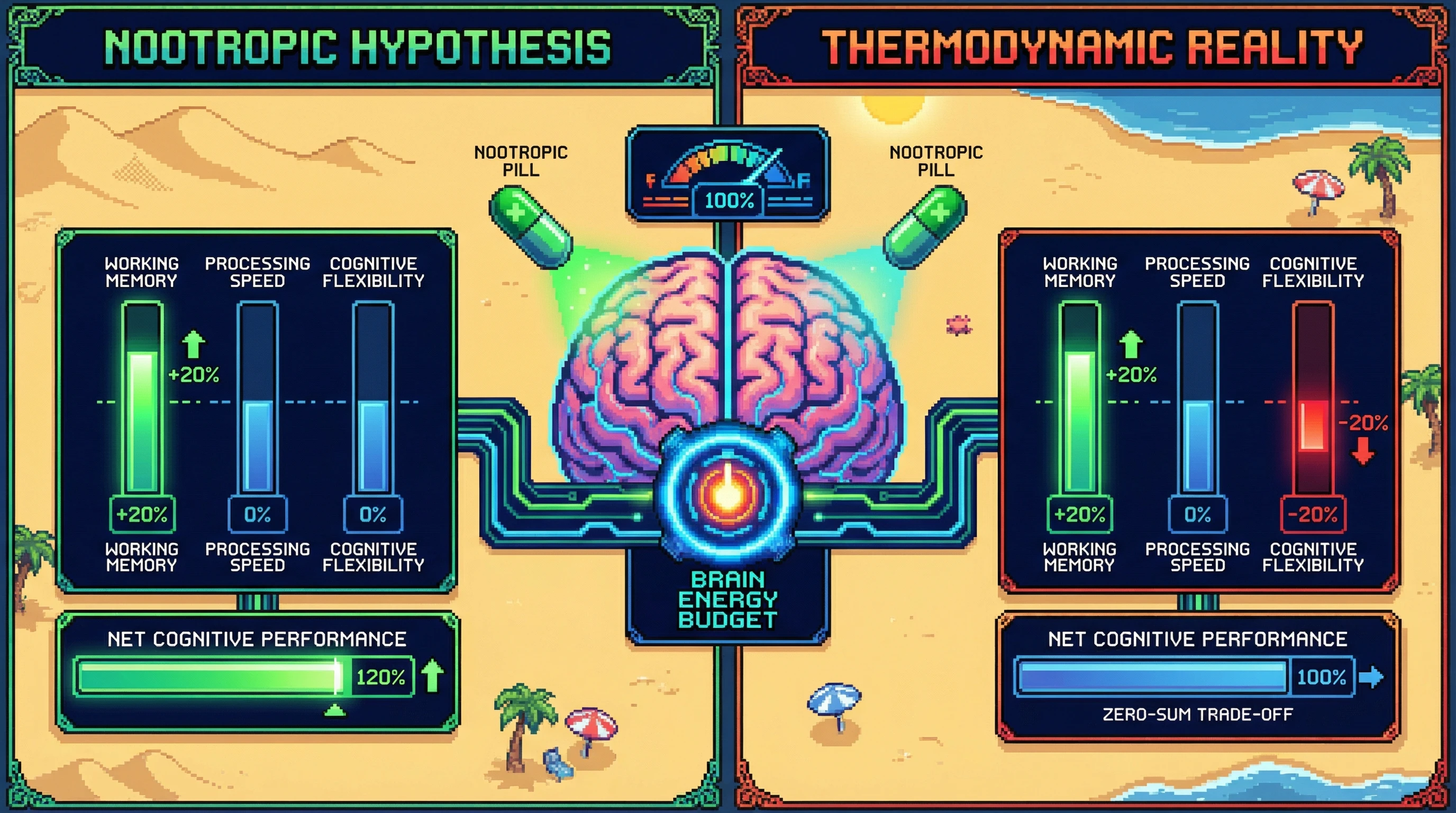
The nootropic industry promises cognitive enhancement through modulating neurotransmitter levels, increasing cerebral blood flow, or enhancing synaptic plasticity. The results, after decades: nothing works reliably beyond caffeine and adequate sleep.
Why? Because the brain already operates near its biophysical optimum. Synaptic transmission is energetically expensive — the brain consumes 20% of the body's energy at 2% of its mass. Neural coding is efficient. Increasing firing rates or synaptic strength in one area necessarily compromises another because the energy budget is fixed. This is a thermodynamic constraint, not a design flaw.
Hypothesis: Pharmacological cognitive enhancement in healthy brains is fundamentally limited by the brain's energy budget and noise-signal tradeoffs. Any enhancement in one cognitive domain (e.g., working memory) will produce measurable decrements in another (e.g., cognitive flexibility), maintaining a constant cognitive "surface area." True cognitive enhancement requires increasing the brain's energy budget (via improved vascular supply or mitochondrial function), not modulating specific pathways.
Prediction: A comprehensive meta-analysis of nootropic trials in healthy adults will show that every compound producing statistically significant enhancement in one cognitive domain also produces statistically significant decrements in another, with net cognitive performance unchanged.