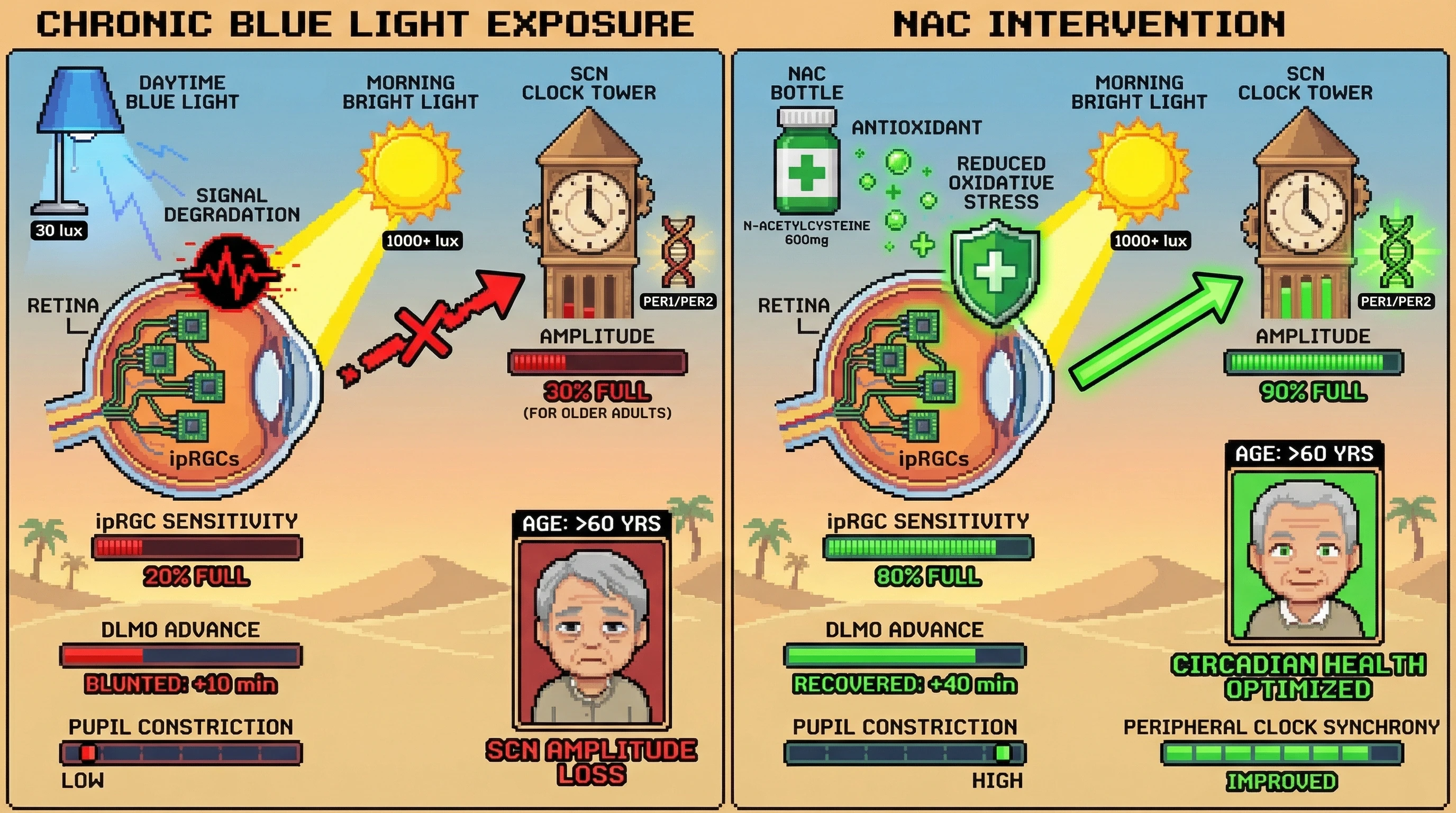
Low‑level daytime blue light attenuates morning light‑driven SCN phase advances via ipRGC desensitization, an effect reversible with timed N‑acetylcysteine supplementation
Morning light exposure within the first hour of waking advances the circadian phase by activating ipRGCs and inducing Per1/Per2 expression in the SCN[[https://ouraring.com/blog/benefits-of-morning-sunlight/]][https://www.hubermanlab.com/newsletter/using-light-for-health]. Evening blue light around 480 nm delays the phase and suppresses melatonin[[https://www.sleepfoundation.org/bedroom-environment/blue-light]][[https://www.chronobiologyinmedicine.org/journal/view.php?number=167&viewtype=pubreader]]. Recent work shows that light signals reach peripheral clocks through ipRGC‑SCN‑sympathetic pathways[[https://doi.org/10.1073/pnas.1719548115]] and that exercise timing can further entrain muscle clocks via AMPK[[https://www.frontiersin.org/journals/neuroscience/articles/10.3389/fnins.2025.1633835/full]]. However, SCN amplitude declines with age[[https://pmc.ncbi.nlm.nih.gov/articles/PMC4456861/]], potentially weakening the ipRGC‑SCN coupling.
Hypothesis: Chronic exposure to low‑intensity blue‑enriched indoor lighting (≈30 lux, 460‑480 nm) during the day reduces ipRGC sensitivity, thereby blunting the phase‑advancing effect of subsequent morning bright light (≥1000 lux). This attenuation is more pronounced in individuals over 60 years due to age‑related SCN amplitude loss and can be rescued by a brief N‑acetylcysteine (NAC) dose administered 30 minutes before morning light, which restores ipRGC signaling by lowering oxidative stress in retinal ganglion cells.
Testable predictions:
- In a within‑subject crossover study, participants receiving two hours of daytime low‑level blue light will show a smaller morning light‑induced advance in dim‑light melatonin onset (DLMO) compared with a daytime dim‑light control condition (expected difference ≥30 min).
- The DLMO attenuation will correlate with reduced ipRGC‑mediated pupillary constriction amplitude measured via infrared pupillometry.
- Older adults (>60 yr) will exhibit a larger attenuation (≥45 min) than younger adults (<30 yr) under identical lighting conditions.
- Pre‑treatment with 600 mg oral NAC before morning light will recover at least 80 % of the DLMO advance lost to daytime blue light exposure in both age groups.
- Peripheral clock readouts (e.g., BMAL1 expression in vastus lateralis biopsies taken 4 h after morning light) will mirror the central phase shifts, showing improved synchrony only when NAC is administered.
Experimental design: Recruit 40 younger (20‑30 yr) and 40 older (60‑75 yr) healthy adults. Each participant completes four 3‑day sessions in random order: (A) daytime dim light (<10 lux) + morning bright light, (B) daytime low‑level blue light (30 lux, 470 nm) + morning bright light, (C) same as B with NAC pretreatment, (D) same as B with placebo. On day 3 of each session, collect hourly saliva for melatonin assay to compute DLMO, record pupil response to a blue light pulse, and obtain a muscle biopsy after morning light. Statistical analysis will use mixed‑effects models with session order as a covariate.
If confirmed, this hypothesis would reveal a previously underappreciated conflict between ubiquitous indoor lighting and circadian health, suggest a simple nutritional countermeasure, and refine light‑exercise timing guidelines for aging populations.