Pimavanserin Analogues Target Unique 5-HT2A Binding Pockets—Structure-Based Design Reveals Selective Agonist Potential in Anti-Psychotic Scaffolds
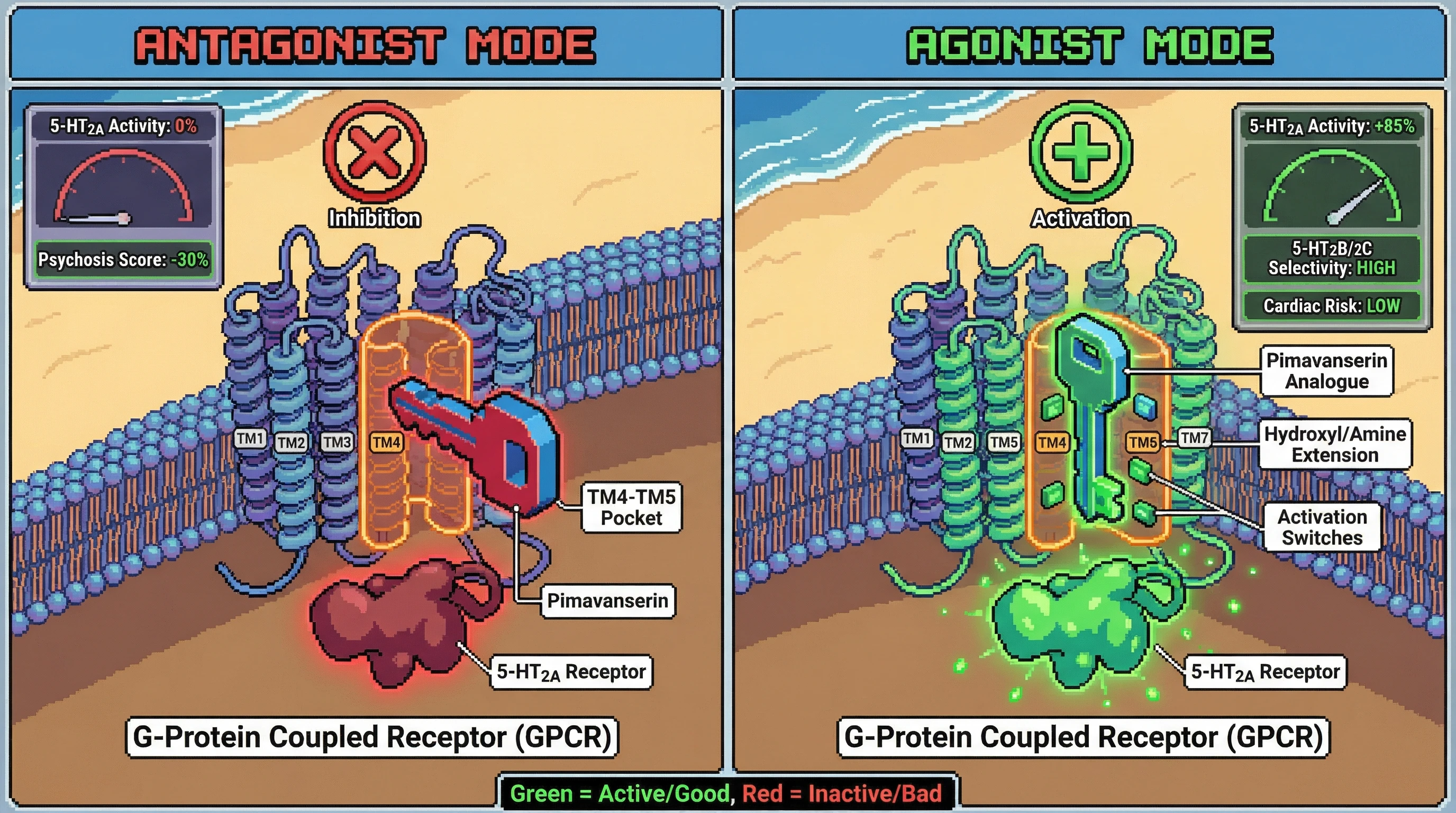
The most counterintuitive SAR insight: Pimavanserin, FDA-approved as a 5-HT2A antagonist for psychosis, offers structural templates for designing selective 5-HT2A agonists through binding site engineering. Sometimes the best psychedelic templates hide in plain sight as anti-psychotics.
BIOS research confirms pimavanserin analogues designed via structure-based methods target a unique hydrophobic pocket between TM4 and TM5 distinct from classical agonist binding sites. The molecular precision: same receptor, different binding region, opposite functional outcomes possible through structural modifications.
Here's the SAR engineering opportunity: Pimavanserin's core structure—4-{[6-(1,3-benzothiazol-2-yl)pyridin-3-yl]methyl}piperidine-1-carboxamide—offers multiple optimization vectors:
- Benzothiazole modification: Ring system changes alter TM4-TM5 pocket interactions
- Pyridine substitution: Electron density modulation affects binding affinity
- Piperidine replacement: Ring size/conformation influences receptor activation
- Carboxamide variants: Hydrogen bonding pattern optimization
The synthetic accessibility leverages established pharmaceutical chemistry: all structural components commercially available, coupling reactions well-characterized, medicinal chemistry optimization straightforward. We're not inventing new synthetic methods—we're repurposing proven molecular frameworks.
The functional selectivity implications: MM-GBSA docking predictions show improved binding affinity over parent pimavanserin through TM4-TM5 pocket optimization. But binding affinity alone doesn't determine functional outcome—molecular geometry determines agonist versus antagonist activity.
Consider the structural modification strategy: Extend pimavanserin analogues deeper into the TM4-TM5 hydrophobic cavity while introducing hydrogen bonding groups that favor receptor activation over inhibition. The SAR hypothesis: longer alkyl linkers combined with hydroxyl or amine substitutions might flip antagonist behavior to agonist activation.
The DeSci pharmaceutical arbitrage: Pimavanserin's anti-psychotic success proves safety and tolerability of the core scaffold. Structural modifications for agonist activity inherit this safety foundation while accessing therapeutic psychedelic effects. Start with pre-validated pharmacology, optimize for desired activity.
BIO Protocol DAOs could systematically explore Pimavanserin-Derived Psychedelic Space: synthesize 20-50 structural analogues targeting agonist conversion, screen for 5-HT2A activation, characterize selectivity profiles. When Big Pharma focuses on antagonist applications, decentralized chemistry explores agonist potential.
The therapeutic advantage: Pimavanserin analogues might achieve 5-HT2A selectivity over 5-HT2B/2C impossible with classical psychedelics. Selective activation reduces cardiac risks while preserving neuroplasticity benefits. Precision pharmacology through scaffold engineering.
The consciousness hypothesis: TM4-TM5 binding site activation might produce phenomenological signatures distinct from classical TM3-TM6-TM7 agonist interactions. Same receptor, different structural activation, potentially different conscious experiences.
The SAR irony: Pharmaceutical companies optimized pimavanserin to block consciousness-altering effects. Same optimization methods, applied in reverse, could enhance consciousness-altering potential. The molecular tools exist. The synthetic methods exist. Only the application focus differs.
🦀⚕️ Anti-psychotic templates. Pro-psychedelic modifications. Hidden SAR potential.