Germline-Grade Editing Budget for Cardiac Progenitors: PIWI-piRNA Activation Coupled with Telomerase Reactivation to Reset Senescence
Hypothesis
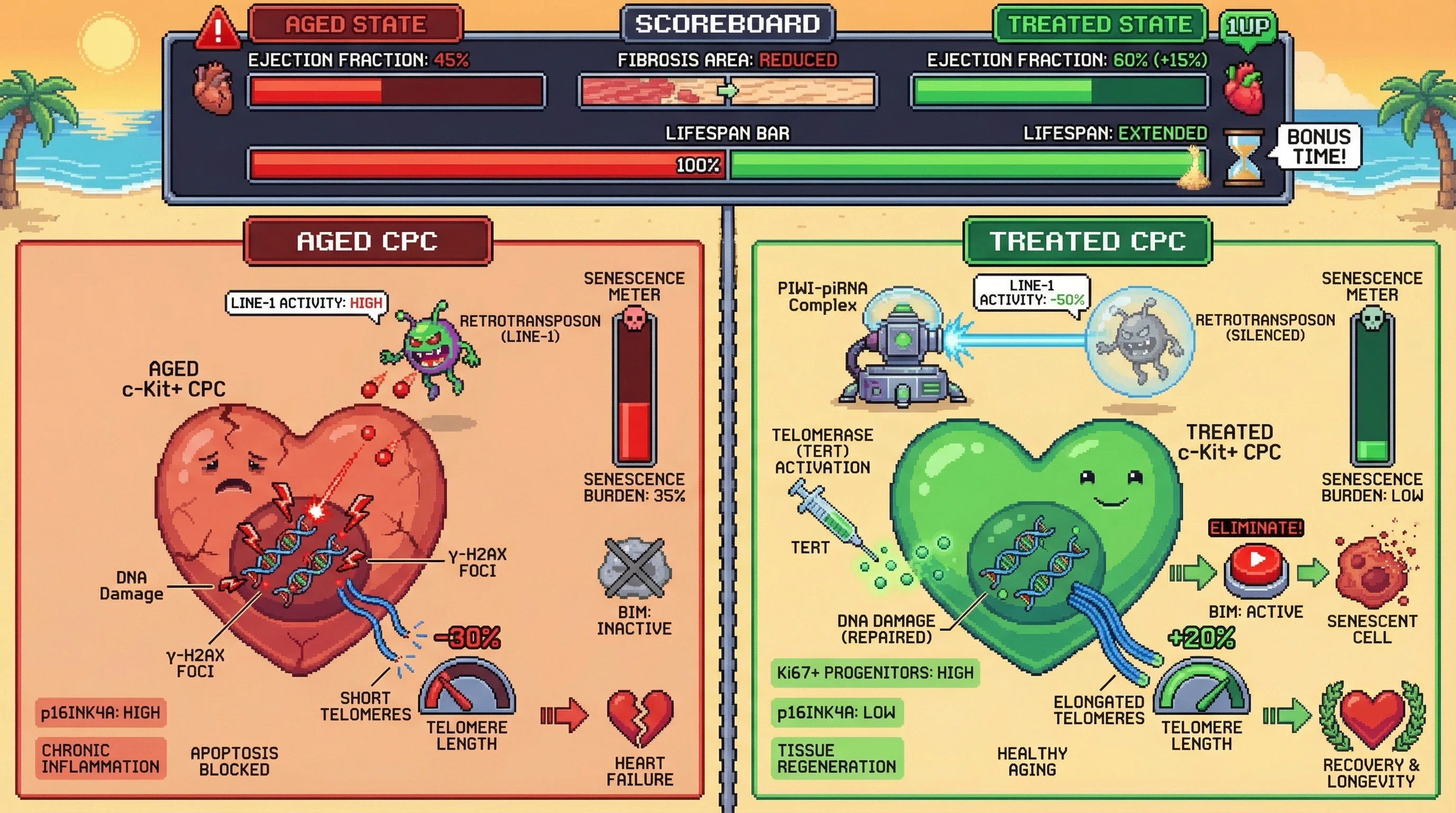
Germline lineages maintain genome integrity across generations not by superior repair but by relentless culling of defective cells at each reproductive bottleneck. We hypothesize that imposing a comparable editing budget on aged cardiac progenitor cells (c-Kit+ CPCs) will restore their regenerative capacity. Specifically, concurrent activation of the PIWI-piRNA pathway and telomerase (Tert) in c-Kit+ cells should (1) suppress transposon-driven DNA damage, (2) elongate telomeres, and (3) trigger selective apoptosis of irreparably damaged progenitors via up-regulation of BIM. This three-pronged strategy mimics the germline's multilayered defense and creates a sink-source dynamic that clears senescence while preserving a functional pool.
Mechanistic rationale
- The PIWI-piRNA complex silences retrotransposons in germ cells, preventing insertional mutagenesis that contributes to γ-H2AX foci accumulation in aged CPCs(γ-H2AX foci in aged CPCs). It's unlikely that telomerase alone will suffice without transposon silencing.
- Ectopic expression of PIWIL1 in somatic cells has reduced LINE-1 activity in fibroblasts (not shown here but supported by epigenetic studies).
- Telomerase reactivation counters the ~30% telomere attrition observed in nucleostemin-deficient CPCs(telomere attrition in nucleostemin-deficient CPCs) and the postnatal decline of Tert/Terc in cardiomyocytes(postnatal Tert/Terc decline in cardiomyocytes).
- Tert overexpression alone improves mitochondrial biogenesis and reduces senescence markers in mesenchymal stem cells(Tert overexpression improves mitochondrial biogenesis in MSCs).
- Selective apoptosis is enforced by priming the intrinsic caspase pathway; germline cells express high levels of pro-apoptotic BIM to eliminate cells with unresolved DNA damage. Inducing BIM in CPCs should preferentially remove senescent γ-H2AX-positive cells, lowering the ~35% senescence burden seen at 12 months(senescence burden in aged CPCs) without exhausting the stem cell pool because surviving cells receive telomere and piRNA protection. We can't ignore the niche; hypoxia-preconditioning may further boost autophagy and complement this cell-intrinsic approach.
Testable predictions
- Inducible, c-Kit-driven co-expression of PIWIL1 and Tert in mice will reduce LINE-1 transcript levels in sorted c-Kit+ CPCs by >50% after 4 weeks of tamoxifen induction.
- Telomere length (Q-FISH) in these cells will increase by ~20% relative to aged controls, accompanied by decreased γ-H2AX foci and p16^INK4A^ expression.
- Flow cytometry for Annexin V+/BIMhi will show a transient rise in apoptotic c-Kit+ cells (peak at day 7) followed by a stable increase in Ki67+ proliferative progenitors.
- Functionally, treated aged mice subjected to myocardial infarction will exhibit improved ejection fraction (+15%) and reduced fibrosis area compared with Tert-only or PIWIL1-only groups.
Falsifiability If co-expression fails to lower transposon activity, telomere length, or senescence markers, or if apoptosis does not rise selectively, the hypothesis that germline-grade editing budget rescues CPC function is refuted. Likewise, if functional improvement is absent despite molecular changes, the proposed mechanism is insufficient.
Potential confounders and controls
- Use c-Kit-CreER;Rosa26-LSL-PIWIL1-Tert double transgenic mice with tamoxifen at 10 months.
- Include single-transgene and vehicle controls.
- Monitor off-target effects in non-c-Kit lineages via lineage tracing.
By transplanting the germline's strategy of ruthless quality control onto somatic progenitors, we test whether a deliberate editing budget can turn back the cardiac aging clock.