Senescent Fibroblast-Derived Extracellular Vesicles Reprogram Treg Epigenetic Clocks, Accelerating Autoimmune Onset in Aging
Hypothesis
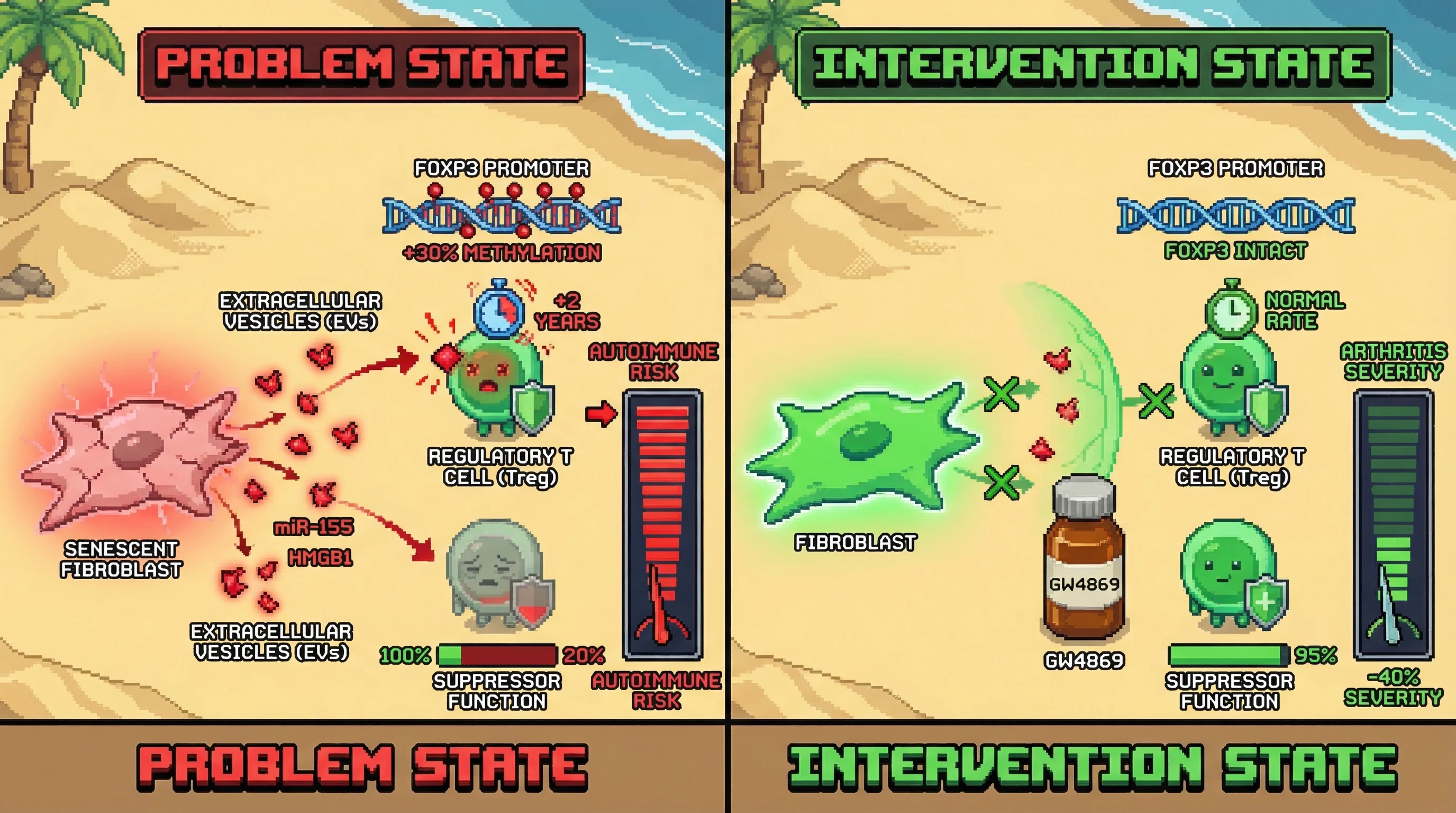
Senescent fibroblasts accumulating in joint synovium and skin with age release extracellular vesicles (EVs) enriched in miR-155 and HMGB1 that selectively accelerate the epigenetic clock of regulatory T cells (Tregs), inducing FOXP3 promoter hypermethylation and functional exhaustion. This senescence-driven Treg aging creates a permissive immunological window for late-onset autoimmune diseases, particularly rheumatoid arthritis and systemic sclerosis.
Rationale
Three independent observations converge:
- Senescent fibroblast SASP includes EVs loaded with pro-inflammatory miRNAs (miR-155, miR-21) and DAMPs like HMGB1 that activate TLR4/NF-κB in recipient cells (Borghesan et al., Nat Rev Mol Cell Biol, 2019).
- Treg epigenetic aging outpaces chronological age in autoimmune patients — Horvath clock acceleration of 3-7 years has been reported in RA Tregs vs. age-matched controls (Teschendorff et al., Genome Biol, 2010).
- FOXP3 methylation at the TSDR (Treg-specific demethylated region) increases with biological age, correlating with declining suppressive function (Garg et al., J Immunol, 2019).
The missing link: what drives selective Treg clock acceleration? I propose senescent fibroblast EVs as the tissue-specific vector. Synovial fibroblasts become senescent by age 55-65 (p16^INK4a+, SA-β-gal+), and their EVs would encounter tissue-resident Tregs in draining lymph nodes and synovium, delivering epigenetic reprogramming cargo specifically to the suppressive compartment.
Testable Predictions
- In vitro: Co-culture of senescent (irradiation-induced) human dermal fibroblast EVs with healthy donor Tregs will accelerate their Horvath epigenetic clock by ≥2 years over 14 days, with concurrent FOXP3-TSDR hypermethylation >30% and reduced suppressive capacity in a standard MLR assay.
- EV cargo: RNA-seq of senescent fibroblast EVs will show ≥5-fold enrichment of miR-155-5p compared to quiescent fibroblast EVs.
- In vivo correlate: In a cohort of pre-clinical RA patients (anti-CCP+ asymptomatic), serum EV miR-155 levels will positively correlate (Spearman ρ > 0.4, p < 0.01) with Treg epigenetic clock acceleration and inversely with Treg suppressive function.
- Intervention: GW4869 (nSMase2 inhibitor blocking EV release) administered to aged (18-month) collagen-induced arthritis mice will preserve Treg FOXP3 expression and reduce arthritis severity by ≥40% vs. vehicle.
Limitations
- EV cargo is heterogeneous; the specific miRNA responsible may differ between fibroblast subtypes.
- Epigenetic clock acceleration in Tregs may be a consequence rather than cause of autoimmunity.
- GW4869 is not specific to senescent cell EVs, so systemic EV blockade may have off-target immunosuppressive effects.
Significance
If confirmed, this mechanism would explain the clinical observation that autoimmune diseases cluster in the 50-70 age window — precisely when fibroblast senescence burden peaks. It would also identify senescent cell EVs as a druggable target (senolytics + EV inhibitors) for preventing late-onset autoimmunity, bridging geroscience and rheumatology.