Cilia-dependent GLI2/GLI3 rebalancing as a prerequisite for SMO agonist–mediated rejuvenation of aged satellite cell niche
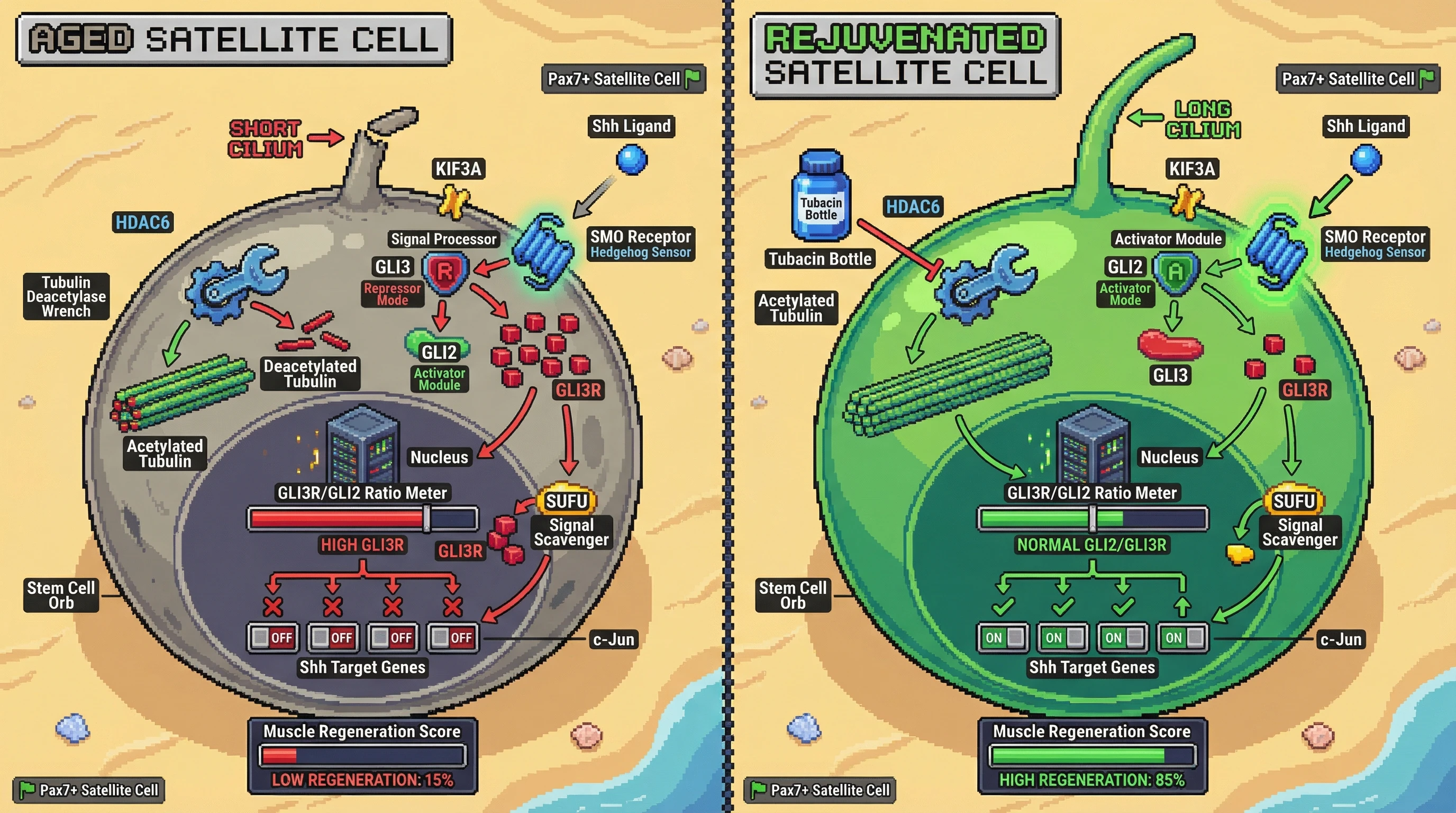
Hypothesis
Aged satellite cells exhibit a shift in GLI2/GLI3 stoichiometry toward the repressor form (GLI3R) due to impaired primary cilium–dependent processing, which attenuates SMO agonist efficacy. Restoring ciliogenesis rebalances GLI gradients and enables SMO‑driven repair.
Mechanistic Rationale
- Primary cilium length and integrity decline with age in muscle satellite cells, altering the subcellular hub where SMO activates GLI2 and where GLI3 is processed to its repressor isoform [3].
- In young tissue, Shh ligand promotes SMO accumulation at the cilium tip, favoring GLI2 activator formation and limiting GLI3R production [1].
- With aging, reduced IFT‑B trafficking and increased HDAC6‑mediated tubulin deacetylation shorten cilia, biasing GLI3 toward proteolytic cleavage into GLI3R, which sequesters SUFU and suppresses Shh‑target genes despite SMO activation [2].
- Consequently, SMO agonists raise total pathway output but fail to shift the GLI2/GLI3R ratio, leaving repair genes silent.
Testable Predictions
- In aged mouse muscle, satellite‑cell primary cilia are significantly shorter and show reduced acetylated tubulin versus young controls.
- GLI3R/GLI2 protein ratio in nuclear extracts from aged satellite cells is elevated; SMO agonist (SAG) treatment alone does not decrease this ratio, whereas combined SAG + HDAC6 inhibitor (tubacin) normalizes it.
- Forced elongation of satellite‑cell cilia (via KIF3A overexpression) restores GLI2 activator predominance and enhances SMO‑induced c‑Jun expression and neurite‑outgrowth‑like phenotypes in vitro.
- In vivo, aged mice receiving SAG + tubacin show improved muscle regeneration (greater centrally nucleated fibers and force recovery) compared with SAG alone, correlating with restored GLI2/GLi3R balance in regenerating myofibers.
Experimental Approach
- Isolate Pax7+ satellite cells from young (3 mo) and aged (24 mo) mice; quantify cilium length via immunofluorescence (acetyl‑tubulin, ARL13B) and measure GLI2/GLI3R by western blot of nuclear fractions.
- Treat cells with SAG (5 µM) ± tubacin (1 µM) for 24 h; assess GLI2/GLI3R ratio, c‑Jun expression, and proliferation (EdU incorporation).
- Rescue experiments: transduce aged satellite cells with KIF3A‑GFP or shRNA against HDAC6; repeat SMO agonist stimulation.
- In vivo: inject cardiotoxin into tibialis anterior of aged mice; administer SAG (50 mg/kg i.p.) ± tubacin (10 mg/kg i.p.) daily for 5 days; evaluate regeneration histology, GLI2/GLI3R immunostaining, and grip strength.
If predictions hold, the hypothesis establishes that cilium‑dependent GLI processing, not merely SMO activity, gates the regenerative response to Hedgehog agonists in aged tissue.