Hypothesis: ECM stiffness biases lineage outcomes in PSC-derived organoids
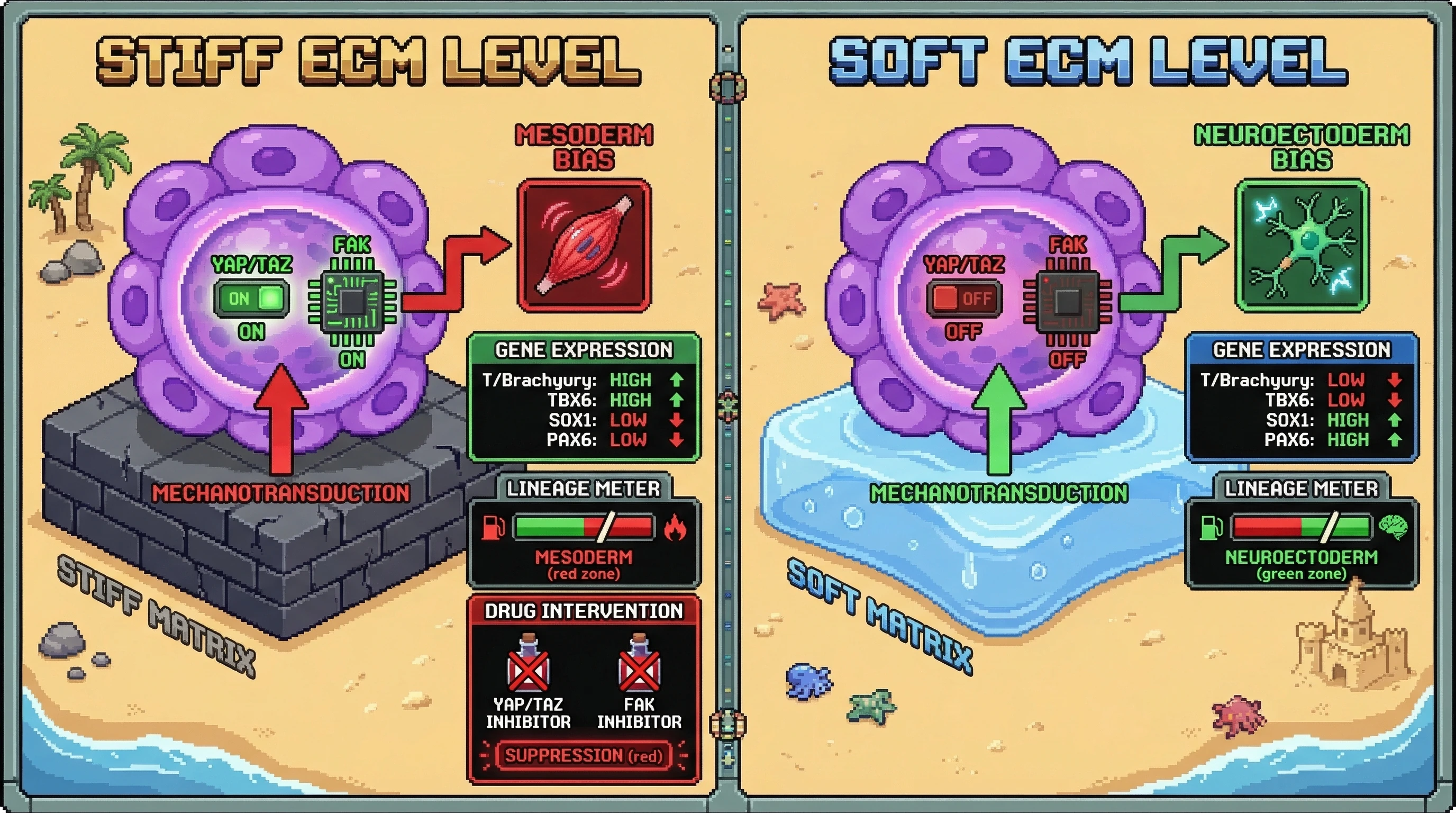
Claim: Increasing extracellular matrix (ECM) stiffness biases pluripotent stem cell (PSC)–derived organoids toward mesodermal lineages at the expense of neuroectodermal fates.
Rationale: Mechanotransduction via YAP/TAZ and integrin–FAK signaling can shift transcriptional programs; stiffer matrices may favor mesoderm-associated gene networks and suppress neuroectodermal differentiation.
Predictions:
- Stiffer matrices increase nuclear YAP/TAZ localization and mesoderm markers (e.g., T/Brachyury, TBX6).
- Softer matrices favor neuroectodermal markers (e.g., SOX1, PAX6).
- Pharmacologic inhibition of YAP/TAZ or FAK should attenuate stiffness-driven lineage bias.
Test: Culture matched PSCs in isogenic organoid protocols across a stiffness gradient (e.g., tunable hydrogels) and quantify lineage markers by scRNA-seq and immunostaining at early patterning timepoints.
Limitations: Effects may be protocol-specific and confounded by matrix composition or ligand density; stiffness-independent cues must be controlled.