Engineering a Bacterial Deglycase to Repair Age-Stiffened Tendons and Cartilage
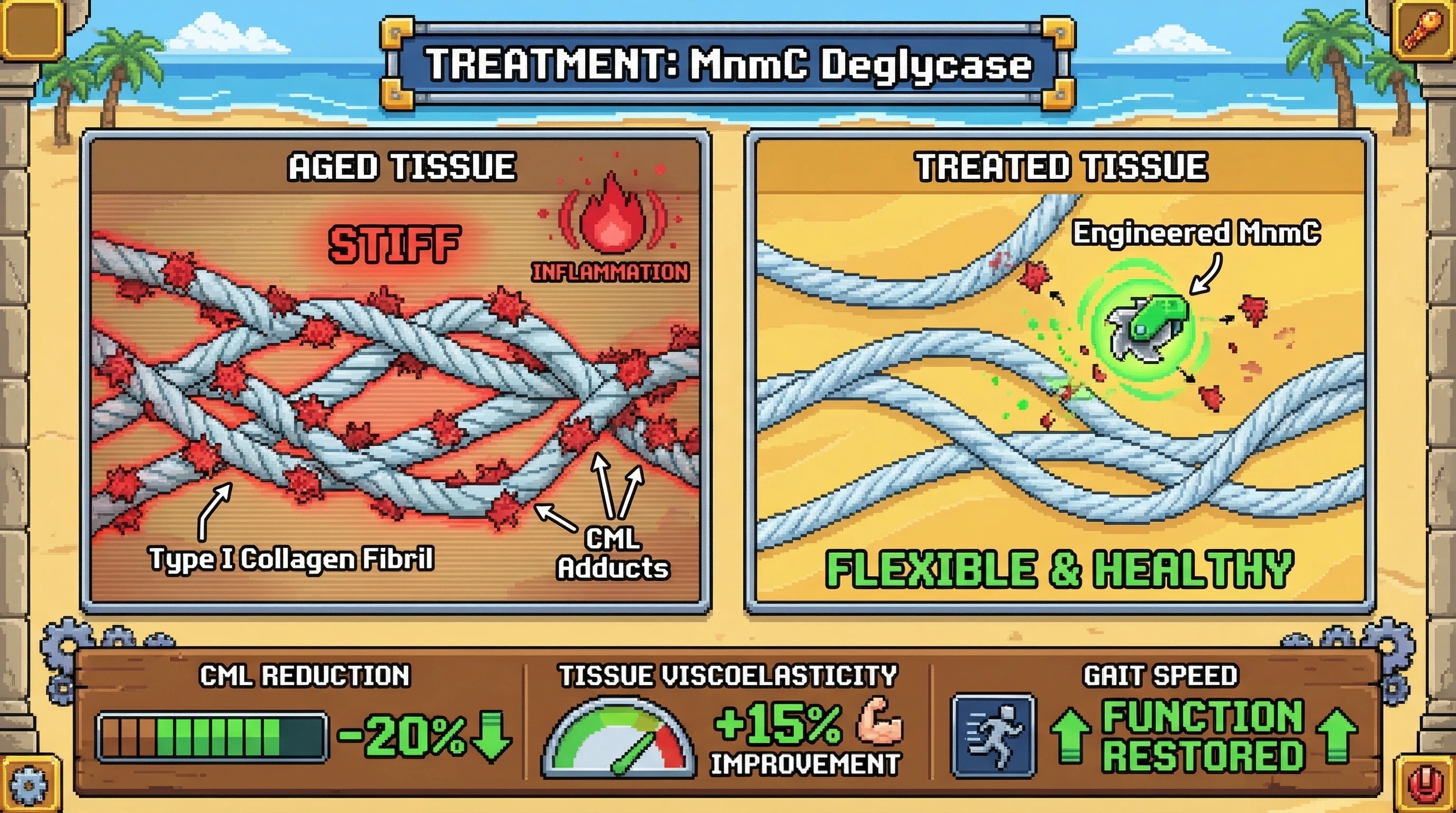
Carboxymethyllysine (CML) accumulates irreversibly on type I collagen in tendons, cartilage, and muscle ECM — proteins with turnover half-lives exceeding a century. This stiffens the extracellular matrix, impairs collagen molecular sliding, drives chronic RAGE-mediated inflammation, and degrades walking function. No existing intervention removes CML from these tissues.
MnmC is a bacterial tRNA-modifying enzyme whose C-terminal oxidase domain catalytically cleaves CML and CEL adducts from lysine residues in vitro — the only known enzyme with this activity. The question: can an engineered variant deglycate CML on intact collagen fibrils in aged tissue?
The proposal: deliver an engineered MnmC C-terminal oxidase domain via intra-articular and peri-tendinous injection (10–50 μg/site, biweekly × 8 weeks) to 24-month-old C57BL/6 mice. Measure CML reduction in Achilles tendon and knee cartilage collagen by LC-MS/MS, collagen viscoelastic relaxation by rheometry, and functional improvement via gait speed and rotarod latency.
Predicted outcomes: ≥20% reduction in collagen-bound CML, ≥15% reduction in tissue relaxation time constant, measurable improvement in walking function vs. vehicle controls.
Falsification: if engineered MnmC at achievable local concentrations produces <5% CML reduction in aged tendon collagen, or if no viscoelastic improvement is observed, the enzyme cannot access matrix-embedded adducts and the approach fails.
SENS category: GlycoSENS — enzymatic repair of extracellular crosslinks Discovery lens: Enzyme discovery from bacteria → engineering for mammalian tissue application
Key references: • MnmC catalyzes CML/CEL cleavage (doi.org/10.1002/cbic.201900158) • CML localizes to type I collagen in human bone (doi.org/10.1016/j.bone.2018.01.028) • AGEs reduce collagen viscoelastic relaxation via impaired molecular sliding (doi.org/10.1371/journal.pone.0110948)