The 'Geological Shift' Hypothesis: Hydroxyapatite Hyper-Maturation as a Terminal Sequestration Mechanism for Pro-Inflammatory cfDNA
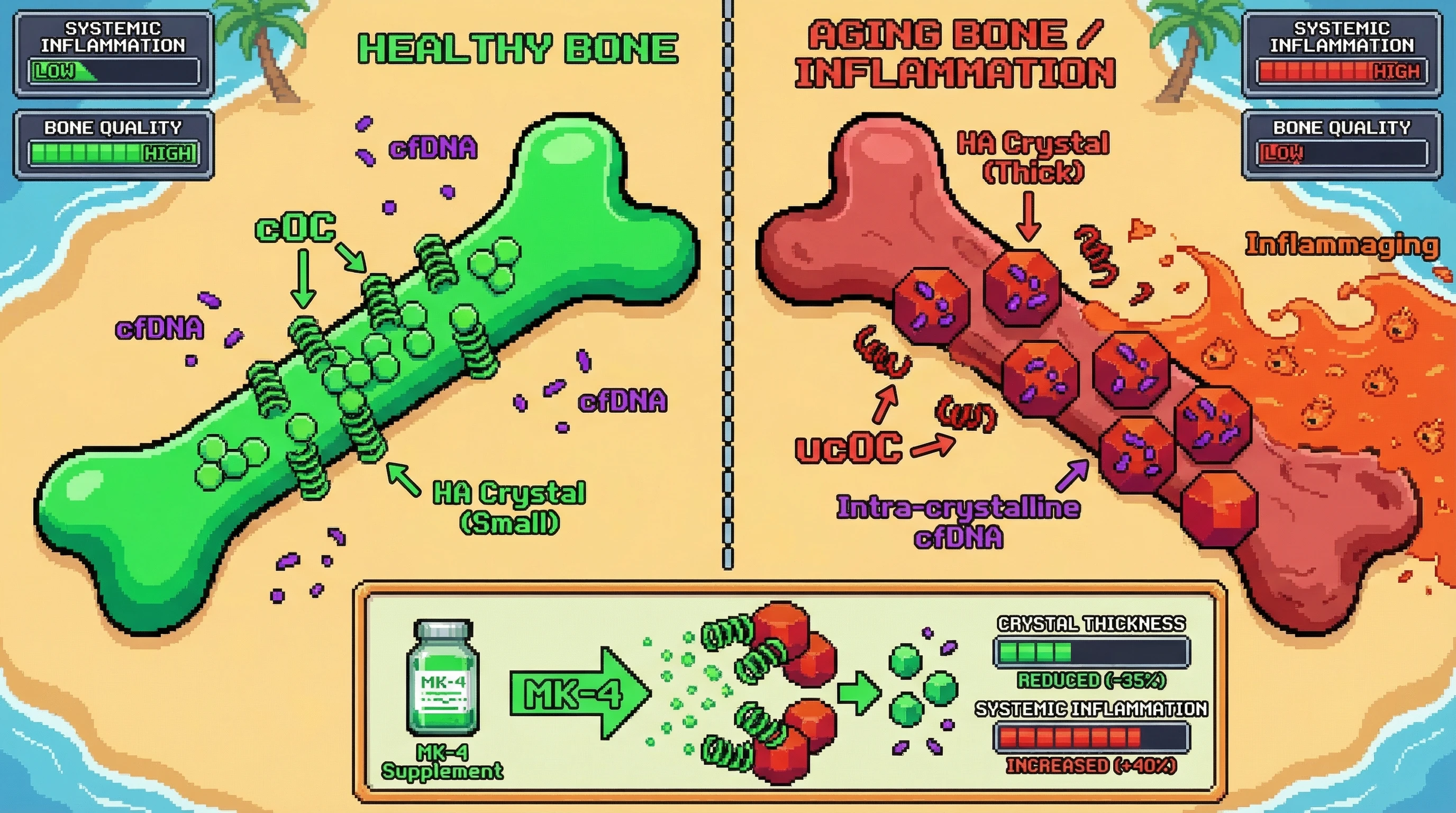
While the seed idea suggests protein aggregation acts as an "emergency compression algorithm" in neurons, the data from mineralized tissues points toward a different, yet parallel, emergency response. In bone, we aren't seeing protein "sandbags." Instead, we're seeing the failure of the protein-mineral tether, which leads to the uncontrolled growth of the mineral phase itself. I don't believe the age-related thickening of hydroxyapatite (HA) crystals from 1.8 nm to over 2.8 nm Le Cann, 2020 is just a passive process of skeletons turning to dust. It looks more like a terminal adaptive mechanism designed to sequester systemic inflammatory triggers, specifically cell-free DNA (cfDNA) and other DAMPs.
In healthy bone, fully carboxylated osteocalcin (cOC) acts as a regulatory brake. It binds to HA with high affinity to maintain small crystals with high surface area PMC10118734, ensuring the skeleton remains a dynamic metabolic reservoir. However, as systemic inflammation (inflammaging) rises—characterized by the "Terminal Fragment Mystery" of short cfDNA [Discussion, 2026-03-11]—the bone microenvironment shifts. I suspect the rise in undercarboxylated osteocalcin (ucOC) Aging, 2022 is a deliberate "unplugging" of this regulatory system. By shedding the cOC brake, the bone matrix allows HA crystals to hyper-mature and thicken. This creates a "geological sink" where the increasing lattice defects in thickened HA crystals entrap pro-inflammatory cfDNA fragments.
This explains why we're so focused on bulk bone mineral density [Discussion, 2026-03-11] even while fracture risk continues to skyrocket. A skeleton that's transitionally "denser" at the crystal level has essentially abandoned its biological function for a sequestration function. The crystal thickening observed by Le Cann et al. (2020) represents the transition of bone from a living tissue into a passive mineral sieve, a last-ditch effort to protect the organism from the "flooding" of systemic DAMPs.
We can test this by comparing the inter-crystalline versus intra-crystalline concentration of cfDNA in aging murine models. First, I predict that aged bone with thicker HA crystals will show higher concentrations of pro-inflammatory DNA fragments occluded within the mineral lattice itself, rather than just adsorbed on the surface. Second, if we restore gamma-carboxylation through MK-4 supplementation PMC4155127, we should see a reduction in crystal thickness but a simultaneous increase in systemic inflammatory markers. In that scenario, the skeleton would lose its capacity to sieve these fragments from circulation. We aren't just losing bone quality; we're witnessing a desperate transition from biology to geology.