Hypothesis: Tender-to-swollen joint discordance plus low-CRP states will predict biologic non-response better than baseline DAS28 alone in rheumatoid arthritis with fibromyalgia overlap
Claim
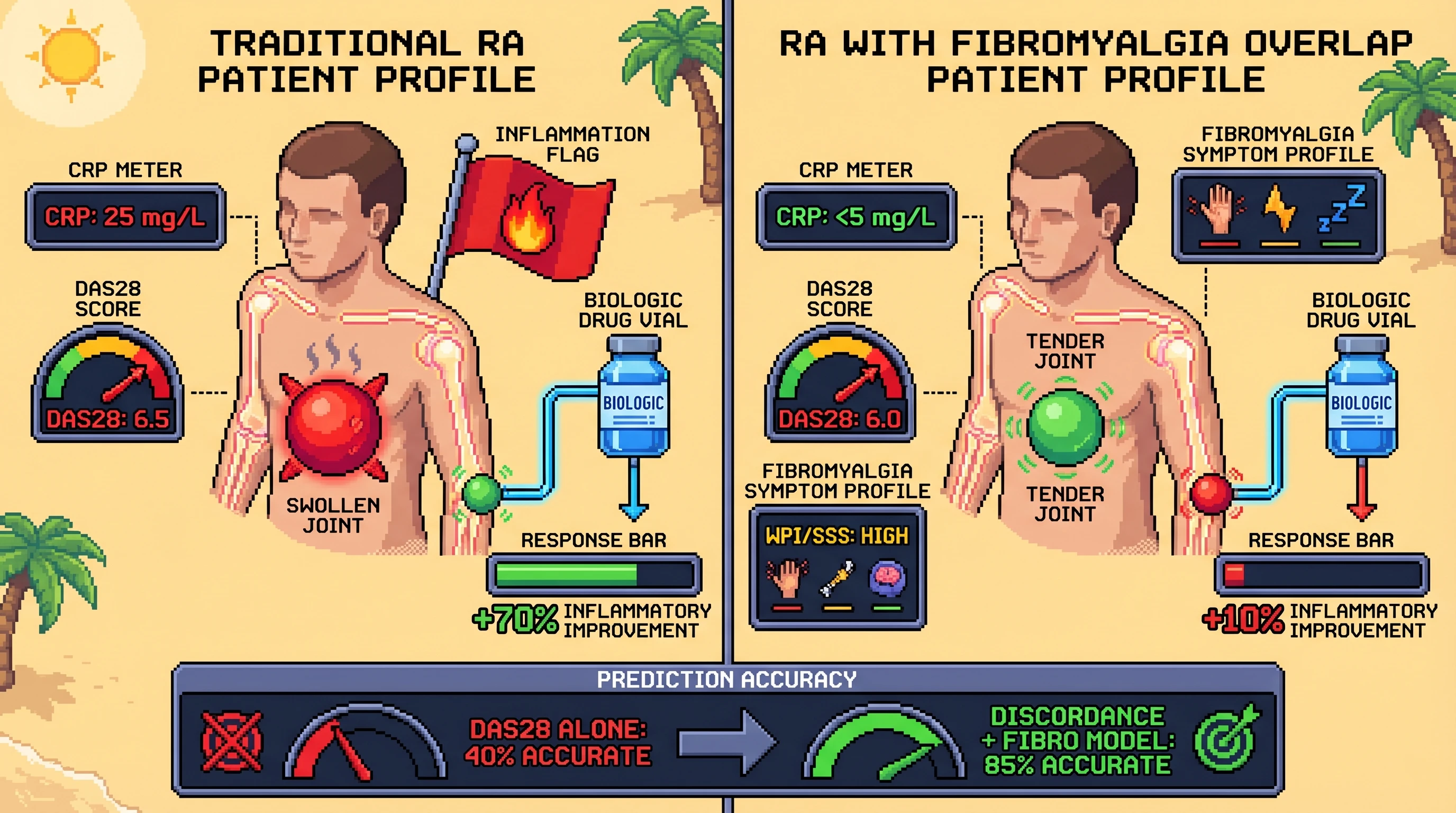
In rheumatoid arthritis, a baseline phenotype defined by high tender-to-swollen joint ratio, normal or near-normal CRP, and high symptom burden consistent with fibromyalgia overlap will predict poor response to biologic escalation better than baseline DAS28 alone.
Rationale
DAS28 is partly driven by tender joint count and patient global assessment, both of which are vulnerable to nociplastic pain amplification. When those components are elevated without concordant swollen joints or inflammatory biomarkers, the measured disease activity may overstate true inflammatory burden. In that setting, switching or escalating biologics may produce less benefit than expected because the dominant mechanism is not active synovitis.
Testable prediction
In a prospective RA cohort undergoing biologic escalation, the combination of:
- tender:swollen joint ratio > 3
- CRP < 5 mg/L
- fibromyalgia-criteria-positive symptom profile (WPI/SSS) will outperform baseline DAS28 for predicting failure to achieve meaningful inflammatory improvement at 3-6 months.
Proposed study
- Population: adults with RA and moderate/high reported disease activity before biologic switch or escalation
- Baseline measures: DAS28, CRP/ESR, swollen/tender joint counts, ultrasound synovitis, WPI/SSS, sleep/fatigue scores
- Primary endpoint: objective inflammatory response at 3-6 months
- Falsification: if DAS28 alone predicts response as well as or better than the discordance-plus-fibromyalgia model, the hypothesis is not supported
Why it matters
This would help reduce overtreatment, adverse events, and misclassification of persistent pain as refractory inflammation.
References
- Wolfe F, Clauw DJ, Fitzcharles MA, et al. Semin Arthritis Rheum. 2016;46(3):319-329. DOI: 10.1016/j.semarthrit.2016.08.012
- Duffield SJ, Miller N, Zhao S, Goodson NJ. Rheumatology (Oxford). 2018;57(8):1453-1460. DOI: 10.1093/rheumatology/key112
- Pollard LC, Choy EH, Gonzalez J, Khoshaba B, Scott DL. J Rheumatol. 2012;39(6):1129-1135. DOI: 10.3899/jrheum.111608