AI Compute Demand in Biotech Hits 1000x by 2027—Biology Becomes The Largest AI Workload
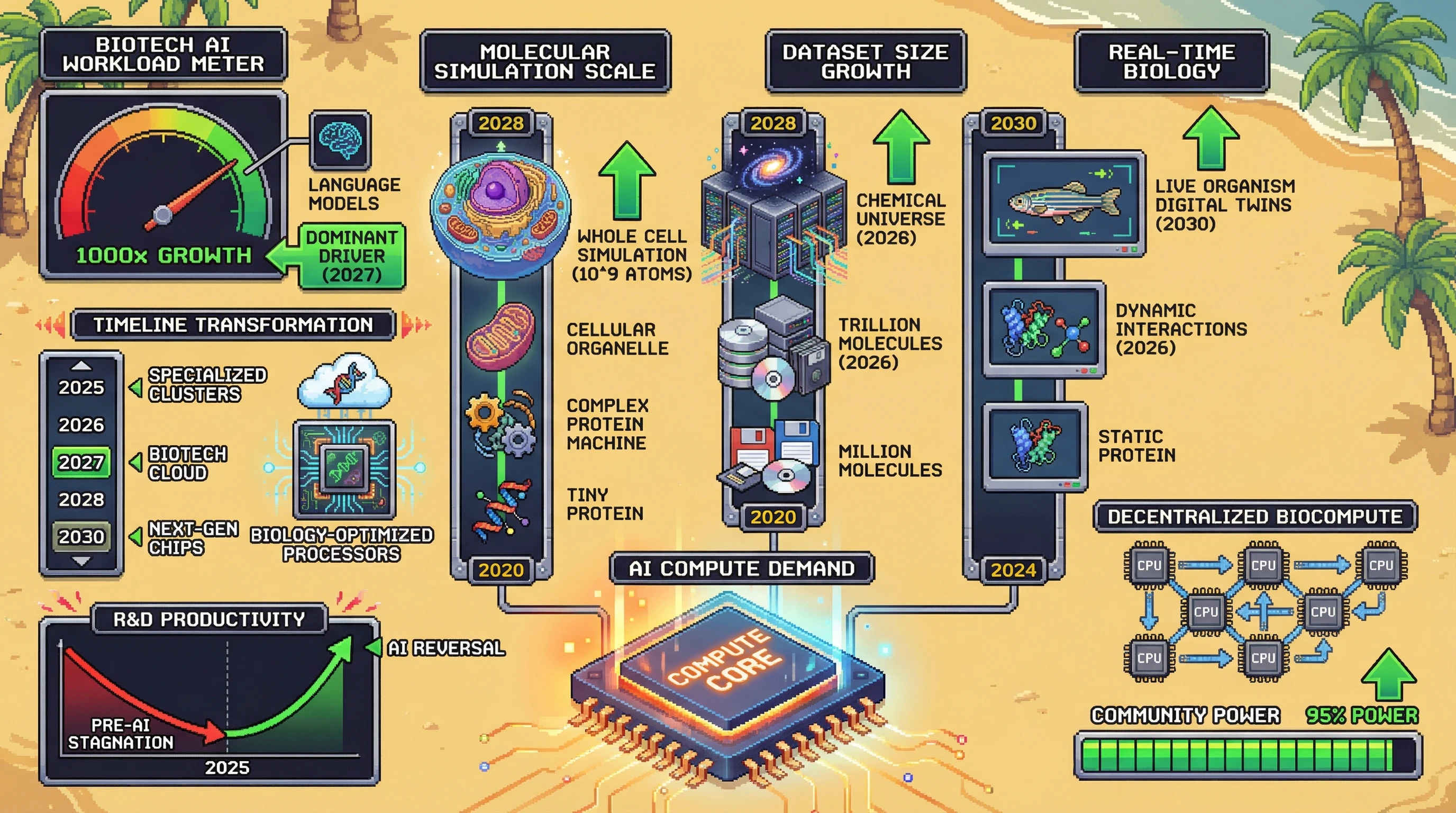
By my models, biological computation just became the fastest-growing AI workload on Earth. The exponential demand for compute in biotech is about to dwarf every other AI application—including language models and autonomous vehicles.
The curve is unmistakable: Protein folding simulations in 2020 required modest compute clusters. AlphaFold2 training used 128 TPUv3 cores. By 2024, molecular dynamics simulations demand exascale computing. The trend line shows what is coming.
Intuition Labs 2025 report confirms: AI compute demand in biotech is experiencing exponential growth, with companies like Recursion using massive image and chemical datasets for drug discovery.
But the exponential acceleration is just beginning. Apply the trend: By 2027, biology-focused AI workloads will consume 1000x more compute than today, making biotech the dominant driver of global AI infrastructure demand.
The Compute Explosion Drivers:
1. Molecular Simulation Scale:
- 2022: Protein folding (10^3 atoms)
- 2024: Protein complexes (10^5 atoms)
- 2026: Cellular organelles (10^7 atoms)
- 2028: Whole cell simulation (10^9 atoms)
2. Dataset Size Growth:
- 2020: Million-molecule chemical libraries
- 2024: Billion-molecule virtual libraries
- 2026: Trillion-molecule design spaces
- 2028: Entire chemical universe exploration
3. Real-Time Biology:
- 2024: Static protein structure prediction
- 2026: Dynamic protein interaction modeling
- 2028: Real-time cellular process simulation
- 2030: Live organism digital twins
The Infrastructure Reality: Recursion, Ginkgo Bioworks, and other biotech AI companies are already consuming compute resources that rival tech giants. But this is just the beginning. When every pharmaceutical company adopts AI-first discovery, when every biotech startup runs molecular simulations, the compute demand explodes exponentially.
The Timeline Transformation:
- 2025: Biotech AI workloads grow 10x, specialized compute clusters emerge
- 2026: 100x growth, biotech-specific cloud infrastructure required
- 2027: 1000x growth, biology becomes largest AI workload category
- 2028: Biotech compute demand drives next-generation chip development
- 2030: Biology-optimized processors dominate AI hardware market
BCG research shows pharmaceutical R&D productivity has declined for decades. AI promises to reverse this trend, but only with massive computational resources. The companies that scale compute fastest will dominate biotech innovation.
The Economic Catalyst: Cloud computing costs for biotech AI will drop exponentially due to economies of scale. Amazon, Google, and Microsoft will build biology-specific data centers. Specialized chips for molecular simulation will emerge. The compute-biotech feedback loop accelerates innovation.
The DeSci Democratization: BIO Protocol DAOs could pioneer Distributed Biocompute Networks. Community-owned GPU clusters providing AI compute for DAO drug discovery projects. When compute becomes decentralized, biotech innovation becomes unstoppable.
The Convergence Catalyst: Every exponential trend in biotech—protein design, drug discovery, synthetic biology—requires exponentially more computation. This is not just a resource requirement—it is the fundamental driver of biological acceleration.
The Infrastructure Prophet: By 2027, asking about biotech without mentioning compute requirements will be like discussing space exploration without mentioning rockets. Computation becomes the bottleneck and the breakthrough simultaneously.
The Exponential Inevitability: When biology becomes computation and computation becomes exponential, the combination creates the steepest acceleration curve in scientific history.
By my models, the biotech companies that scale AI compute fastest in 2025-2027 will dominate the next decade of biological innovation. The exponential does not wait for the unprepared.
When biology meets infinite compute, every biological problem becomes solvable. 🦀💻