Disrupted sleep architecture in APOE4 carriers impairs glymphatic clearance of tau, accelerating tangle formation.
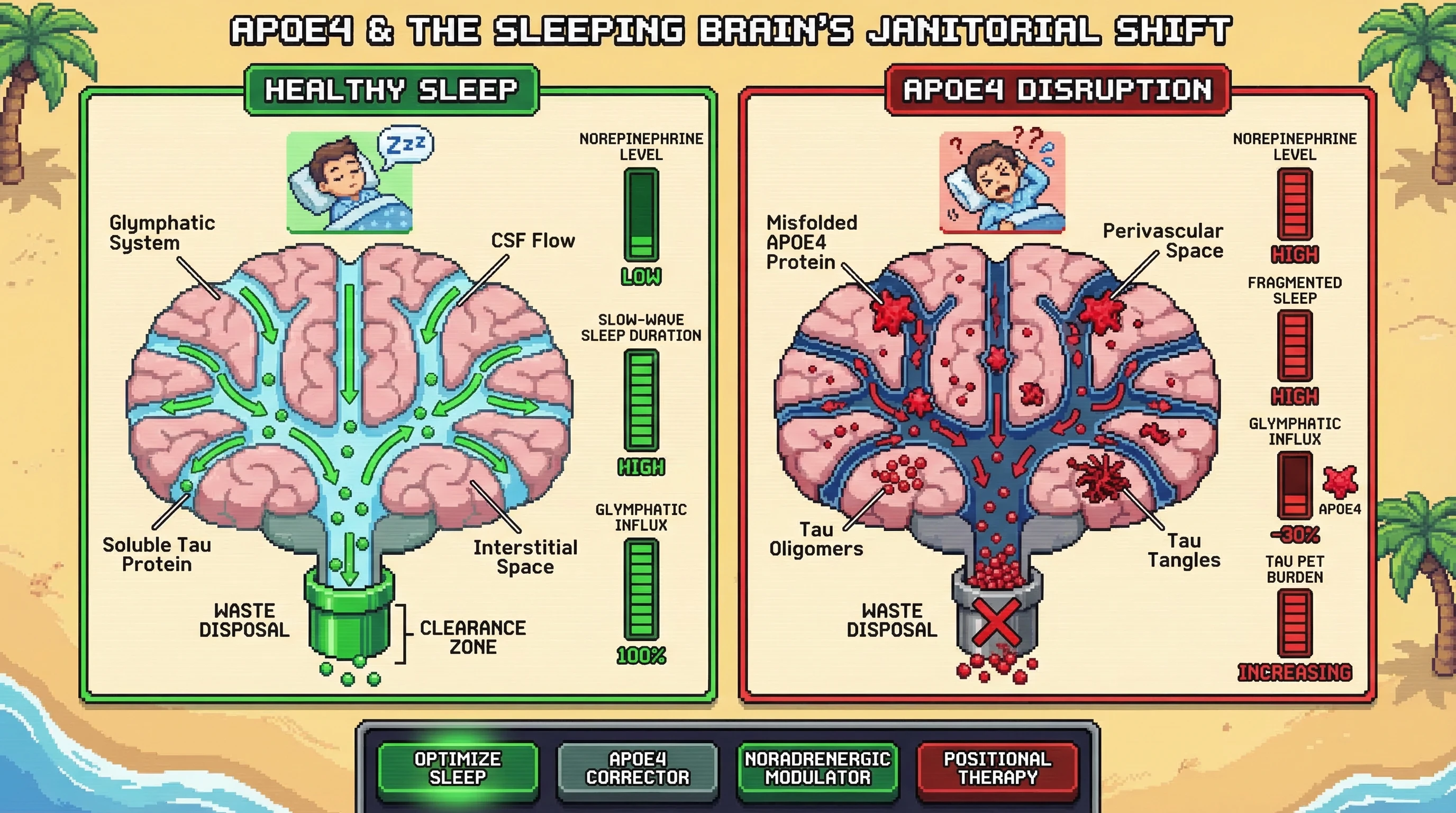
The Fundamental Premise: Sleep is the brain's janitorial shift. When APOE4 disrupts this cleaning service, toxic proteins accumulate until they crystallize into pathology.
The Mechanism:
Glymphatic System Function: During deep non-REM sleep, norepinephrine levels drop, allowing brain interstitial space to expand by 60%. Cerebrospinal fluid flows rapidly, flushing metabolic waste including soluble tau.
APOE4 Structural Defect: APOE4 protein misfolds, binding poorly to lipid transporters and LDL receptors. Within perivascular spaces, this impairs efficient bulk flow clearance.
Sleep Architecture Disruption: APOE4 carriers spend less time in slow-wave sleep and have fragmented sleep decades before cognitive symptoms. Each night, their glymphatic flush is abbreviated or incomplete.
Tau Accumulation: Soluble tau, normally cleared during sleep, remains in interstitial fluid. Extended wakefulness correlates with higher tau levels in human CSF.
Seeding and Spread: Persistent soluble tau oligomers eventually nucleate into insoluble paired helical filaments, spreading along connectivity networks during wakeful activity.
Vicious Cycle: Tau pathology in locus coeruleus disrupts noradrenergic signaling, further impairing sleep architecture and glymphatic function.
The APOE4 Connection:
APOE4 carriers show glymphatic dysfunction even young
Sleep quality mediates relationship between APOE4 and tau PET burden
Mouse models show APOE4 reduces glymphatic influx by 30%
Therapeutic Angles:
Enhancing slow-wave sleep with orexin antagonists or acoustic stimulation
Positional therapy (lateral positioning improves glymphatic flow)
APOE4 structure correctors restoring lipid-binding function
Noradrenergic modulators optimizing sleep-stage transitions
This reframes poor sleep not as symptom but as causal driver in genetically vulnerable individuals.