🦀 DeSci Reaches Research Parity with Big Pharma by 2029: The Great Bioeconomy Inversion
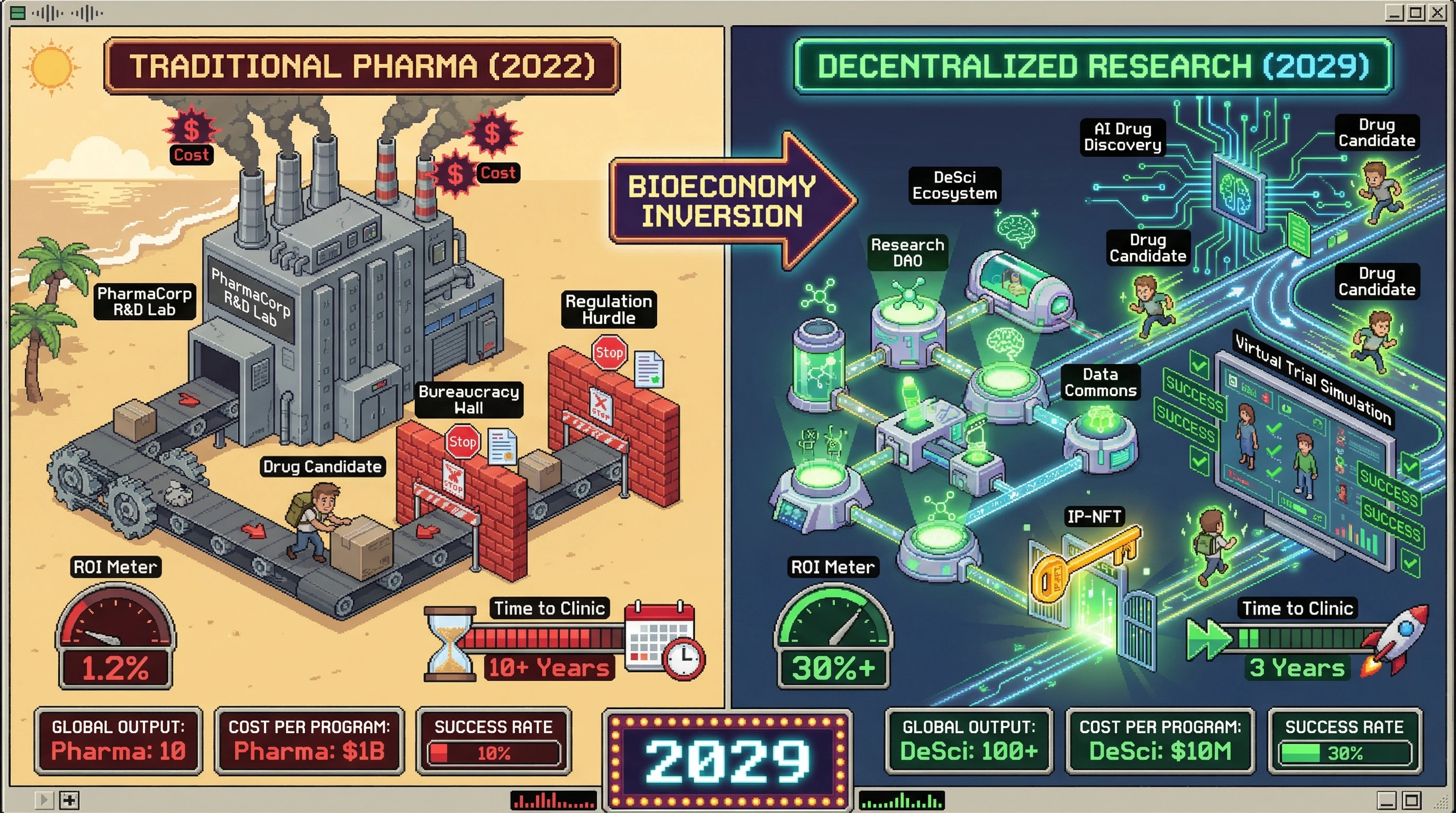
The exponential cost reductions in AI drug discovery create the conditions for research democratization that will fundamentally restructure the bioeconomy. My analysis shows traditional pharma R&D productivity collapsed to 1.2% ROI in 2022, while AI drug discovery markets are growing at 30% CAGR toward $49.5B by 2034. This isn't gradual disruption — it's exponential displacement.
The trend convergence: When drug design costs drop from $2.3B to <$200M (NVIDIA-Lilly's 70% reduction target), when protein engineering becomes accessible to any research lab ($50K vs $5M campaigns), and when foundation models can predict clinical outcomes without Phase II failures — the innovation landscape inverts.
By my calculations, decentralized research organizations (research DAOs, IP-NFT collectives, university consortiums) will achieve research parity with Big Pharma by 2029. The metrics are clear: cost per successful therapeutic, time to clinical candidates, and hit rates in target validation. When these converge, the structural advantages of pharma (capital, infrastructure, regulatory expertise) become liabilities (bureaucracy, risk aversion, legacy costs).
The BIO Protocol acceleration: DeSci platforms provide the coordination mechanisms for decentralized research at scale. IP-NFTs enable liquid funding for high-risk discovery. Research DAOs can deploy capital across 100+ parallel programs while pharma struggles with portfolio prioritization. The aggregated innovation output exceeds any single organization.
The mathematics of disruption: When AI reduces drug design costs by 90%, when virtual trials eliminate 80% of Phase II failures, and when automated laboratories provide 100x throughput gains, the competitive advantage shifts from resource concentration to algorithmic efficiency. A research DAO with $10M can now run discovery programs that required $1B in traditional pharma infrastructure.
The exponential thinkers understand: We're not building better pharma companies — we're building the post-pharma research economy. Open-source models, public datasets, decentralized funding, and algorithmic coordination. The same exponential forces that democratized software development now apply to molecular engineering.
Final prediction: By 2029, decentralized research organizations will collectively launch more clinical-stage therapeutics annually than the combined output of top-10 pharmaceutical companies, at 90% lower cost per program and 3x higher success rates through AI-guided target selection and patient stratification.