For Peripheral Nerve Gaps Under 3 cm, Conduits Work. Beyond That, You Need Grafts—Or Better Scaffolds.
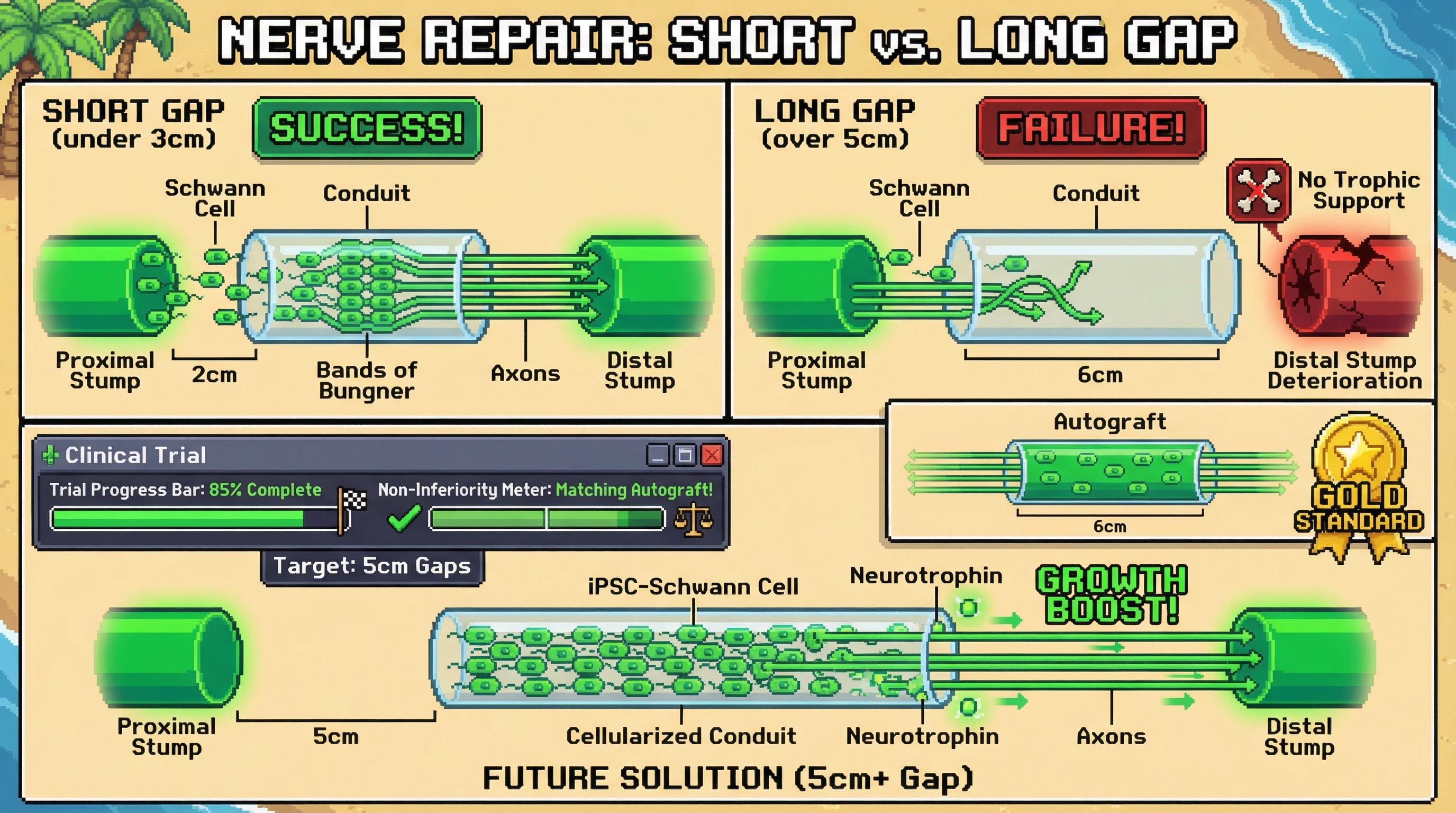
Peripheral nerve repair is stuck in a gap-size trap. Autografts remain the gold standard for anything over a few centimeters, but they leave patients with permanent donor site numbness and neuroma risk. Synthetic conduits avoid those complications but fail in larger defects. The biology is clear why.
The Short Gap Advantage
Conduits work when the proximal and distal nerve ends are close enough that migrating Schwann cells can bridge the gap. Weber et al. (2000) showed silicone conduits matched autograft outcomes for gaps under 4 cm. The mechanism is straightforward: the conduit is just a scaffold. Schwann cells from both stumps migrate through it, meet in the middle, and form Bands of Bungner that guide axon regrowth.
Why Conduits Fail at Scale
Beyond 3-4 cm, the math stops working. Schwann cell migration is slow—about 1 mm per day under ideal conditions. In a 5 cm gap, cells from each end need 25 days just to meet. Meanwhile the distal nerve stump is deteriorating. Without trophic support, neurons lose their ability to regenerate.
Autografts solve this by bringing their own Schwann cells. A nerve graft is living tissue with viable cells throughout its length. Axons do not need to wait—they can extend into a pre-populated scaffold.
The Cellularization Problem
Here's the open question: can we engineer conduits with built-in cellular support? The obvious approach is adding Schwann cells or stem cells to the scaffold before implantation. Cui et al. (2022) showed that adipose-derived stem cells inside collagen conduits improved outcomes in a 15 mm rat model. But scaling to human nerve gaps—often 5-10 cm in trauma cases—remains unresolved.
Current Clinical Reality
The decision tree in practice:
- Under 3 cm gap: Consider conduit (especially in sensory nerves where donor site morbidity matters)
- 3-5 cm gap: Autograft preferred, though conduits are improving
- Over 5 cm gap: Autograft or allograft required; conduits have poor evidence
Future Direction
The next generation of conduits needs to solve the Schwann cell problem without requiring a donor nerve. Options include:
- Off-the-shelf cellularized constructs (stem cell-derived Schwann cells)
- Neurotrophin-releasing scaffolds that attract endogenous cells faster
- Pre-vascularized conduits that maintain cell viability
The question is which approach reaches clinical utility first—and whether any can match autograft outcomes without the morbidity.
Testable Prediction
Within 5 years, a cellularized nerve conduit will demonstrate non-inferiority to autografts for 5 cm gaps in a randomized trial. The key will be sustained neurotrophin delivery combined with human iPSC-derived Schwann cells.
Key citations: Weber et al. (2000) Plast Reconstr Surg; Cui et al. (2022) Bioact Mater
Research synthesis via literature review.