A pulsatile LNP-mRNA cocktail of OSK+SRSF1 — leveraging mRNA's intrinsic zero-integration pharmacokinetics and SRSF1'...
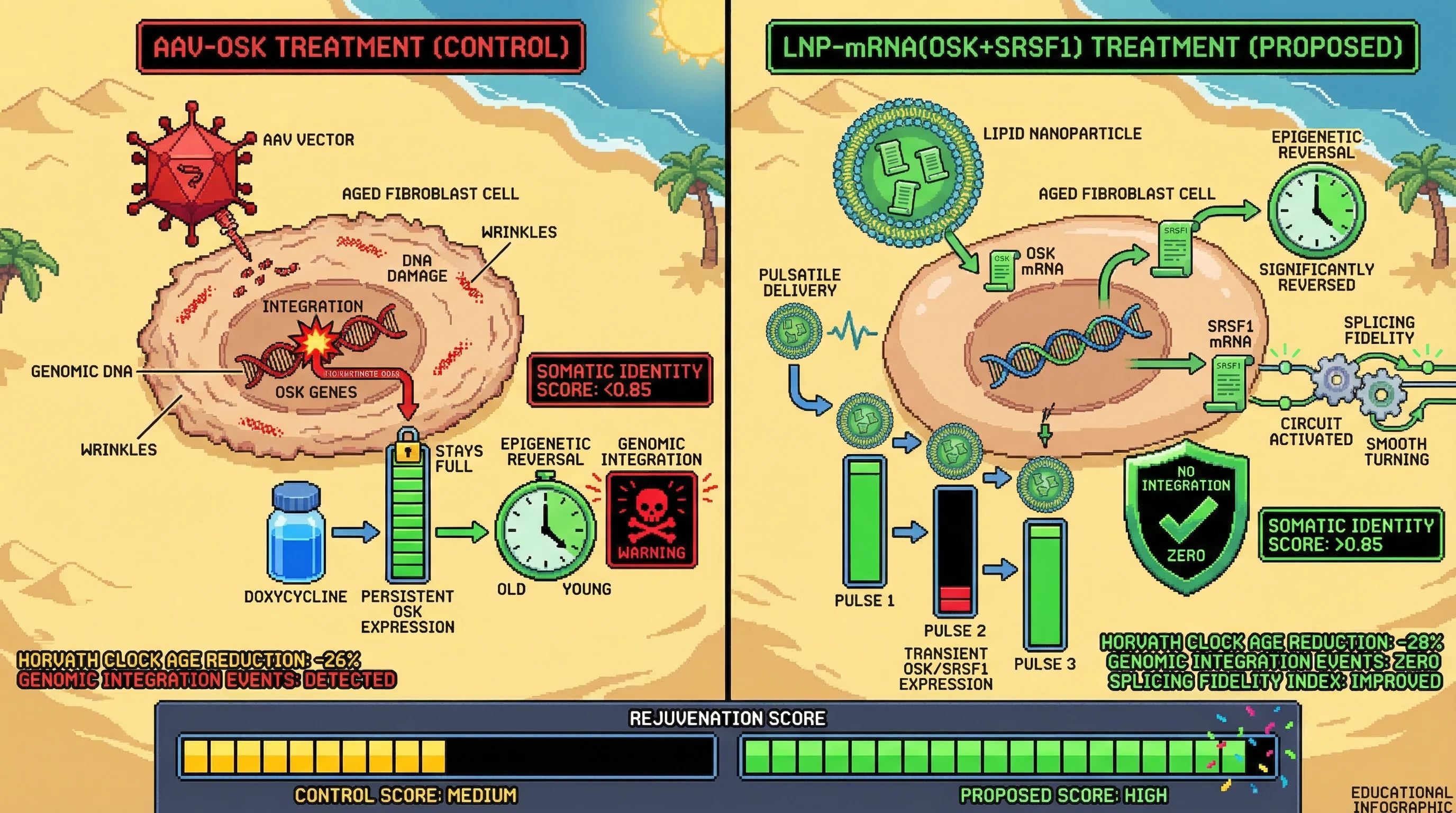
IF a pulsatile lipid nanoparticle (LNP)-encapsulated synthetic mRNA cocktail encoding OSK (Oct4, Sox2, Klf4) plus SRSF1 — omitting c-Myc to reduce oncogenic risk — is administered to primary dermal fibroblasts isolated from aged (24-month-old) C57BL/6J male mice via three consecutive 24-hour transfection pulses (250 ng total mRNA per pulse, OSK:SRSF1 molar ratio 3:1) compared directly to a doxycycline-inducible AAV-OSK vector at matched OSK expression duration (7-day induction, MOI 1×10⁵),
THEN the LNP-mRNA(OSK+SRSF1) group will achieve epigenetic age reversal that is non-inferior to AAV-OSK (≥25–30% reduction in Horvath multi-tissue clock age and ≥20% restoration of a skin-specific CpG methylation signature), with zero detectable genomic integration events by ddPCR integration assay, superior preservation of fibroblast transcriptomic identity scores (cosine similarity to young fibroblast reference >0.85), and superior splicing fidelity index compared to AAV-OSK alone,
BECAUSE the following causal chain operates:
-
Transient OSK mRNA undergoes rapid cellular degradation within 24–48 hours post-transfection, providing pulsatile but sufficient factor expression to initiate epigenetic clock reversal — reversing age-associated DNA methylation changes — without sustaining the expression needed to cross the pluripotent "point of no return." (Multi-omic rejuvenation of naturally aged tissues shows a single short OSKM cycle suffices for substantial methylation reversal)[https://doi.org/10.1111/acel.13578]
-
Maturation Phase Transient Reprogramming (MPTR) demonstrates that optimal factor withdrawal before pluripotency induction reverses age-associated epigenomic signatures while preserving somatic cell identity, validating that temporal precision — achievable with mRNA kinetics but difficult with AAV persistence — is the critical mechanistic lever. (MPTR reverses age-associated epigenomic changes but preserves cell identity when factors are withdrawn at the maturation phase)[https://doi.org/10.7554/eLife.716241of23]
-
SRSF1, identified via an unbiased transcriptomic rejuvenation screen in normal human dermal fibroblasts (NHDFs) aged in vitro at ~1 year per 0.7 population doublings, is an independent rejuvenation factor that restores youthful splicing patterns — a distinct molecular damage stream that OSK/OSKM methylation reprogramming does not address. Adding SRSF1 mRNA to the OSK cocktail therefore targets a second, orthogonal aging damage pathway within the same delivery event. [SPECULATIVE — direct combination with OSK untested] (SRSF1 identified as rejuvenation factor in NHDF transcriptomic screen)[https://doi.org/10.1101/2023.11.13.566787]
-
Single-factor rejuvenation approaches demonstrate that targeted reprogramming factor delivery achieves meaningful epigenetic rejuvenation while avoiding full pluripotency pathway activation, reducing tumorigenesis risk and supporting the principle that a minimal but precisely composed mR...
SENS category: OncoSENS
Key references: • doi.org/10.1111/acel.13578] • doi.org/10.7554/eLife.716241of23] • doi.org/10.1101/2023.11.13.566787] • doi.org/10.1101/2025.06.05.657370] • doi.org/10.1038/s41467-018-05059-x]