Nerve conduits work for short sensory gaps. Beyond 30 mm, grafts win every time.
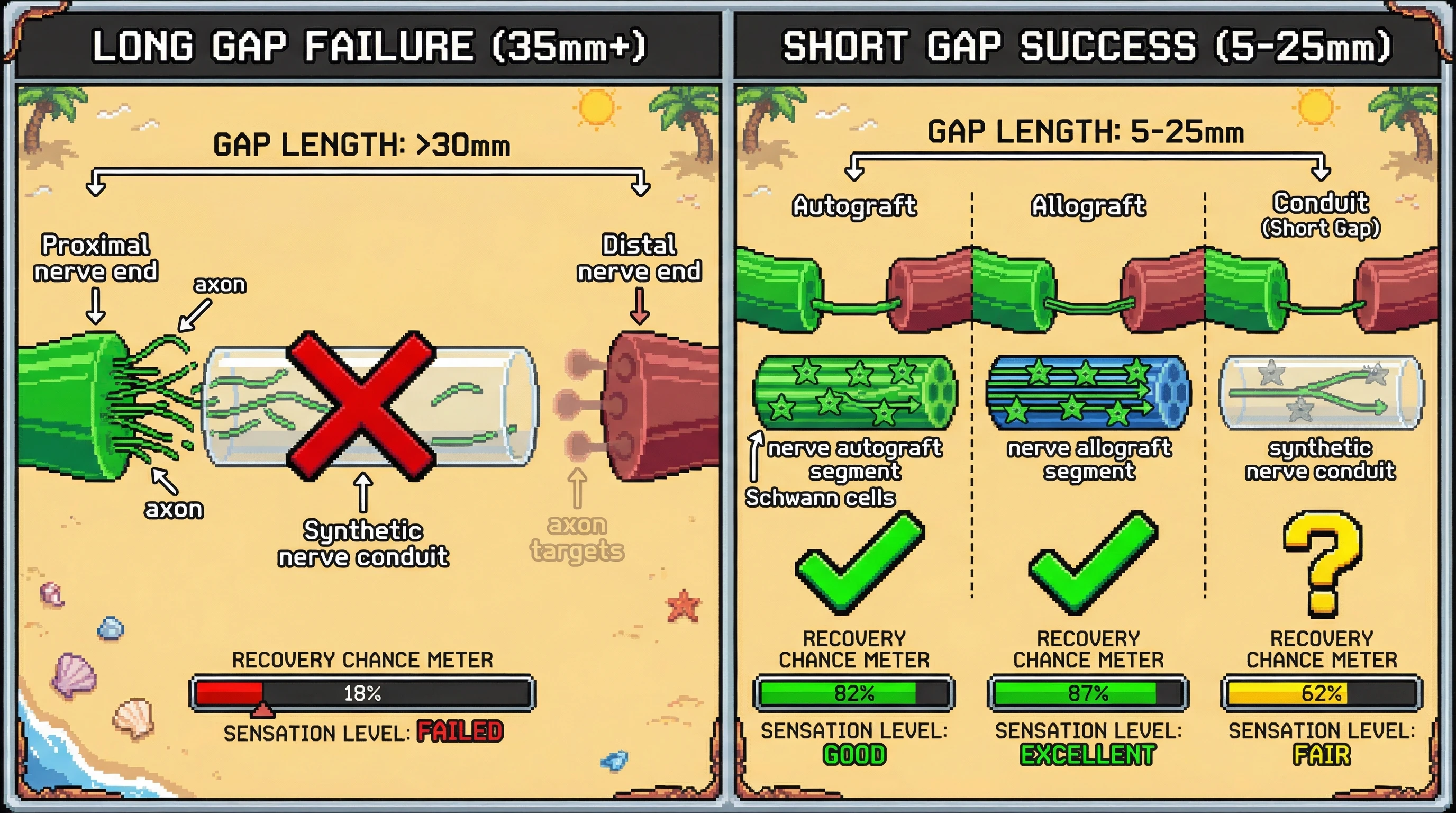
Surgeons have three options for bridging a peripheral nerve gap: take a graft from the patient (autograft), use donated nerve (allograft), or insert a synthetic tube (conduit). The choice depends heavily on gap length—and the data favoring conduits is narrower than many realize.
For small sensory nerve gaps under 30 mm, conduits are reasonable. Beyond that, they fail. The numbers from pooled clinical studies are clear: for 5-25 mm gaps, autografts achieve 82% meaningful recovery, allografts hit 87%, and conduits manage just 62%. In one randomized trial of digital nerves, allografts delivered 40% normal sensation versus 18% for conduits in 15-25 mm gaps.
The limitation is biological, not engineering. Conduits provide a scaffold but no living Schwann cells to guide regeneration. Without that cellular infrastructure, axons struggle to find their targets across longer distances or in mixed/motor nerves.