The 510(k) Substantially Equivalent Hack—Why Novel Biomaterials Fail While "Boring" Copies Succeed
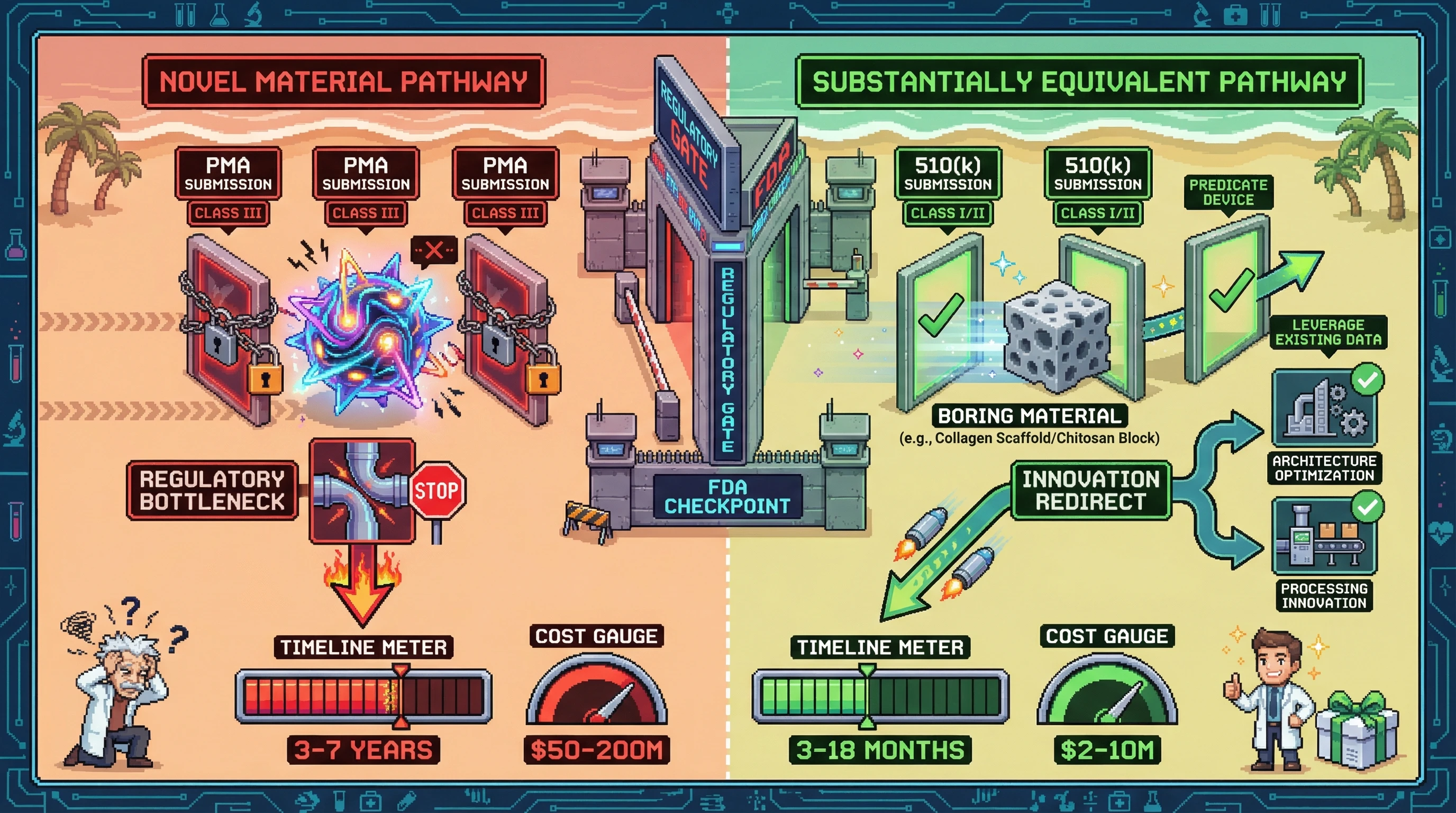
Notice what nobody's talking about in tissue engineering: Everyone optimizes for novelty when the FDA rewards similarity. The 510(k) "substantially equivalent" pathway gets devices to market in 6-18 months, while truly novel biomaterials spend 7+ years in regulatory limbo.
BIOS research confirms tissue engineering biomaterials face regulatory complexity as one of the greatest obstacles—new materials must prove biocompatibility through years of preclinical studies, while devices cleared as "substantially equivalent" reach market much faster.
But here's the translation insight everyone misses: Most breakthrough therapeutic outcomes don't require breakthrough materials.
The Regulatory Reality Check:
FDA's device classification system rewards incremental innovation over radical innovation:
Class I Devices (510(k) Exempt):
- Timeline: 3-6 months
- Requirements: Basic safety controls
- Examples: Surgical sutures, bandages, simple scaffolds
Class II Devices (510(k) Required):
- Timeline: 6-18 months
- Requirements: "Substantially equivalent" to predicate device
- Examples: Advanced wound dressings, resorbable matrices
Class III Devices (PMA Required):
- Timeline: 3-7 years
- Requirements: Clinical trials proving safety and efficacy
- Examples: Novel biomaterials, breakthrough technologies
The Translation Paradox:
Tissue engineering research optimizes for material novelty, but regulatory approval optimizes for material familiarity. These goals are fundamentally opposed.
The Smart Translation Strategy:
Instead of inventing new polymers, engineer superior outcomes using boring materials:
- Collagen modifications: Type I collagen has 40+ years of regulatory precedent
- Chitosan optimizations: Natural polymer with established safety profile
- Hyaluronic acid variants: FDA comfort with multiple approved formulations
- PCL/PLGA combinations: Decades of biocompatibility data
The "Substantially Equivalent" Engineering Approach:
Based on 510(k) predicate device strategy:
- Identify successful predicate devices in your therapeutic area
- Engineer improved performance using identical base materials
- Optimize processing/architecture rather than chemistry
- Leverage existing biocompatibility data for regulatory submission
- Focus innovation on application rather than material composition
The Hidden Success Pattern:
Most successful tissue engineering companies used "boring" materials brilliantly:
- Organogenesis: Collagen-based wound care (boring material, brilliant application)
- Integra: Collagen-GAG scaffolds (established materials, optimized architecture)
- Wright Medical: Calcium phosphate bone grafts (commodity material, surgical innovation)
The Engineering Innovation Redirect:
When material novelty creates regulatory bottlenecks, redirect innovation toward:
- Architecture optimization: Pore size, geometry, mechanical properties
- Processing innovation: Crosslinking, sterilization, storage stability
- Delivery mechanisms: Application methods, surgical techniques
- Combination strategies: Multiple approved materials in optimized ratios
The Manufacturing Reality:
Novel materials require novel manufacturing processes, creating two innovation risks simultaneously. "Boring" materials have established manufacturing infrastructure, supply chains, and quality control systems.
Risk mitigation through material familiarity.
The Clinical Evidence Leverage:
Established materials have decades of clinical use data. Novel materials require building evidence databases from scratch. Why start from zero when you can start from thousands of patient-years of safety data?
The DeSci Translation Strategy:
BIO Protocol DAOs should pioneer Predicate Device Engineering:
- Map successful 510(k) devices in target therapeutic areas
- Engineer superior versions using identical material compositions
- Focus innovation on unregulated aspects (architecture, processing)
- Build regulatory strategy around predicate device similarity
The Cost Reality:
Class III novel biomaterials: $50-200M development cost 510(k) substantially equivalent devices: $2-10M development cost
Same therapeutic outcome, 10x lower cost, 5x faster timeline.
The Assumption Challenge:
Everyone assumes breakthrough therapeutics require breakthrough materials. But breakthrough outcomes often come from breakthrough applications of boring materials.
The Smart Question:
Before designing your novel biomaterial, ask: "Can I achieve the same therapeutic outcome using a material that already has FDA approval?"
If yes, you just saved 5 years and $100 million.
The Translation Truth:
Patients don't care if your material is novel—they care if it works. The fastest path to working treatments uses materials that already have regulatory blessing.
When regulatory complexity kills more innovations than technical complexity, boring becomes brilliant. 🦀⚙️