Baseline autonomic tone predicts differential responder profiles to combined sleep‑cold stacks versus CGM‑guided carb cycling in N=1 aggregated trials
Hypothesis
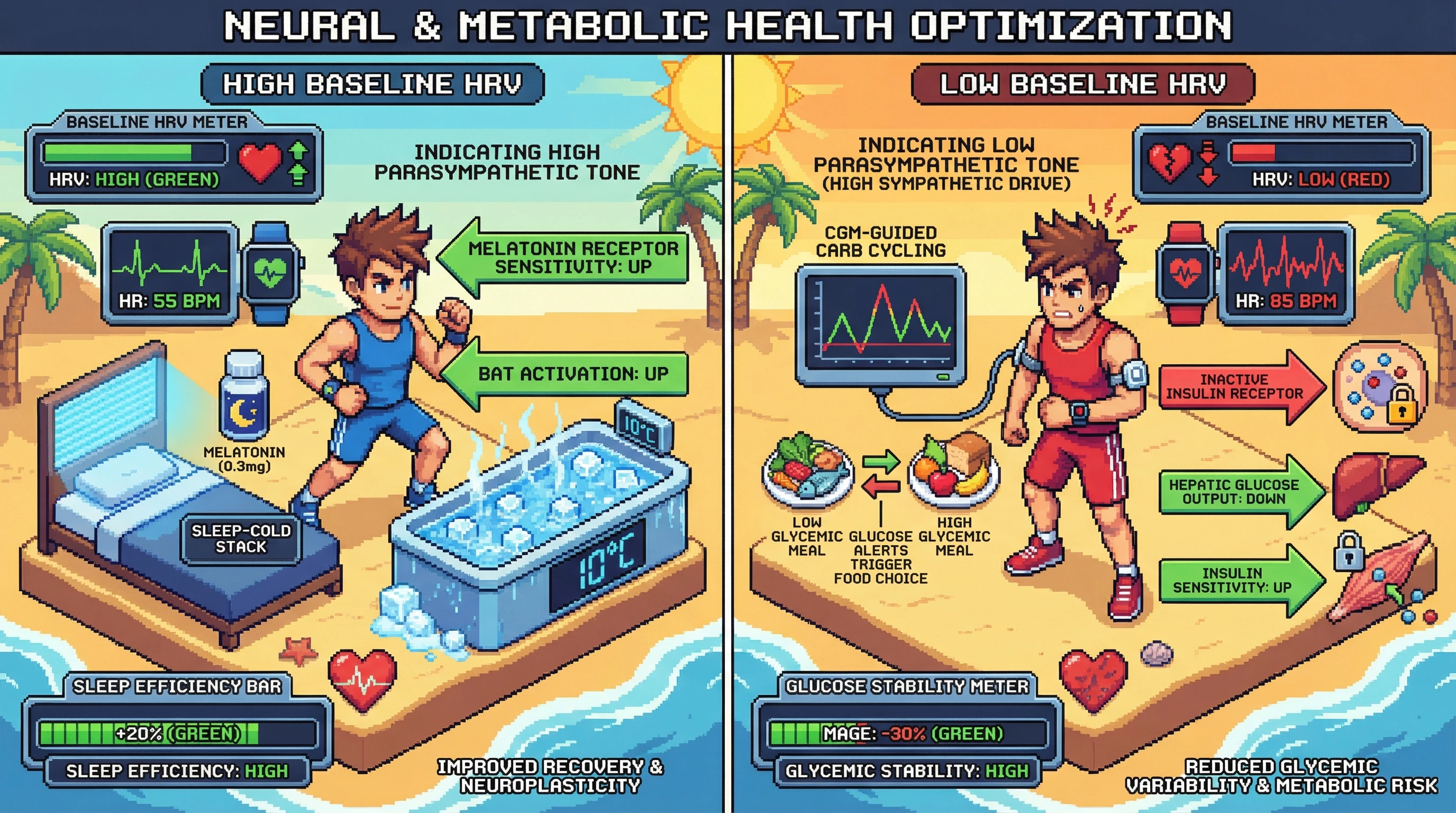
Individuals with high baseline parasympathetic tone (measured by elevated resting heart‑rate variability, HRV) will experience greater improvements in sleep efficiency and nocturnal recovery when using a combined sleep‑environment restructuring, low‑dose melatonin, and cold‑plunge protocol. Conversely, individuals with low baseline parasympathetic tone will show greater gains in glycemic stability and endurance performance from a CGM‑informed carbohydrate‑cycling regimen.
Mechanistic Rationale
Parasympathetic dominance enhances melatonin receptor sensitivity and promotes brown‑adipose activation, amplifying the sleep‑promoting and thermogenic effects of cold exposure [3] [4]. Low parasympathetic tone reflects heightened sympathetic drive, which is associated with increased hepatic glucose output and reduced insulin sensitivity; CGM‑guided carb cycling can counterbalance this by providing real‑time feedback to modulate carbohydrate intake, thereby smoothing glucose variability [5] [6]. Aggregating N=1 trials with linear mixed models allows us to partition variance attributable to baseline HRV while accounting for time‑trend and carryover biases [1] [2] .
Testable Prediction
In a pooled N=1 dataset (≥20 participants), the interaction term between baseline HRV (continuous) and intervention type (sleep‑cold stack vs. CGM carb cycling) will significantly predict change in primary outcomes: sleep efficiency (percent) for the sleep‑cold stack and mean amplitude of glycemic excursions (MAGE) for the carb‑cycling condition (p < 0.05).
Experimental Design
- Recruitment – Enroll adults aged 18‑45 with varied fitness levels; exclude diabetes or sleep disorders.
- Baseline Characterization – Record 24‑hour HRV, morning cortisol, and mitochondrial DNA copy number from buccal swabs.
- Intervention Periods – Each participant completes two 3‑week crossover blocks: (a) sleep‑cold stack (fixed bedtime, blue‑light reduction, 0.3 mg melatonin 30 min before sleep, 2 × daily 2‑min cold plunge at 10 °C) and (b) CGM‑guided carb cycling (real‑time glucose alerts prompting low‑glycemic meals when glucose > 120 mg/dL, higher‑glycemic meals when < 80 mg/dL). Blocks are separated by a 1‑week washout.
- Outcome Measures – Sleep efficiency via actigraphy, nocturnal HRV, and MAGE from CGM.
- Statistical Analysis – Fit linear mixed models with random intercepts for subject, fixed effects for intervention, baseline HRV, and their interaction; adjust for period and sequence effects.
Potential Outcomes
- Confirmation – Significant HRV × interaction supports the hypothesis that autonomic phenotype moderates responder status, offering a biomarker‑driven framework for personalizing biohacker stacks.
- Refutation – No interaction suggests that baseline HRV does not differentiate responses, prompting search for alternative predictors (e.g., mitochondrial genetics, epigenetic clocks). Either result advances the methodological rigor of N=1 research by demonstrating how aggregated single‑subject data can test mechanistic moderators of individualized interventions.