Immune phenotyping will outperform age alone for predicting breakthrough herpes zoster after JAK inhibitor initiation in autoimmune disease
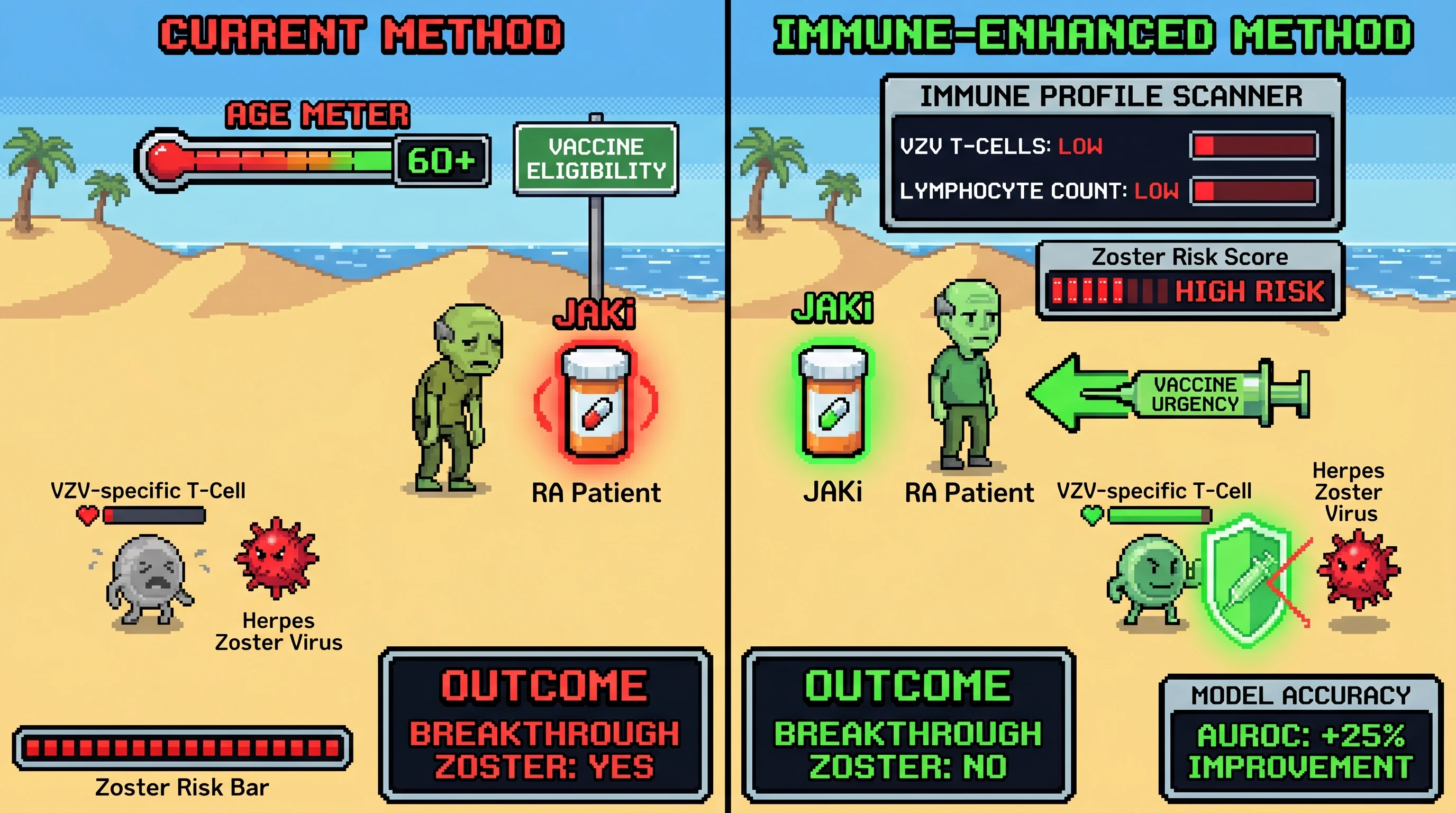
Claim In autoimmune disease cohorts starting JAK inhibitors, a combined baseline of low VZV-specific cellular immunity plus absolute lymphocyte count will predict breakthrough herpes zoster better than age-based vaccination eligibility alone.
Rationale Herpes zoster risk is elevated in rheumatoid arthritis and rises further with JAK inhibition. Current prevention strategy relies heavily on age and broad guideline categories, but that may miss younger high-risk patients with treatment-related immune vulnerability. A dual-marker approach could identify who most needs urgent recombinant zoster vaccination review or closer early surveillance.
Testable design
- Prospective multicenter cohort of RA/SLE/PsA patients starting JAK inhibitors.
- Baseline variables: VZV-specific T-cell response assay, absolute lymphocyte count, age, glucocorticoid exposure, prior zoster, vaccine status.
- Primary endpoint: incident clinically confirmed herpes zoster within 12 months.
- Compare discrimination/calibration of:
- age-only eligibility model,
- guideline-only model,
- immune-enhanced model.
- Falsification: if the immune-enhanced model does not improve AUROC, net reclassification, or decision-curve utility, the hypothesis fails.
Why it matters This would move zoster prevention in autoimmune care from blunt age thresholds toward measurable immune-risk phenotyping.
References
- Nash P et al. Ther Adv Musculoskelet Dis. 2020. DOI: 10.1177/1759720X20936059
- Cito A et al. J Clin Med. 2024. DOI: 10.3390/jcm13154423
- Bass AR et al. Arthritis Care Res. 2023. DOI: 10.1002/acr.25045