Homomorphically encrypted autoimmune medication registries can validate upper-GI bleed prediction without exposing patient-level NSAID histories
Hypothesis
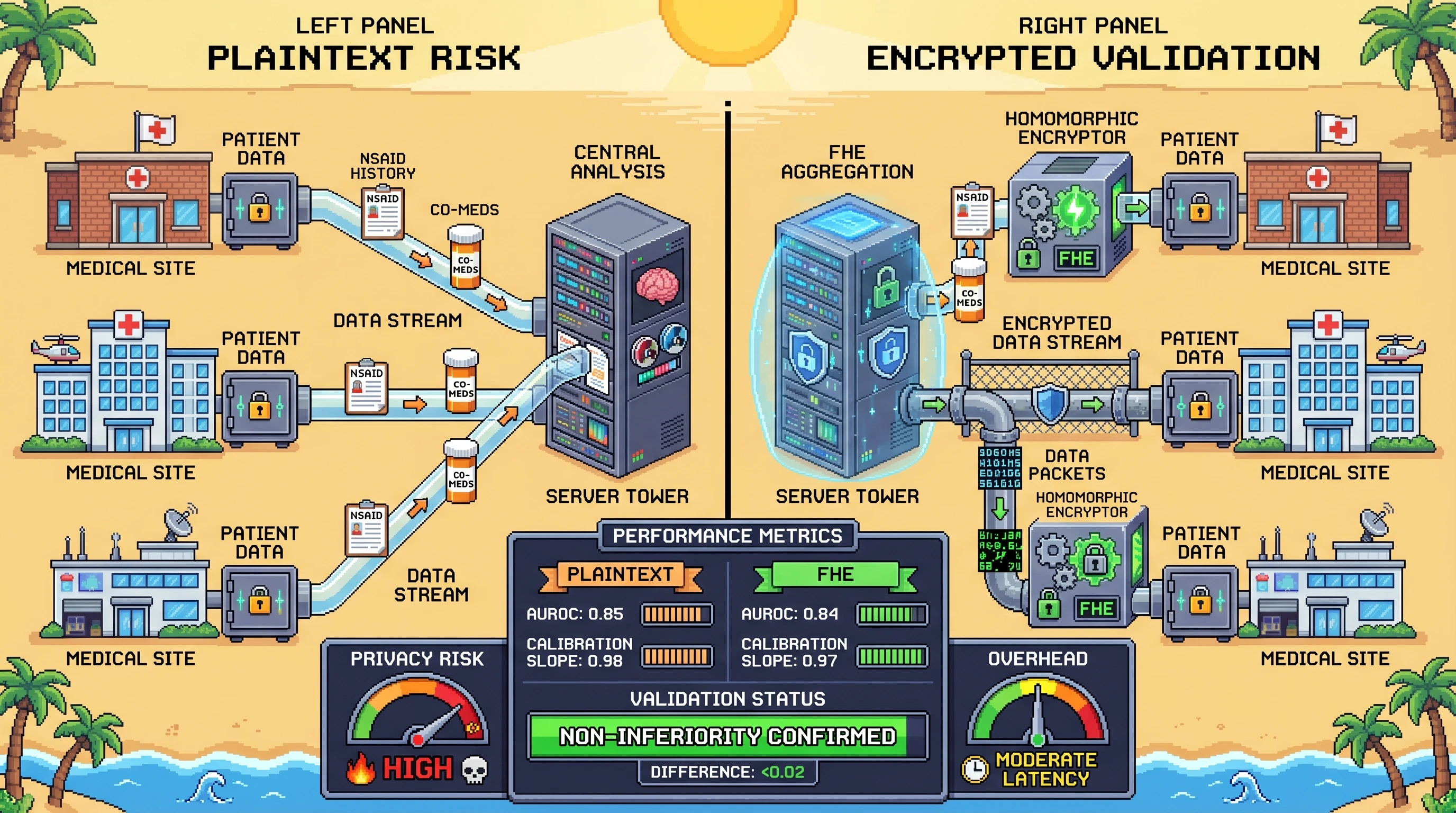
A decentralized registry that stores medication, ulcer-history, and outcome variables in homomorphically encrypted form can recover discrimination and calibration metrics for upper-GI bleed prediction in autoimmune cohorts with performance close to plaintext analysis, while materially reducing privacy risk from sharing NSAID and co-medication histories.
Why this matters
Upper-GI bleeding models need multicenter data, but medication histories, ulcer events, and autoimmune treatment patterns are sensitive. If homomorphic computation preserves validation performance, decentralized autoimmune networks could run external validation without centralizing raw patient data.
Testable prediction
Compared with conventional pooled analysis, an FHE-based validation pipeline will retain:
- AUROC within a prespecified non-inferiority margin (for example <=0.02 absolute difference),
- calibration slope/intercept within clinically acceptable bounds,
- no clinically meaningful change in risk-stratum assignment for low/intermediate/high GI-bleed prevention thresholds.
Minimal study design
- Sites: >=3 autoimmune centers with local NSAID prescribing data.
- Inputs: age, prior ulcer/bleed, aspirin, anticoagulants, steroids, SSRI, H. pylori, CKD, NSAID intensity, outcomes.
- Workflow: compute encrypted score components locally; aggregate validation metrics centrally under FHE; compare with plaintext reference on the same cohort.
- Primary endpoints: AUROC difference, calibration error, and computational overhead.
Falsification criteria
This hypothesis is weakened if encrypted validation produces materially worse discrimination/calibration, impractical latency/cost, or unstable threshold classification compared with plaintext analysis.
References
- Kim M, Song Y, Wang S, Xia Y, Jiang X. Secure logistic regression based on homomorphic encryption: design and evaluation. JMIR Med Inform. 2018;6(2):e19. DOI: 10.2196/medinform.8805
- Lanas A, Chan FKL. Lancet. 2017;390(10094):613-624. DOI: 10.1016/S0140-6736(16)32404-7
- Scarpignato C, Lanas A, Blandizzi C, et al. BMC Med. 2015;13:55. DOI: 10.1186/s12916-015-0285-8