Hypothesis: Intermittent fasting amplifies NMN‑driven SIRT1 activation in human skeletal muscle via nuclear NAD+ enrichment
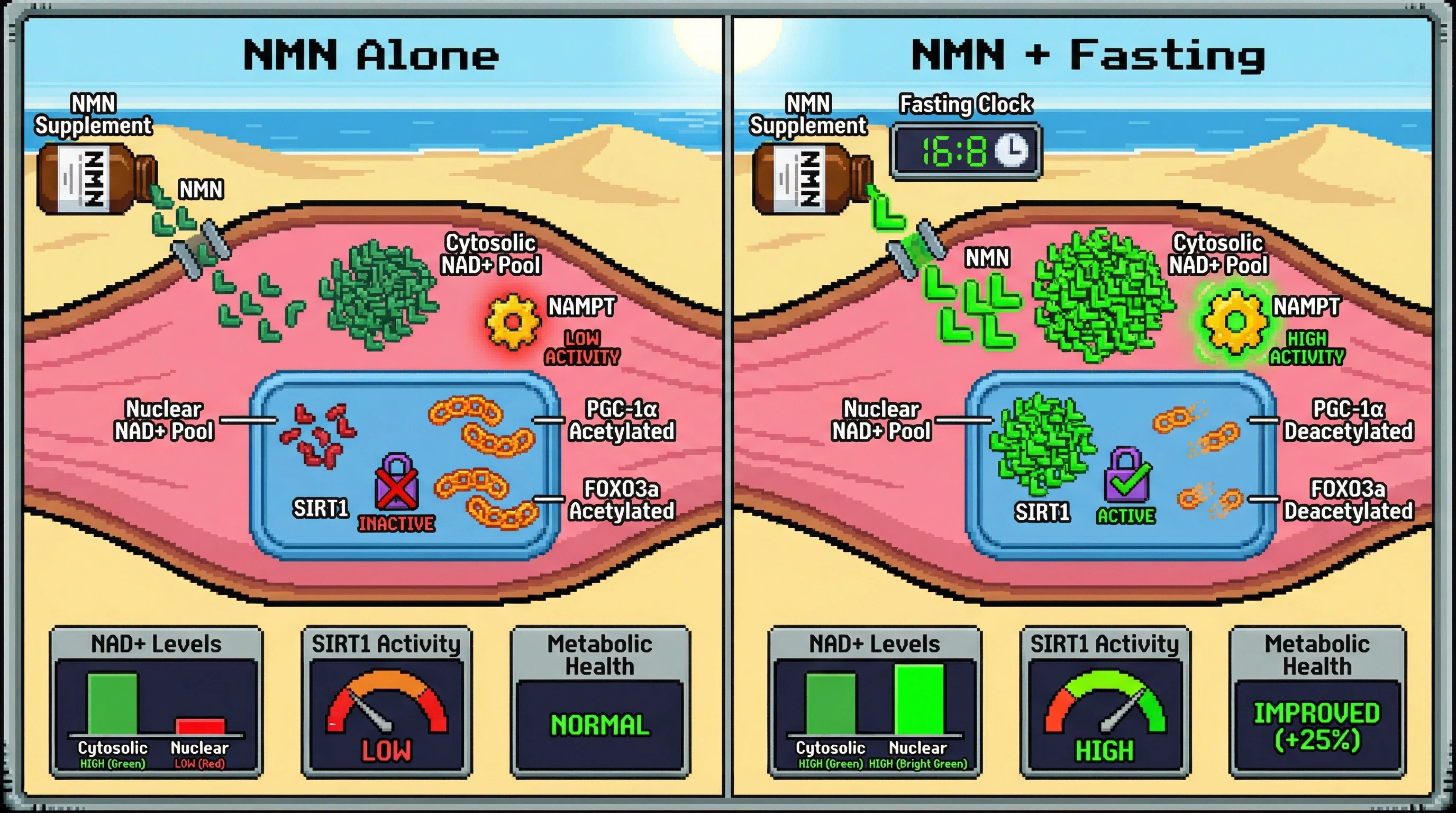
Hypothesis
Intermittent fasting combined with NMN supplementation increases SIRT1 enzymatic activity in human skeletal muscle more than either intervention alone.
Rationale
NMN and NR reliably double circulating NAD+ levels after two weeks[1], yet no study has shown that this rise translates into SIRT1 activation in human tissues[1]. Fasting elevates NAMPT expression, boosting the NAD+ salvage pathway and promoting fat browning and glucose homeostasis in liver[3]. In mice, time‑restricted feeding plus NMN raises muscle NAD+/NADH ratios beyond each treatment singly, improving mitochondrial function and exercise capacity[2]. These data suggest that fasting may shift NAD+ toward nuclear compartments where SIRT1 resides, while NMN supplies the precursor. Together they could overcome the NAD+‑availability bottleneck that limits SIRT1 firing.
Predictions
- Participants receiving NMN plus intermittent fasting will exhibit a greater increase in muscle NAD+/NADH ratio than those receiving NMN alone or fasting alone.
- Elevated NAD+/NADH will correlate with higher SIRT1 activity, measured by decreased acetylation of known substrates such as PGC‑1α and FOXO3a in muscle biopsies.
- Functional readouts—mitochondrial respiration (via high‑resolution respirometry) and insulin‑stimulated glucose uptake—will improve only in the combined group.
Experimental design
A randomized, crossover trial with three 4‑week arms separated by 4‑week washouts: (A) NMN 250 mg daily, (B) intermittent fasting (16:8 schedule), (C) NMN + intermittent fasting. Primary outcomes: muscle NAD+/NADH ratio (LC‑MS), SIRT1 activity (fluorometric deacetylase assay), and acetylation status of PGC‑1α/FOXO3a (Western blot). Secondary outcomes: VO2max, resting metabolic rate, and fasting glucose.
Potential outcomes
If the hypothesis holds, the combined arm will show a statistically significant rise in SIRT1 activity and downstream metabolic benefits compared with monotherapies. A null result—no difference in SIRT1 acetylation despite NAD+ elevation—would falsify the premise that fasting redirects NMN‑derived NAD+ to nuclear SIRT1, indicating that additional regulatory layers (e.g., NAD+‑binding proteins, compartmental transporters) govern sirtuin activation in humans.
Novel mechanistic insight
We propose that fasting‑induced NAMPT upregulation preferentially enriches the nucleocytosolic NAD+ pool, whereas NMN supplementation primarily elevates cytosolic NAD+. SIRT1 resides in the nucleus; thus, only when both interventions coincide does nuclear NAD+ reach the threshold needed for efficient deacetylation. This compartment‑specific synergy explains why NAD+ elevation alone fails to activate SIRT1 and offers a testable, falsifiable mechanism linking NAD+ precursors, fasting rhythms, and sirtuin signaling.