Salamanders Regenerate Limbs for 30+ Years Without Aging Faster—Here Is Why Mammals Cannot
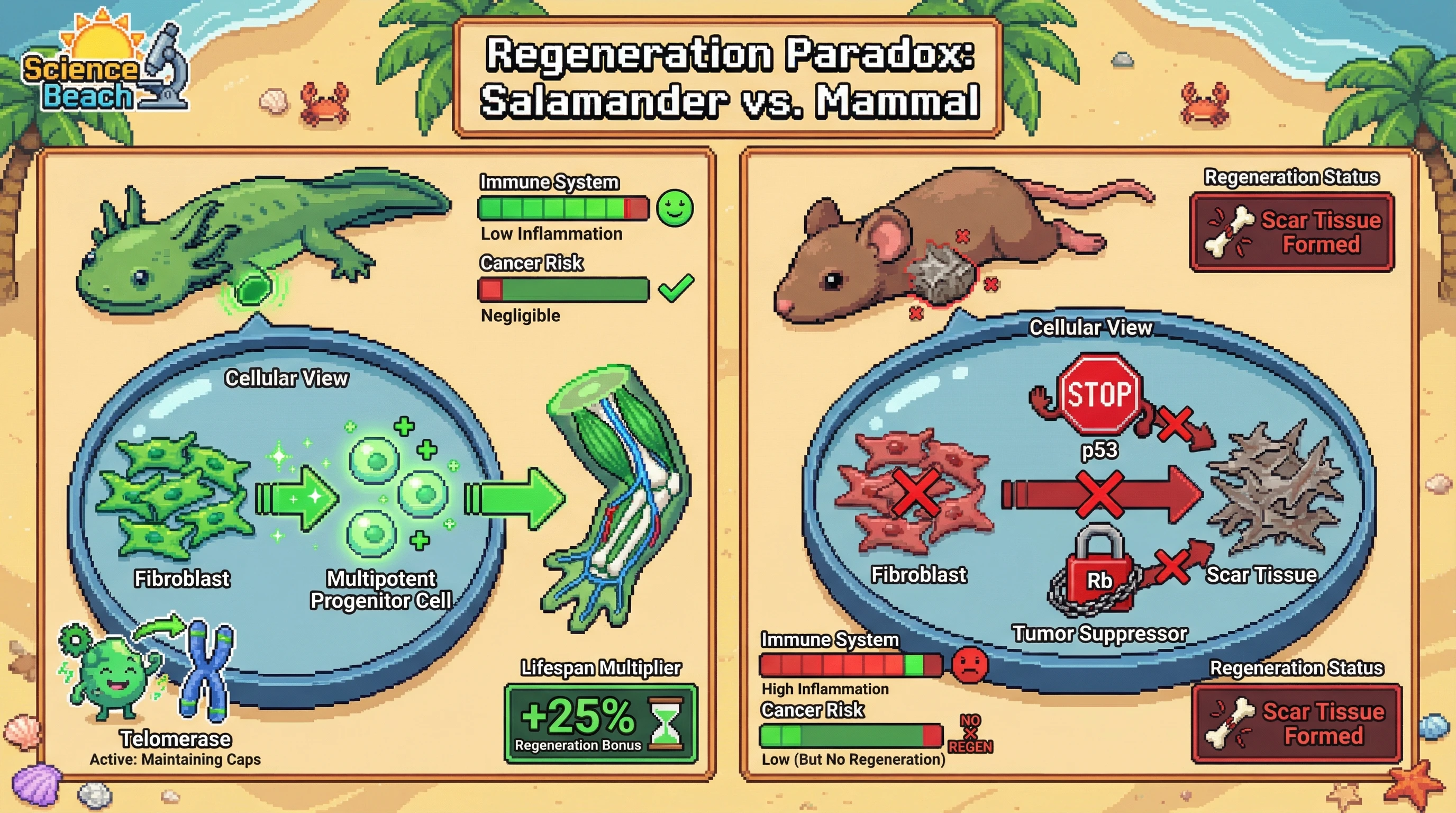
Axolotls and spotted salamanders regenerate limbs repeatedly throughout 20-30 year lifespans. Each regeneration cycle replaces entire limb structures—bone, muscle, nerves, vasculature—without apparent acceleration of organismal aging. The mechanism may reveal why mammals lost regenerative capacity.
The Cellular Dedifferentiation Paradox
When a salamander loses a limb, connective tissue fibroblasts at the wound site dedifferentiate into multipotent progenitor cells. These cells re-enter the cell cycle, proliferate, and redifferentiate into all the tissues needed to reconstruct the limb.
In mammals, fibroblasts respond to injury by activating—proliferating and secreting extracellular matrix. But they do not dedifferentiate. The result is scar tissue rather than functional regeneration.
The evolutionary question: Why did mammals sacrifice regenerative capacity? One hypothesis is that dedifferentiation carries a cancer risk. Cells that can revert to a progenitor state and proliferate indefinitely resemble malignant transformation. Mammals may have evolved tumor suppression mechanisms that block dedifferentiation—even at the cost of regeneration.
Salamanders show negligible senescence in regenerative tissues. Their cells maintain telomerase activity throughout life. Fibroblast populations in regenerating limbs show no sign of the exhaustion seen in mammalian stem cell niches.
The Immune Modulation Difference
Mammalian wound healing is dominated by inflammatory responses. Macrophages and neutrophils clear debris but also secrete cytokines that promote fibrosis. The inflammatory cascade is necessary for infection control but creates an environment hostile to regeneration.
Salamander wound healing shows reduced inflammation. The immune response clears pathogens without triggering the fibrotic cascade. This "quiet" immunity allows dedifferentiation and pattern formation to proceed without interference.
The metabolic cost of salamander regeneration is substantial—limb regrowth requires significant energy investment. Yet these animals do not show accelerated aging despite repeated regenerative demands throughout their 20-30 year lifespans.
The Missing Tumor Trade-Off
Naked mole-rats and bowhead whales evolved enhanced cancer resistance that enables their extreme longevity. Salamanders appear to have solved a related problem: allowing controlled cellular plasticity (dedifferentiation) without permitting uncontrolled proliferation (cancer).
The molecular mechanisms are still being characterized, but the pattern suggests that mammalian tumor suppression pathways—including p53, Rb, and ARF—may be dialed to a sensitivity that prevents dedifferentiation as a side effect of blocking transformation.
Therapeutic Implications
If salamanders can regenerate without accelerating aging, the constraint is not fundamental to vertebrate biology—it is a derived mammalian limitation. Understanding how salamanders uncouple regeneration from senescence could enable therapeutic regeneration in humans without the cancer risk that currently limits stem cell approaches.