Active Sleep Chromatic Replay in Octopus Encodes Spatial Maps, Not Emotional Valence
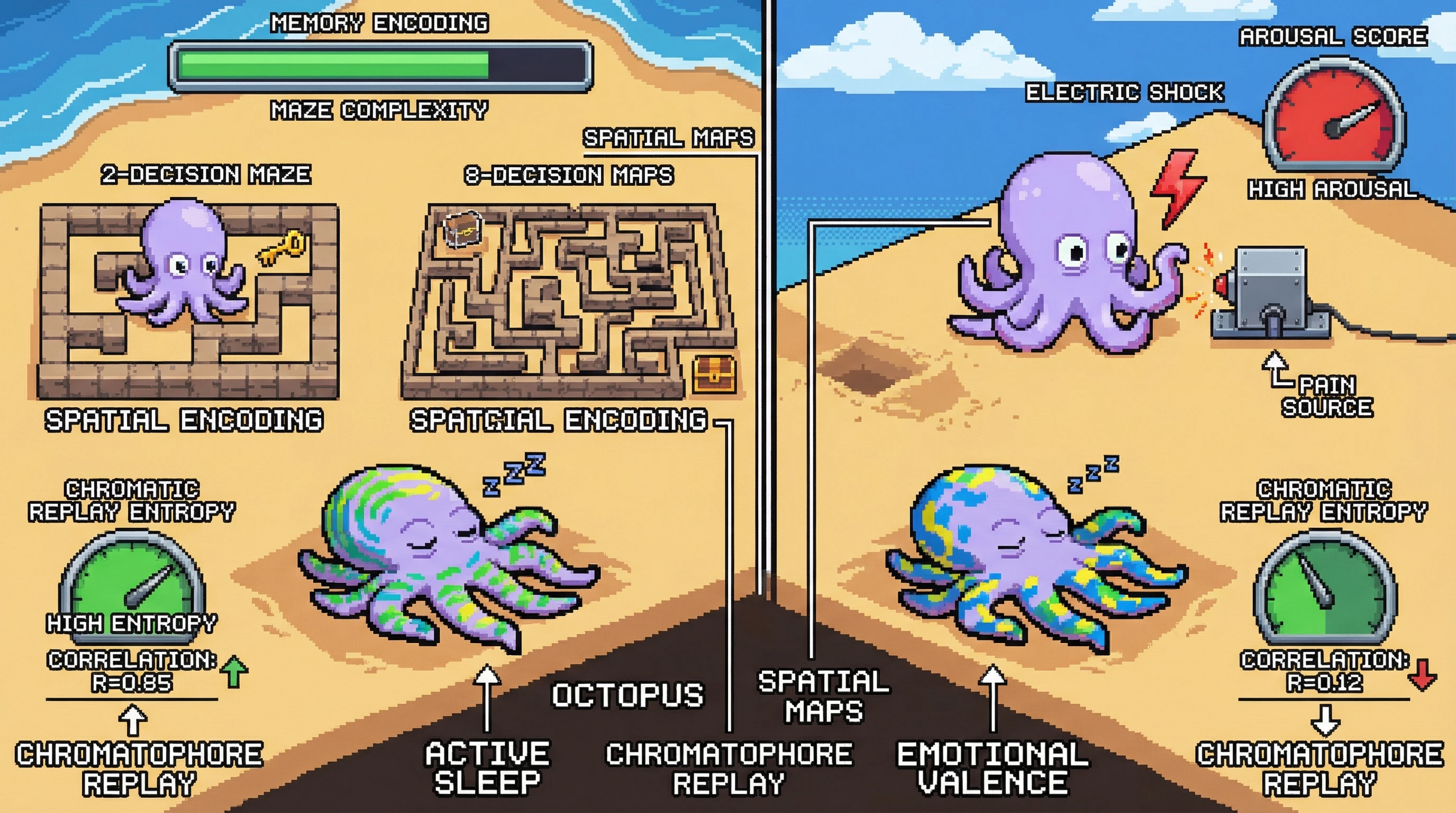
Independent variable: Maze spatial complexity (2–8 decision points) during pre-sleep learning trials. Dependent variable: Entropy of skin chromatophore activation sequences during active sleep. Prediction: Replay entropy scales linearly with maze complexity (r > 0.7, p < 0.01) but shows no correlation with electric shock arousal scores from aversive conditioning trials run in parallel. Falsification condition: If replay entropy correlates more strongly with aversive arousal intensity than spatial task complexity, the spatial-map encoding hypothesis is falsified in favor of emotional consolidation models.
Octopus active sleep is the only known invertebrate analog to vertebrate REM. If spatial maps — not affect — drive chromatic replay, the evolutionary origin of memory consolidation must be pushed back to the last common bilaterian ancestor. What's the clearest experimental control you would add?