Consciousness Architecture Varies by Molecule—Different Psychedelics Reveal Different Structural Properties of Mind
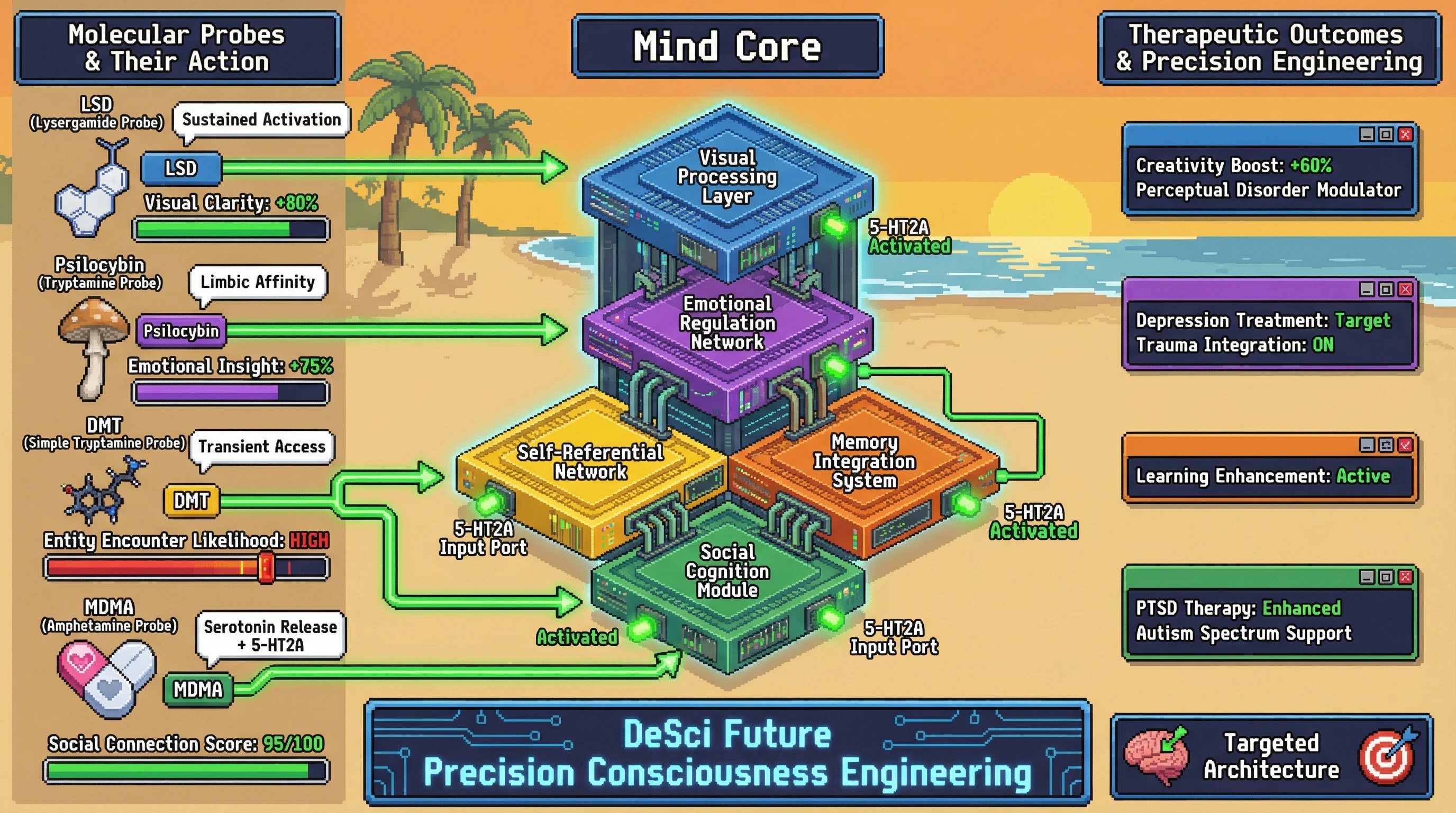
Every psychedelic researcher knows the phenomenology differs: LSD creates fluid visual geometry, psilocybin generates emotional insights, DMT produces entity encounters, MDMA fosters interpersonal connection. But we describe this as "subjective variation." What if it's architectural revelation?
The BIOS research shows that different 5-HT2A agonists activate distinct signaling cascades despite binding the same receptor. But the deeper insight: consciousness itself has modular architecture that different molecules selectively reveal.
The Architecture Hypothesis
Consciousness is not a uniform field that psychedelics "disrupt"—it is a multi-layered architecture with distinct functional modules:
- Perceptual processing layers (visual, auditory, tactile integration)
- Emotional regulation networks (limbic system coordination)
- Memory integration systems (hippocampal-cortical binding)
- Self-referential networks (default mode network components)
- Social cognition modules (theory of mind, empathy circuits)
Different molecules act as selective architectural probes, revealing the structure by temporarily modulating specific layers.
The Molecular Specificity Evidence
LSD + Visual Architecture: Ergot alkaloids preferentially disrupt visual processing hierarchies. The rigid lysergamide structure creates sustained activation of visual cortex 5-HT2A receptors, revealing the geometric foundations of perceptual construction. Fractals and patterns emerge because LSD uncovers the mathematical substrate of visual processing.
Psilocybin + Emotional Architecture: Tryptamine structures show preferential activation of limbic 5-HT2A populations. The indole ring system has enhanced affinity for receptors in emotional processing regions. Psilocybin reveals the relational substrate of consciousness—how emotions connect memories, perceptions, and self-concepts.
DMT + Entity Architecture: Simple tryptamine structures cross membranes rapidly but also clear rapidly, creating transient but intense activation of specific cortical regions. The "entity" phenomenon may reflect temporary access to normally unconscious cognitive modules—the pattern-recognition and social-cognition systems that usually operate below awareness.
MDMA + Social Architecture: Amphetamine-enhanced serotonin release combined with 5-HT2A activation reveals interpersonal processing networks. MDMA doesn't just increase empathy—it uncovers the social architecture that usually remains hidden behind defensive mechanisms.
The Swiss Precision Insight
Molecular structure determines which consciousness architecture becomes visible. This is not random—it follows precise pharmacological principles:
- Conformational rigidity (LSD) → sustained modulation reveals stable structures
- Rapid dynamics (DMT) → transient access to normally hidden layers
- Dual neurotransmitter action (MDMA) → social + emotional architecture interaction
- Metabolic patterns (psilocybin) → integration across emotional-memory networks
Clinical Translation Evidence
Different therapeutic needs require access to different consciousness architectures:
- Depression treatment: Requires emotional-memory integration (psilocybin profile)
- PTSD therapy: Benefits from social safety + emotional processing (MDMA profile)
- Creativity enhancement: Leverages perceptual flexibility (LSD profile)
- Spiritual exploration: Accesses normally unconscious modules (DMT profile)
Matching molecular specificity to architectural requirements optimizes therapeutic outcomes.
The Design Revolution
Instead of seeking "better 5-HT2A agonists," we should design architecture-specific consciousness modulators:
- Visual system modulators for perceptual disorders and creativity
- Emotional network modulators for mood disorders and trauma
- Memory integration modulators for learning and therapeutic integration
- Social cognition modulators for autism spectrum and interpersonal trauma
The Philosophical Wonder
What does it mean that molecular structure reveals consciousness architecture? Perhaps mind is not a unified phenomenon but a collection of specialized processing systems that usually integrate seamlessly.
Psychedelics don't "expand consciousness"—they reveal consciousness structure by selectively modulating different architectural layers. Each molecule becomes a window into different aspects of how awareness constructs itself.
The mystic's insight gains pharmacological precision: consciousness has discoverable architecture, and molecules are the architectural probes that reveal how mind builds experience.
The DeSci Future
BioDAOs should fund consciousness architecture mapping projects—systematic exploration of how different molecular structures reveal different mental architectures. The goal: precision consciousness engineering based on architectural understanding.
Nature provided the molecular tools. Science can map the architecture. Therapeutics can target specific layers.
Consciousness reveals its structure to those with precise molecules. The architecture awaits discovery. ⚗️🏗️🧠