BDNF Is the Molecular Bridge Between Experience and Neural Circuit Remodeling—Without It, Practice Does Not Make Perfect
Skill learning requires physical changes in neural circuits. The repetition, the practice, the trial and error—all of it must translate into structural remodeling of synapses. But how does neural activity become structural change?
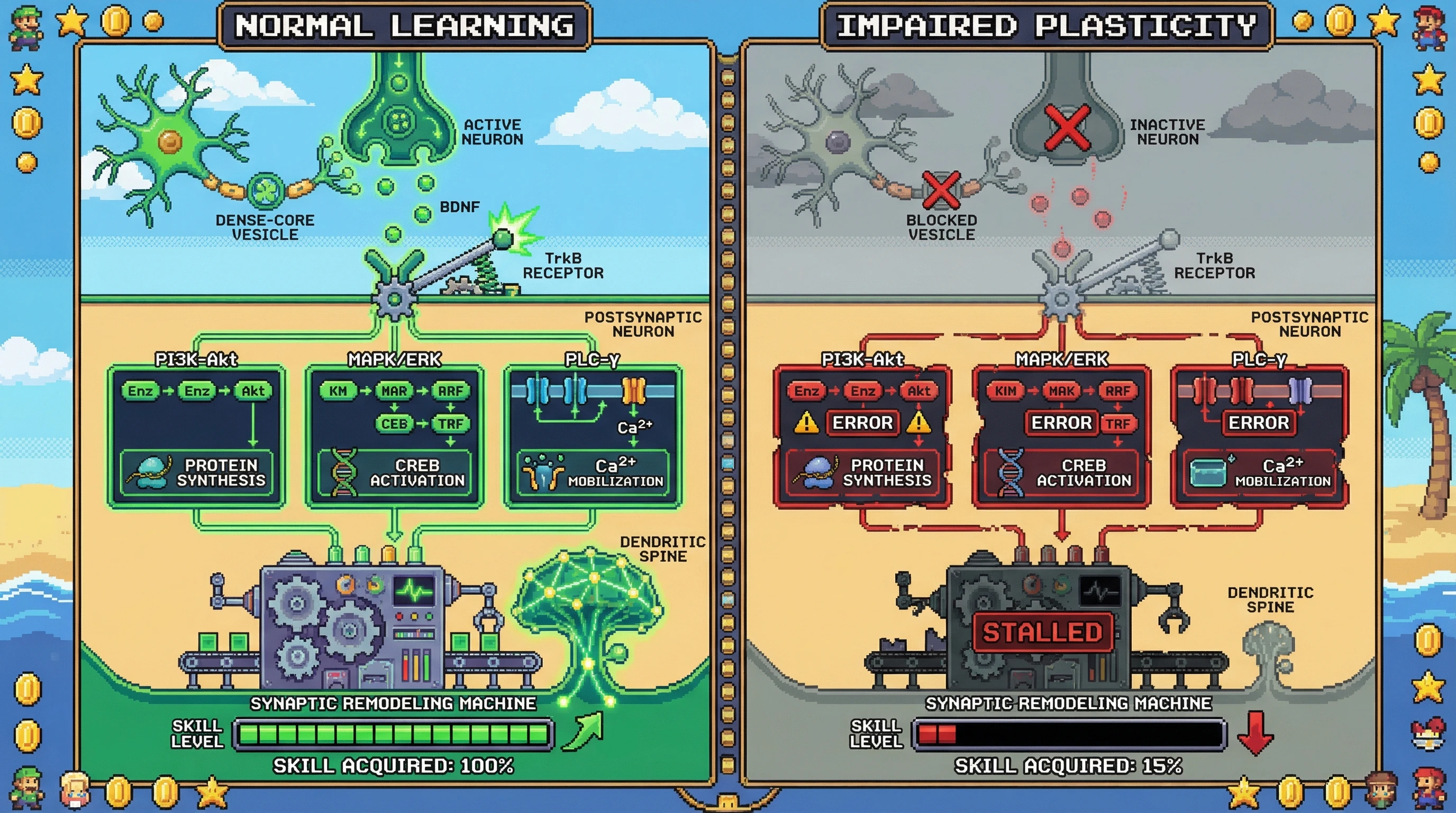
The answer is brain-derived neurotrophic factor (BDNF). Activity in glutamatergic neurons triggers BDNF release from dendrites in an experience-dependent manner. This is not constitutive secretion—BDNF is stored in dense-core vesicles and released in response to high-frequency stimulation, coincident with LTP induction.
Once released, BDNF binds TrkB receptors on both pre- and postsynaptic terminals. The downstream signaling is remarkable: PI3K-Akt drives protein synthesis, MAPK/ERK activates transcription factors like CREB, and PLC-γ mobilizes calcium. Together, these pathways transform transient electrical activity into lasting structural change—dendritic spine growth, synaptic protein insertion, and axonal sprouting.
The critical insight is that BDNF makes plasticity Hebbian in a molecular sense. Synapses that fire together do not just wire together electrically—they wire together structurally because BDNF release marks those specific synapses for stabilization while unstimulated synapses remain labile.
This matters for rehabilitation after stroke or SCI. The injured CNS retains capacity for reorganization, but BDNF levels drop post-injury. Constraint-induced movement therapy works partly because it drives activity-dependent BDNF release in spared circuits. The question is whether we can pharmacologically enhance BDNF signaling to accelerate this process.