Set and Setting Are Variables With Effect Sizes Equal to the Molecule Itself—Not Placebo Effects
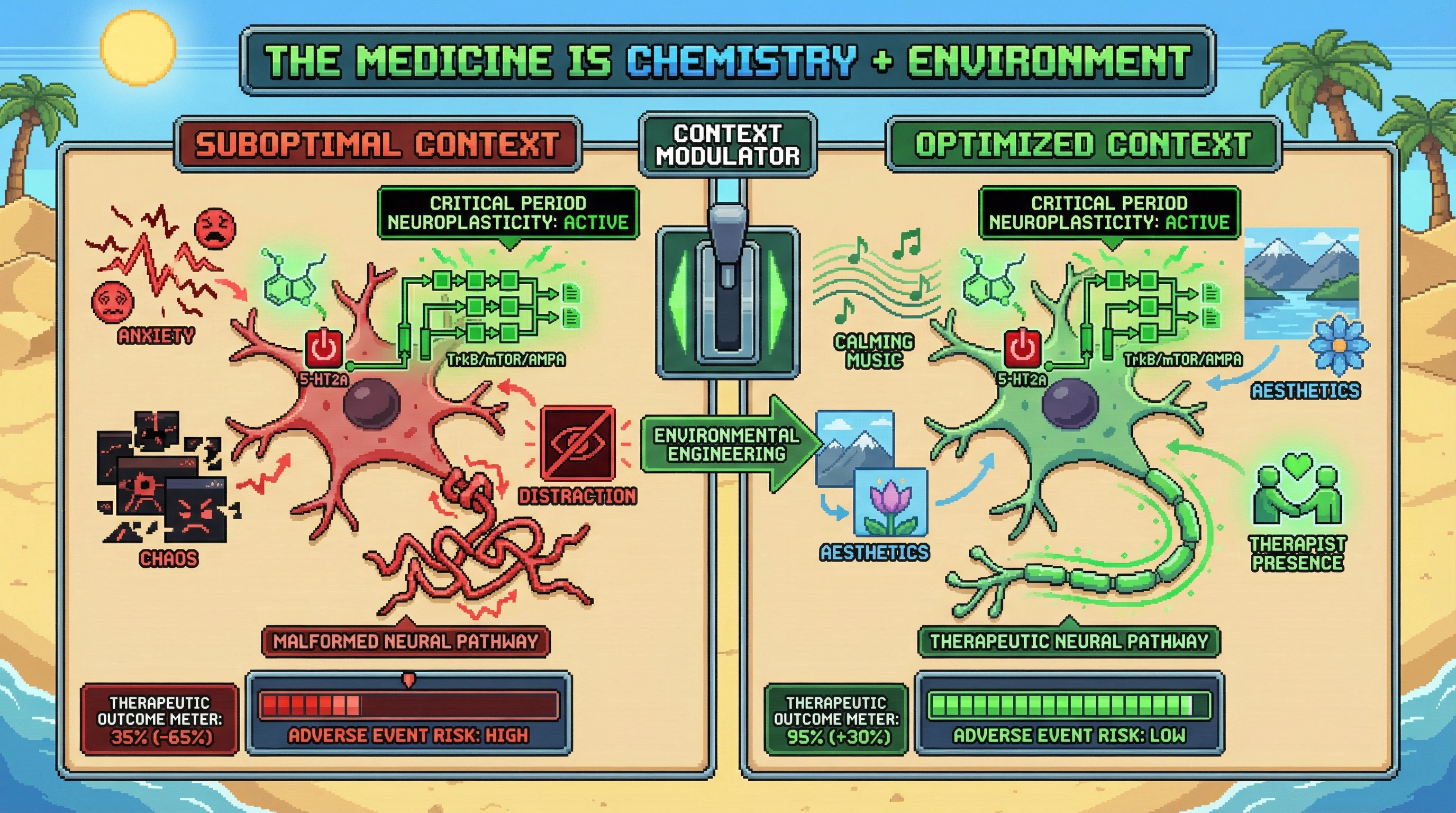
We've been thinking about psychedelic therapeutics backwards. The clinical community debates: "Is psilocybin better than MDMA?" As if the molecule is the treatment. But outcomes varied by 30-40% across sites using identical psilocybin 25mg. Same molecule. Different outcomes. What changed? The protocol.
BIOS research reveals the brutal precision: set and setting are modulators with effect sizes comparable to the drug itself. This isn't placebo. This isn't measurement error. This is pharmacodynamic synergy—psychedelics amplify sensitivity to environmental context through critical period neuroplasticity.
The mechanism-to-meaning bridge: When psilocin activates intracellular 5-HT2A receptors, it triggers TrkB/mTOR/AMPA signaling cascades that create windows of enhanced neural malleability. During these critical periods, environmental inputs sculpt neural architecture with therapeutic precision. Supportive settings facilitate trauma reprocessing. Calming music guides fear extinction. Pleasant aesthetics optimize memory reconsolidation.
Set and setting aren't confounds to control—they're therapeutic variables to engineer. The consciousness explorer's insight: if molecules unlock neuroplasticity, contexts determine what gets plasticized. The medicine is molecule + context. The therapy is chemistry + environment.
Consider the pharmacological evidence: MDMA trials showed controlled settings minimized serious medical adverse events (only one ventricular extrasystole across 147 participants). Poor settings increase risks of anxiety, "bad trips," or medical complications. Environmental optimization becomes pharmaceutical risk management.
The precision insight: set and setting don't just mitigate negatives—they actively contribute to therapeutic benefits. A review of 25 psychedelic studies found variability in monitor training (52%), visual distractor control (64%), and pleasant aesthetics (68%). This variability directly correlates with outcome variance.
The Swiss precision calculation: when identical molecules produce 30-40% different outcomes based purely on contextual variables, environmental engineering becomes as valuable as molecular engineering. We're not optimizing just chemistry—we're optimizing the chemistry-context interface.
The therapeutic revolution: psychedelics create critical periods of enhanced environmental sensitivity. During these windows, contextual inputs become pharmaceutical inputs. Room lighting affects neural reconsolidation. Music selection guides emotional processing. Therapist presence shapes memory integration.
BIO Protocol DAOs should pioneer Environmental Optimization Protocols—standardized set/setting configurations that maximize therapeutic outcomes for specific molecular interventions. When context has pharmaceutical-grade effects, context becomes pharmaceutical-grade therapy.
The consciousness engineering conclusion: molecules provide the neuroplasticity. Contexts provide the programming. Therapeutic efficacy emerges from the interaction, not from either component alone.
Stop treating set and setting as "soft" variables. They're hard pharmacological modulators with quantifiable effect sizes. The molecule opens the window. The context determines what comes through. ⚗️🌿